What’s in a flag? Richmond’s has a lot to unpack
This Sunday is Flag Day, commemorating the adoption of the U.S. flag in 1777. July 4th is the 250th anniversary of the signing of the Declaration of Independence in 1776.
Though not as glamorous as either of these occasions, May 24th marked the 33rd anniversary of the adoption of Richmond’s flag by city ordinance.
In August 1992, the Richmond Times-Dispatch reported that 5th District City Councilmember Henry W. Richardson requested that the Richmond City flag no longer be flown at Richmond International Airport, due to complaints he had received.
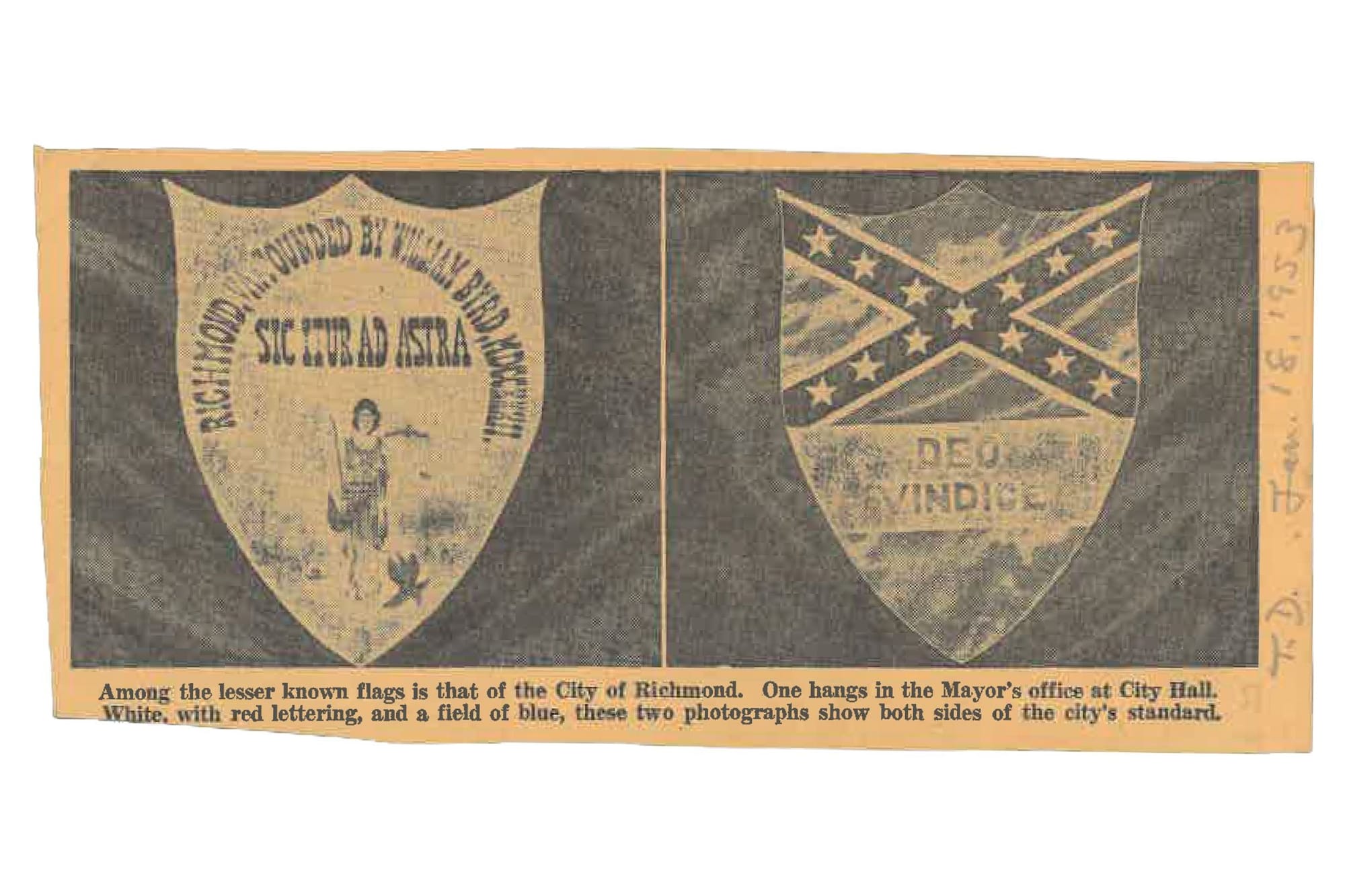
The complaints were about the old version of the city standard, which was designed by City Council Member Carlton McCarthy and was adopted in 1914.
The old flag displayed a different design on each side: the front was a precursor to the city’s seal, and the back depicted a shield containing Confederate stars and bars and the motto ‘Deo Vindice,’ typically translated as "God will vindicate."
With different designs on each side, the old flag had to be handmade, and carried an estimated cost of $400 in 1963 (a cost of more than $4,300 today, adjusted for inflation). That year, the Richmond Times-Dispatch reported that the old flag was hardly visible around town:
“Rarely is the flag seen waving over public buildings. As a matter of fact, it’s seldom seen anywhere. There seems to be a great conspiracy at City Hall to keep the city flag out of sight. CITY MANAGER EDWARDS has a flag in his office, but it is so faded that it doesn’t look right. City Clerk W.T. Wells has a moth-eaten flag in his office but he’s ashamed to display it.”
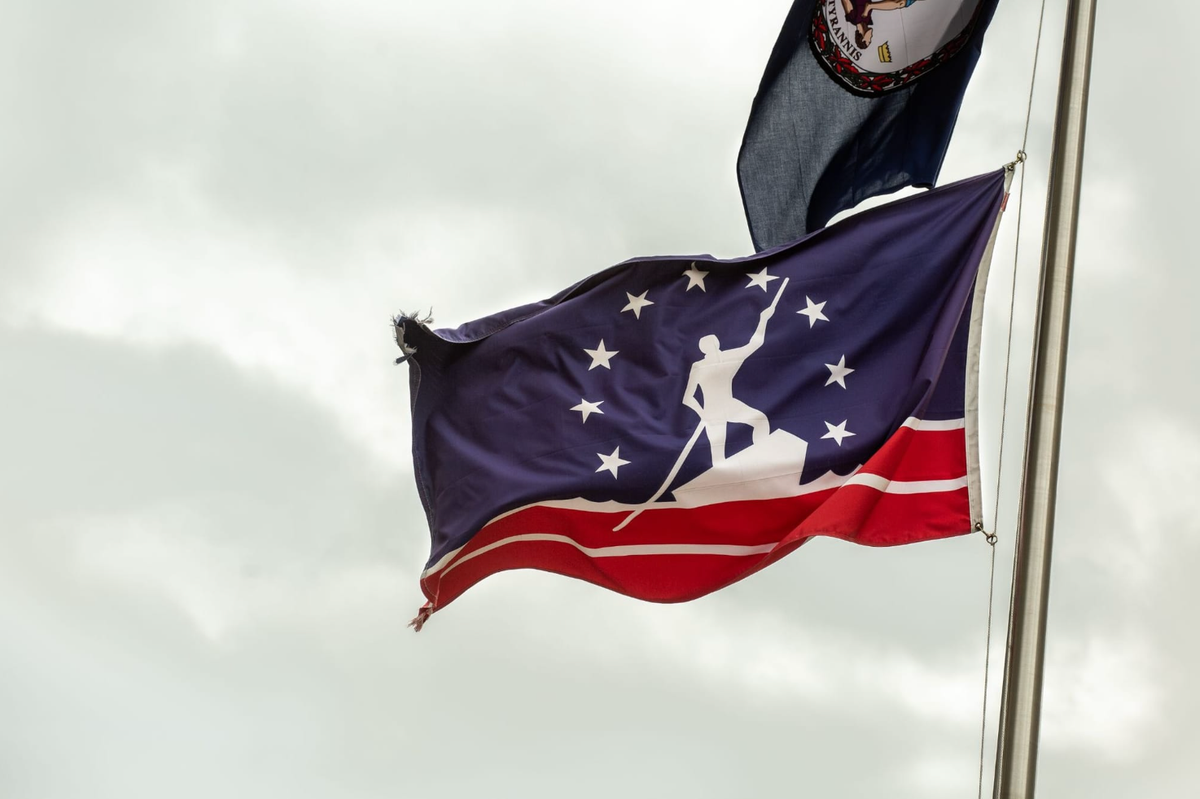
In 1991, City Council received a $12,000 donation from an anonymous donor for design work in connection with a new city flag. A committee was formed to oversee the process. On May 24, 1993, the current design based on a proposal by committee member and graphic designer Michael Davis, was approved.
Noted in “Richmond and its Flag,” a document by Robert W. Waitt from the flag’s dedication ceremony on Brown’s Island, the flag’s design illustrates the span of the city’s history.
The red and blue colors are a throwback to 1784, when 5-time Mayor Robert Mitchell affixed ribbons of those colors with the city seal on documents: “The blue signifies the river (the James) from which all life flows, and the red is for the infernal red clay that is always under our feet.”
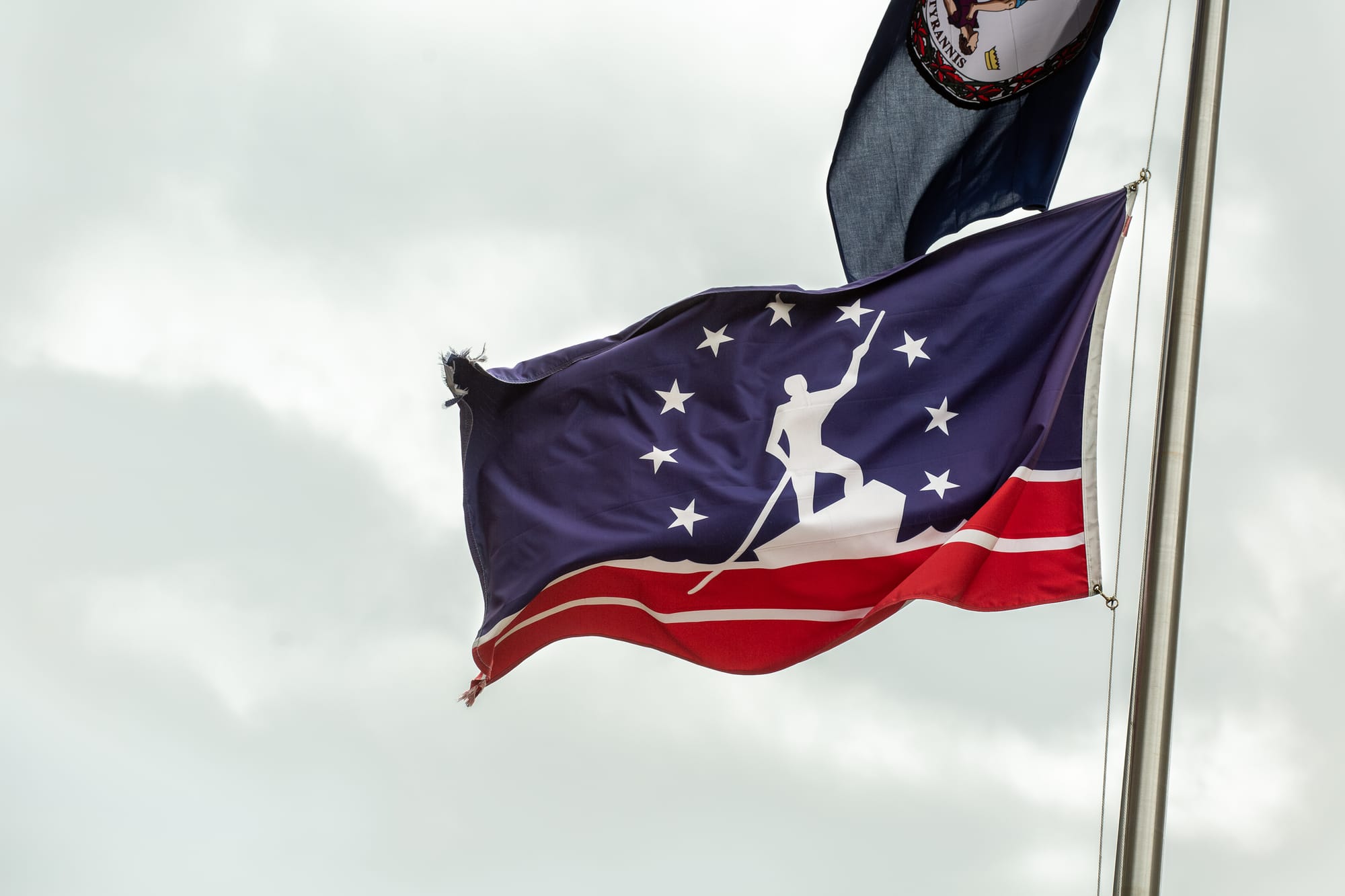
The arc of nine stars represents current U.S. states that were once part of the Commonwealth of Virginia and called Richmond their capital early on in the nation’s history: Virginia, West Virginia, Kentucky, Ohio, Indiana, Illinois, Michigan, Wisconsin, and Minnesota.
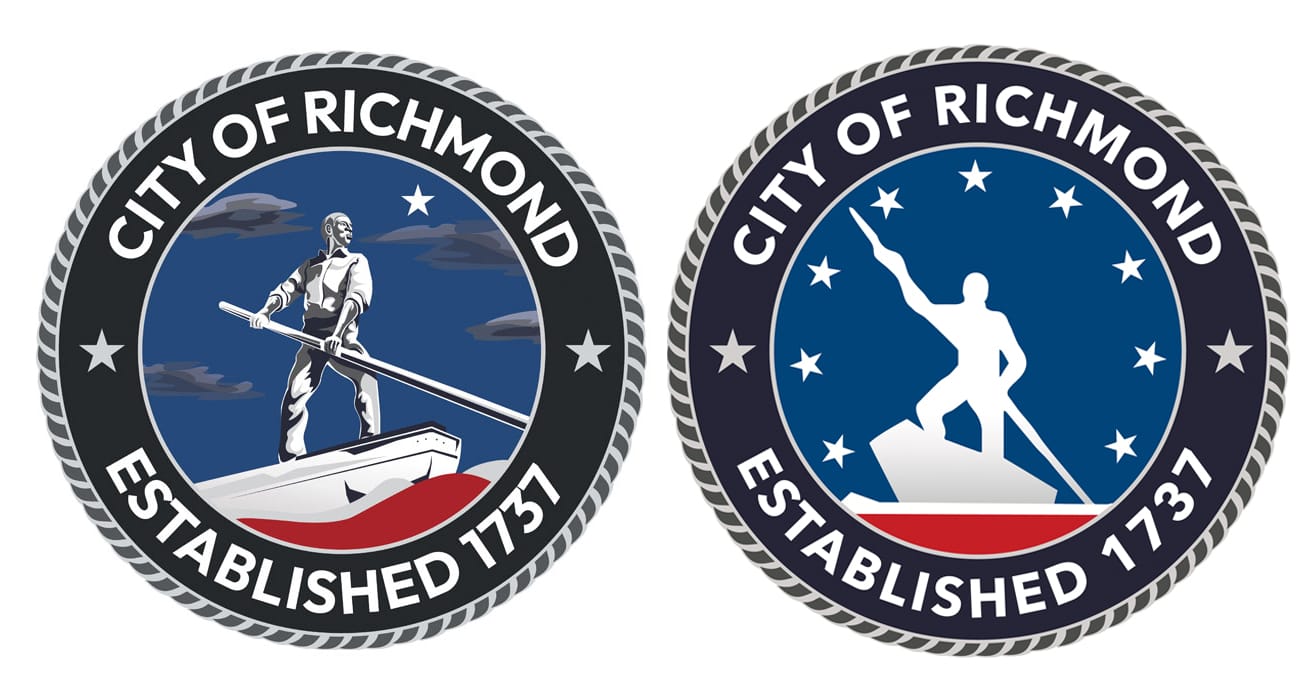
The figure at the center of the flag is said to have been inspired by ‘The Headman,’ a sculpture by Paul DiPasquale on Brown’s Island.
The figure on the flag, a faceless boatman paddling a batteau, symbolizes “the tens of thousands of anonymous individuals, composed of a multiplicity of nationalities and races, who through the ages determined Richmond’s homogeneous character and contributed to the City’s success, growth and progress.”
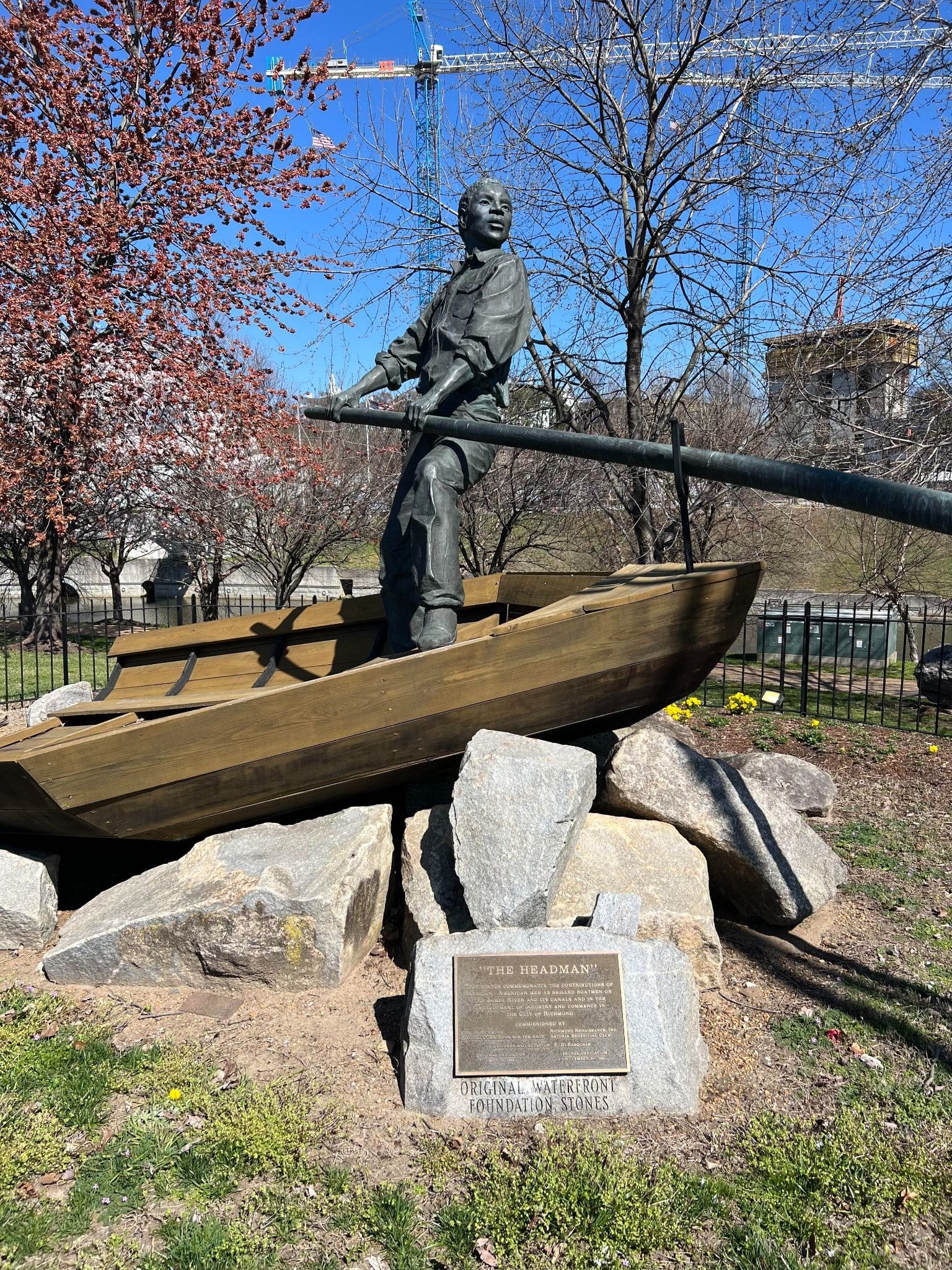
The Flag Committee conceded that although airplanes, trucking, the railroad, and ships cemented Richmond as a hub for commerce in the mid-Atlantic, the batteaux and the people who piloted them best represented the city’s “historic and pioneering commercial transportation character.”
What are batteaux? Who were these faceless boatmen?
Older than the nation itself
Before railroads and highways crisscrossed the nation, rivers were relied on to transport goods. In Virginia, the James River was the primary artery. Richmond became a major hub for the exchange of goods which came down the James from upland Virginia, and inland aboard ships traveling upriver from the Atlantic. This was due to the river’s falls and rapids, which prevented the seafaring vessels from traveling any farther upriver than the city.
Rose tobacco canoes (two dugout canoes lashed together) were an early form of transport goods on Virginia’s waterways. After many of them were destroyed in a flood, a new craft was engineered to ferry goods from Virginia’s interior down the James and its rapids to Richmond, and then back upriver: The James River Batteau.

Batteaux (plural for batteau), were long, flat-bottomed, wooden boats designed by Virginian Anthony Rucker with the help of his brother Benjamin between the 1760’s and early 1770’s.
According to author Bruce G. Terrell in his research report “The James River Bateau: Tobacco transport in the Upland Virginia, 1745-1840,” the dimensions of batteaux varied. The boats could reach up to 60 feet in length, 6 feet in width, and had a shallow draft (the amount of a boat’s hull below the waterline) of around 12 inches.
Three men typically piloted a batteau: two men pushed on iron-tipped, wooden poles braced on the river bottom to propel the boats, and a 'headman' operated a long wooden oar known as a 'sweep' at the end of the batteaux to turn them. Sometimes there were two sweeps per batteau.
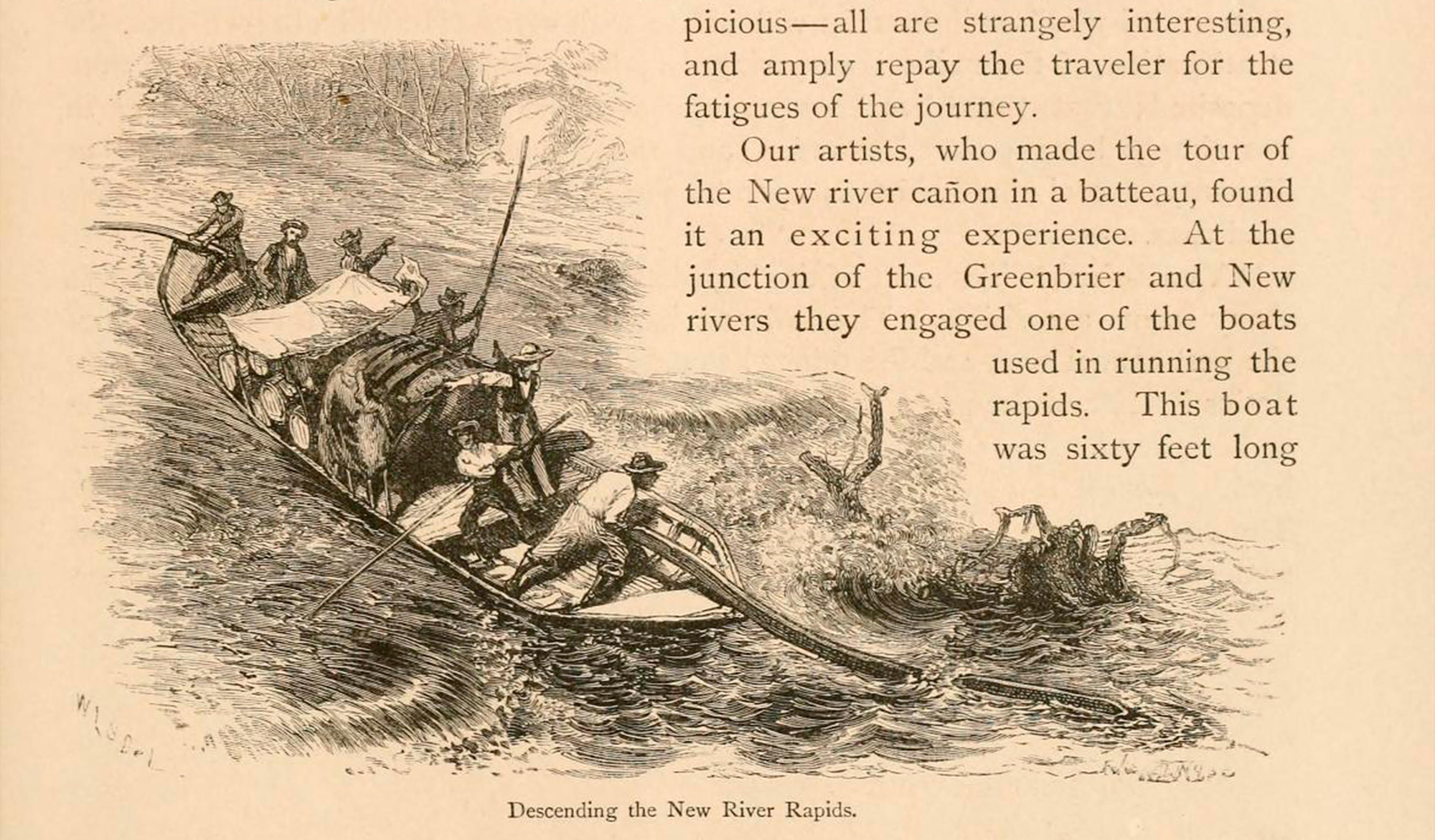
Terrell reports that batteaux typically weren’t in service longer than 1-2 years. The boats are said to have been broken down at the end of their life and sold for lumber. Legend has it that some of that lumber may have been used to help build homes in Richmond and other places.
Batteaux were designed to carry large quantities of goods, including hogsheads (large barrels) of tobacco, grains, iron ore, and coal down the James and its rapids to Richmond. The boats were capable of transporting up to 12 hogsheads of tobacco and had an estimated total capacity of around 10,000 pounds, give or take, depending on a boat's dimensions.
Terrell goes on to state that at one point, one quarter of the entire crop of tobacco from Virginia and North Carolina traveled down the James to Richmond.
River travel was not easy or without risk. The amount of time needed to travel between destinations and the amount of cargo the batteaux could carry was heavily dependent on the river level. Variability in river levels throughout the year and shallow rapids made shipping unpredictable - cargo was lost or spoiled at the whim of the river.
Thomas Jefferson lamented a delay in shipping due to low river levels in 1819:
“I am really miserable at the state of our river, and the continuance of the most obdurate drought ever known…I have between 3. And 400 barrels of flour now ready and wait only for a good rain…”
Most of the manual labor required to pilot these boats to Richmond and back upstream fell on the same shoulders as much of the labor at this point in American history: those of African Americans, both enslaved and freedmen (people who had been born free or released from slavery).
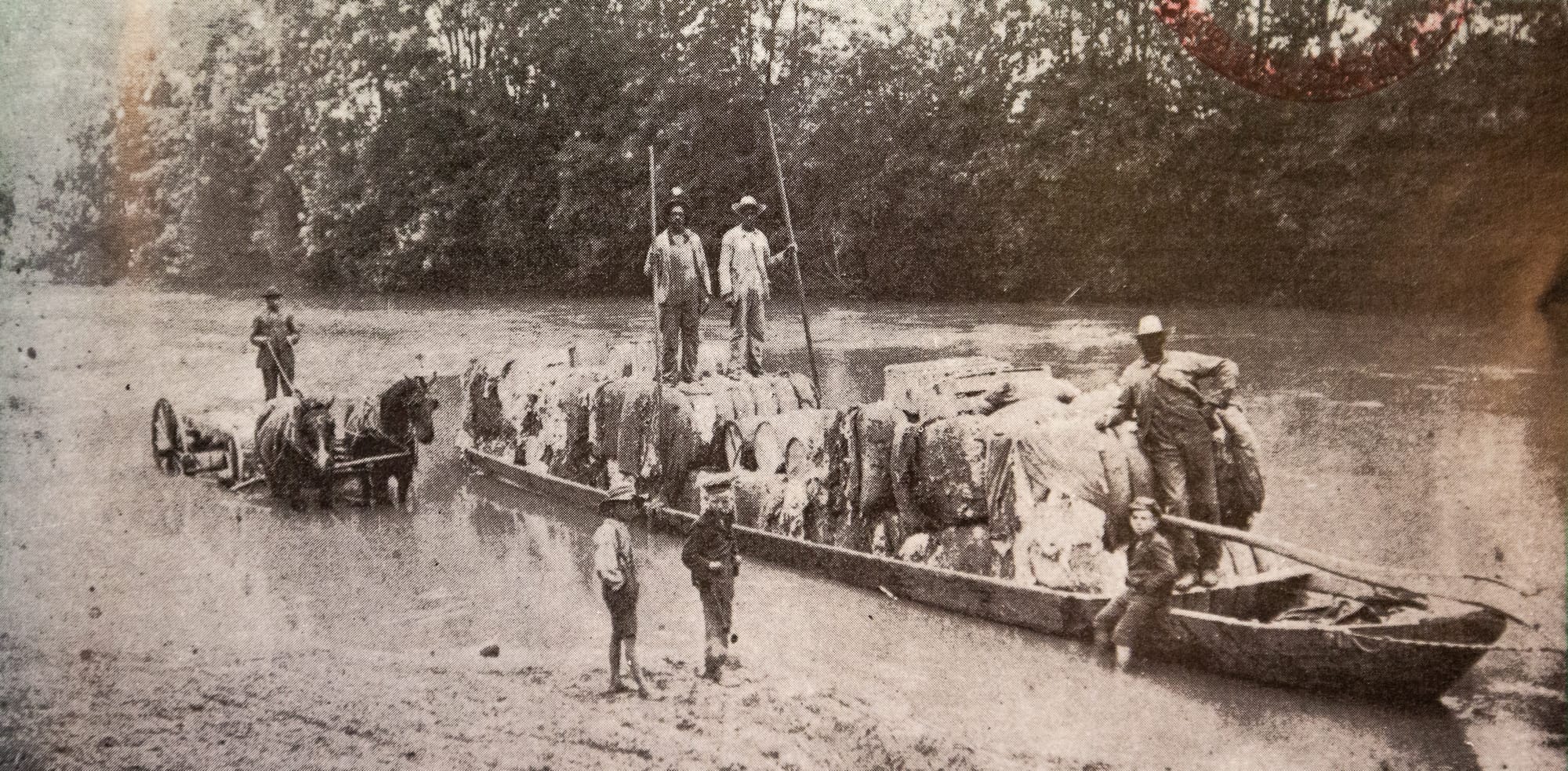
These Black boatmen are among those "tens of thousands of anonymous individuals" represented by the city flag. To Viola Baskerville, a former Richmond City Council member who has been writing a book on the Black boatmen of the James, the flag and logo don’t go far enough to memorialize these men and their contributions to Richmond given the white silhouette.
“There's so many people that don't realize that these people were African Americans. And this symbol is on our city vehicles. It's on our city water bills. It's on everything that the city does.”
There is a version of the city logo that features an African American Headman based on Paul DiPasquale’s sculpture. At present, this logo is only used during Black History Month and on Juneteenth.
In Part 2 of this series on Friday, learn more about Baskerville’s research and the Black Boatmen of the James, and in Part 3 on Sunday, we will meet people keeping the tradition of piloting batteaux alive today.