Avula tweaks financial transparency plan, but after months of discussion, Council’s stance remains unclear
Mayor Danny Avula has proposed a series of tweaks to his proposal to resume publication of a narrower financial database showing how City Hall is spending taxpayer dollars.
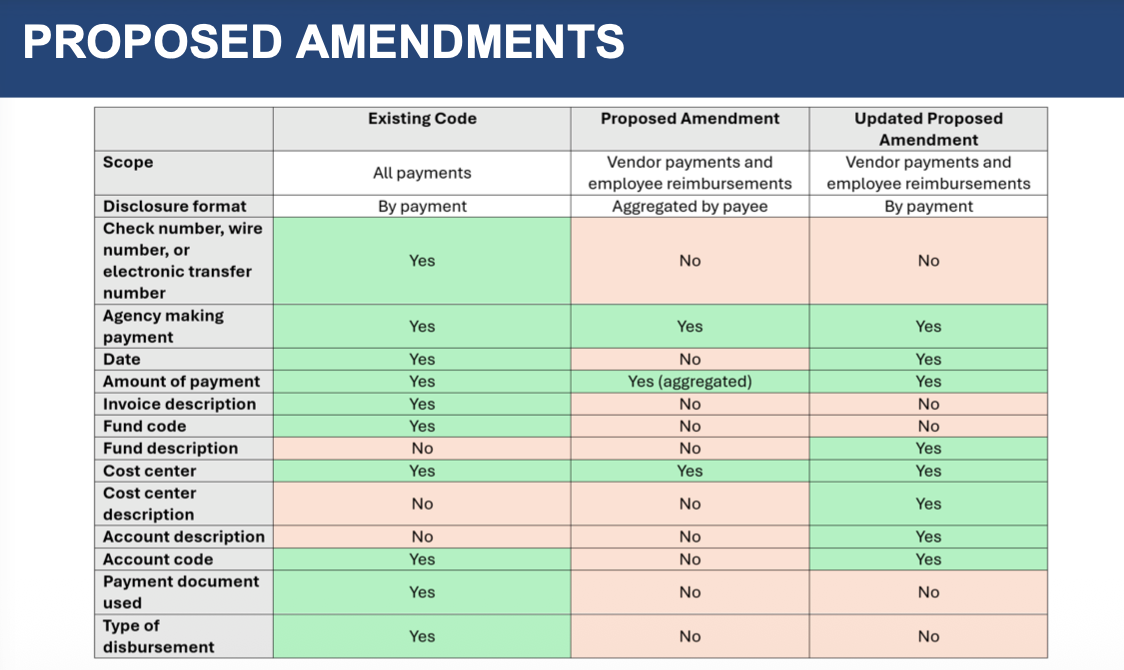
The changes increase the overall level of transparency under the mayor’s proposal for the city’s payment register, adding back in several fields such as payment dates, account descriptions and account codes. Under the mayor’s original proposal, those data points would have been excluded from the online data.
The proposed amendments would also break down payment amounts into greater line-by-line detail rather than listing aggregated amounts of money spent with each company doing business with the city.
“I hope we can work through these amendments so that we can start producing the payment register in a sustainable way as soon as possible,” Avula Chief of Staff Lawson Wijesooriya told a Council committee on Wednesday.
The changes — which the Avula administration said were informed by their recent push to review and publish payment data for fiscal year 2025 — were previewed for the City Council this week. However, they have not been officially incorporated into the plan, which requires Council action. That means the revisions are likely to delay the proposal until at least September after several City Council hearings that have yet to produce a substantive vote.
 Graham Moomaw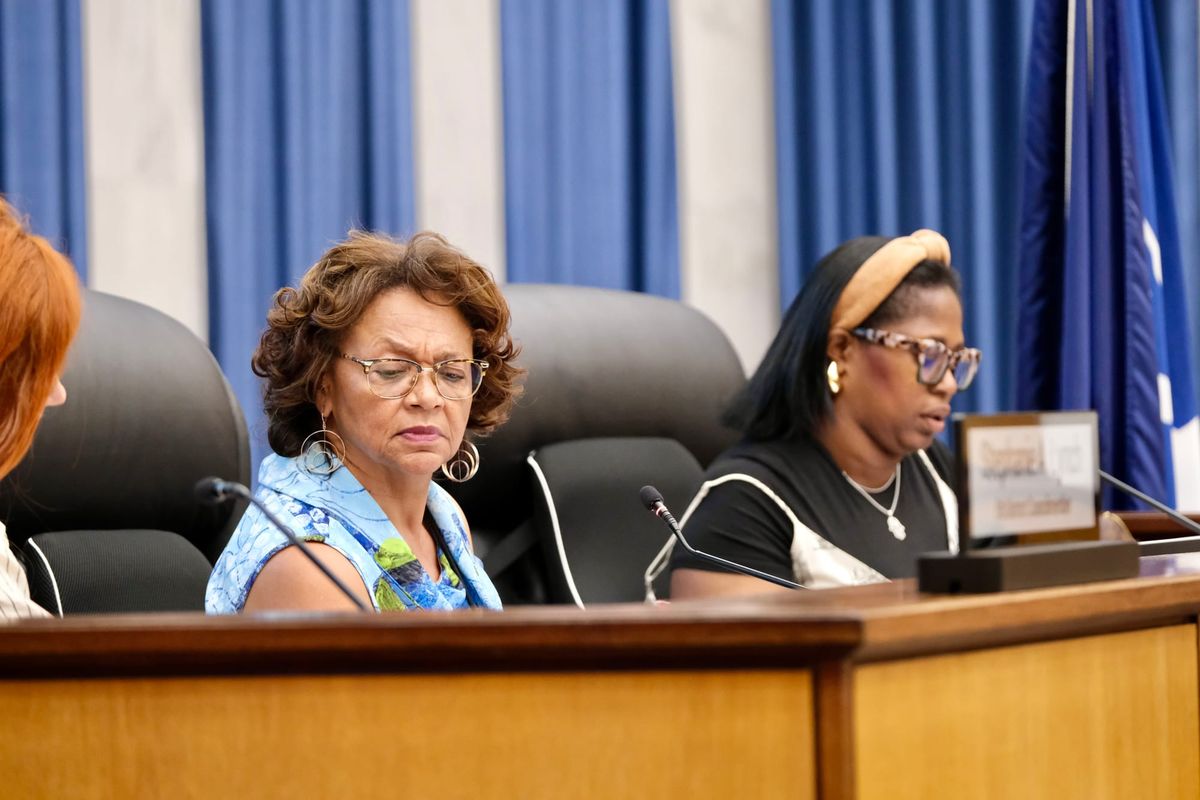
Avula first rolled out his proposal in April to start publishing a trimmed-down version of the city’s payment register.
The city has been required to publish the data showing how money is spent since the Council passed a law mandating it in 2015. However, officials stopped following the law in 2019 after concluding publishing the data was taking up too much staff time and creating too much risk that sensitive information could be revealed to the public.
Though the city’s non-compliance with its own law began before Avula became mayor, his administration has suggested a possible fix that would involve narrowing down the payment register. The goal is to reduce the amount of information the city publishes by default and, by extension, reduce the staff hours spent on reviewing and redacting the information.
There’s some skepticism of that approach among at least a few Council members. Councilor Kenya Gibson (3rd District) has introduced an alternate proposal to have the Council formally exercise its oversight powers and launch an investigation into the city’s failure to publish the payment register.
For two months in a row, the Council’s Finance and Economic Development Committee delayed votes on both plans.
 Graham Moomaw
On Wednesday, the committee took different action with the two proposals.
Gibson’s call for an investigation is now headed to the full body on July 27 with no recommendation, meaning it could be put to an up-or-down vote before the Council decides what to do with the mayor’s plan.
Avula’s proposal was continued to the Finance committee’s Sept. 16 meeting, with an expectation the amendments will be adopted at some point before it goes back to the committee.
On Wednesday, the mayor’s chief of staff gave a detailed rundown of how the administration handled the review and publication of the payment register data for fiscal 2025.
More than a third of 231,933 transaction records for that budget year had to be redacted, according to Wijesooriya’s presentation. Of the 82,760 spreadsheet rows that had to be redacted, 79,961 could be redacted through automated processes, without significant human intervention. After reviewing 151,972 records manually, 2,799 required manual redaction. That’s about 1.2% of the total data.
The information that could be redacted automatically involved payments related to tax refunds, social services benefits, utility bills, juror pay and personnel matters such as paycheck garnishments.
The rows requiring manual redaction appeared to involve more complex topics such as health and medical records, law enforcement tactics (including “surveillance techniques”) and records involving youth programs and minors.
Officials said it took hundreds of staff hours to produce the register for fiscal 2025, but noted that amount of time involved an entire year of data and wouldn’t be necessary if the city were routinely publishing the payment register on a monthly basis.
“As you can see, carrying this out was a tremendous amount of work,” Wijesooriya said.
Gibson questions admin about visibility into purchasing cards
At Wednesday’s committee hearing, Gibson, the Council member who wants a fuller investigation into what the city redacts and why, began to offer her perspective on those stats. She began making a case that, even though publishing the data may involve a lot of work, transparency should be a fundamental part of government given the mandates of the Virginia Freedom of Information Act.
“The work of government is hard,” Gibson said. “But I am taken by the emphasis of how difficult the work is when ultimately being transparent, providing ready access to public information, is a legal requirement.”
Gibson spoke for about a minute before Councilor Ellen Robertson (6th District), the chair of the Finance committee, interjected to ask Gibson to get to her questions for the mayor’s team.
“I appreciate the commentary… and we all respect that. But let’s see if we can get to the questions that would be most helpful,” Roberton said.
“I understand,” Gibson replied. “But the editorial is important because that was the bulk of the presentation… how difficult it is to do more.”
At a previous committee meeting, Robertson would not allow Gibson to ask questions about the payment register issue. After being asked to minimize the commentary Wednesday, Gibson was allowed to extensively question the administration about specifics of Avula’s plan.
In response to one of those questions, the administration acknowledged its proposal would create only limited visibility into the use of government purchasing cards (or p-cards), one of the types of city spending that’s been most controversial and subject to abuse in recent years.
“P-card payments are separate from the payment register,” said Finance Director Letitia Shelton. “P-cards go in through Bank of America, which is our primary processing company for p-cards. So they wouldn’t be in a check registry.”
Gibson then said the city law calls for a payment register, not a check register.
“This is a payment register. So if a payment is made, it would need to be included,” Gibson said. “That is concerning.”
 Graham Moomaw
With the way purchasing cards are handled, officials later explained, those transactions would only show up in the payment register as money going to Bank of America as the vendor, with specifics of what was being purchased located elsewhere in the data.
The Avula administration’s revised ordinance does not include invoice descriptions, the field that presumably would contain the most detail on what the city is buying with public money.
Wijesooriya said that field is still left out because it mostly involves employees manually typing out a description of the purchase, and those descriptions are often left blank.
“It's a field where different people track different pieces of information in there,” Wijesooriya said. “So it was kind of a minefield of needing to manually redact it.”
Gibson suggested that if there are data integrity issues with the ways the city keeps its financial records — such as blank invoice descriptions or the occasional inclusion of sensitive info like social security numbers — those issues could be addressed head-on and not treated as an impediment to publishing a more thorough payment register.
“If we’re finding a lot of social security numbers here or there, I would assume that’s probably something that needs to be fixed rather than covered up,” Gibson said. “How can we get better?”
Contact Reporter Graham Moomaw at gmoomaw@richmonder.org