As electricity costs rise and federal tax credits wind down, Richmond hopes to move fast on solar
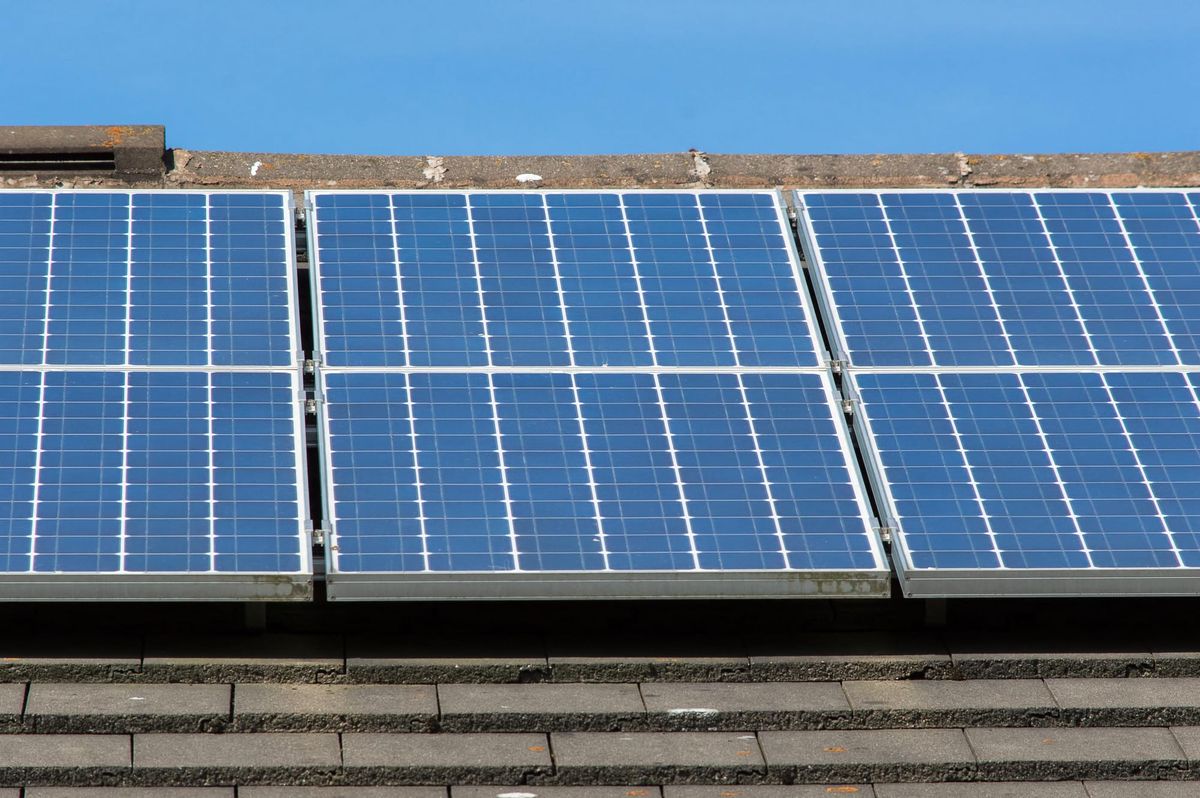
With local governments facing steeper electricity costs this year, Richmond officials are considering a proposal to install solar panels on an array of city-owned buildings in hopes of both bringing down expenses and furthering city climate goals.
“We can get cheaper electricity from our own rooftops rather than [what] we would be paying Dominion,” Dawn Oleksy, Richmond’s energy program manager, told a City Council committee on July 6.
Under a plan outlined by the Office of Sustainability, Richmond would enter into a power purchase agreement with Secure Solar Futures that could produce up to 5 megawatts of power from solar panels mounted on city buildings.
Through the PPA, Secure Solar Futures would install and maintain the solar panels and then sell the energy they produce back to the city at a lower rate than what Richmond would otherwise pay Dominion Energy, the region’s electric monopoly. To simplify the process, Richmond would “ride” a contract Secure Solar Futures already has in place with Prince William County Public Schools through a process known as cooperative procurement.
Over the next 25 years, the Office of Sustainability estimates that Richmond would save $12 million in electricity costs, with roughly $260,000 saved in the first year of operation.
“One of the main benefits is that it can lower costs for the city in electric rates,” said Carolyn Pugh of the Community Climate Collaborative, which has been working with the city on its solarization plans. “And then, of course, there’s the climate benefits as well.”
While the project would be the first solar PPA undertaken by City Hall, power purchase agreements have been used widely by local governments and school districts throughout Virginia to obtain solar power without steep upfront costs. Richmond Public Schools currently has solar on 10 of its buildings through a PPA with Secure Solar Futures, and both Henrico and Chesterfield counties have used the agreements to install solar on municipal sites.
Richmond, by contrast, only has solar panels on one of its buildings: the T. B. Smith Community Center. Those panels are owned directly by the city and were installed during the construction of the facility using $500,000 in American Rescue Plan Act funds.
“Direct ownership provides maximum flexibility,” Oleksy told the City Council. “But it also requires 100% upfront costs.”
Under the PPA, by contrast, the city only pays for the electricity produced by the panels, with no installation or maintenance costs.
“There is no construction cost, no loan, and no budget request tied to this contract. Secure Solar Futures pays for and owns all the equipment,” the Office of Sustainability wrote in a document on the proposal shared with the City Council. “The City only pays for the electricity it actually uses, at a locked-in rate lower than Dominion’s.”
So far, 30 buildings on 27 sites have been identified as feasible locations for panels to be installed.
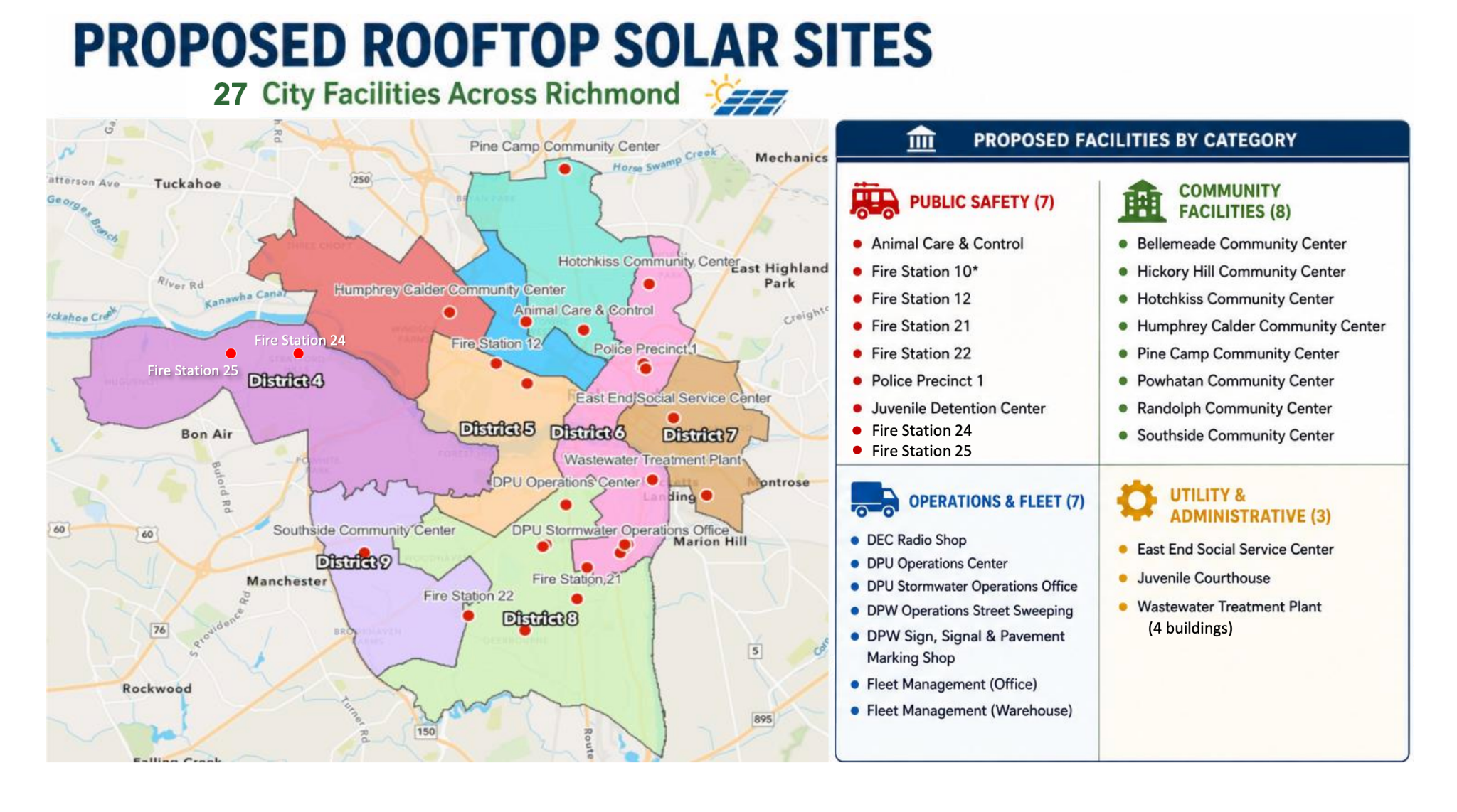
A City Council vote on the proposal isn’t expected until September, and some councilors like 8th District representative Reva Trammell have said they will need more information on the plan before they can make a decision. Others are more enthusiastic.
“I’m very excited about this opportunity,” said Councilor Andrew Breton (1st District) during the July 6 meeting. “Climate chaos is here, and everything we can do to mitigate it is fantastic.”
A sense of urgency
While Richmond has been considering putting solar panels on municipal buildings for at least a decade, officials say two factors are driving up the sense that the city should move now.
One is the looming expiration of federal tax credits for solar installations.
Those credits, which would be used by Secure Solar Futures, could bring down installation costs by between 30 and 50%. But they are also beginning to sunset, with various deadlines passing this summer and by the end of 2027.
The second, and more pressing factor, is rising electricity rates. The city of Richmond, like some 170 other local government bodies in Virginia, negotiates its electricity rates through the Virginia Energy Purchasing Governmental Association, a body set up by the state in 2002.
Under the latest two-year contract struck between VEPGA and Dominion, the overall rates paid by local governments will rise by about 25% this year, with an expected additional 12% increase beginning July 1, 2027.
Currently, Richmond’s annual electricity costs are about $18.7 million.
The increases have caused some trepidation in the region. Henrico County, as reported by the Henrico Citizen, recently asked county employees to look for energy-saving measures they can take to help cushion the impact of the rise.
During the July 6 meeting, Councilor Sarah Abubaker (4th District) also asked the Office of Sustainability about efforts to reduce energy costs beyond the savings that the solar PPA could produce.
“Just thinking about long-term planning, $12 million is significant over 25 years, but it’s not that significant,” she said.
A Joint Energy Team stood up by the city is “looking hard at all the opportunities to save energy costs for Richmond,” said Oleksy. Besides energy efficiency projects planned through the capital improvements budget, she said the city is considering the use of energy savings performance contracts.
Pugh of the Community Climate Collaborative said the solar PPA project offers a rare chance for the city to save money without major investments of its own.
“In this moment of time, there’s almost no way to imagine that the city of Richmond would be able to purchase and install and cover all the upfront capital costs of these solar arrays,” she said.
Richmond, she added, “does not typically have cash to spare.”
Contact Reporter Sarah Vogelsong at svogelsong@richmonder.org. Dominion Energy is a sponsor of The Richmonder but was not allowed to influence or review this article.