As Richmond’s rezoning begins to solidify, a proposal to allow more duplexes may be on shaky ground
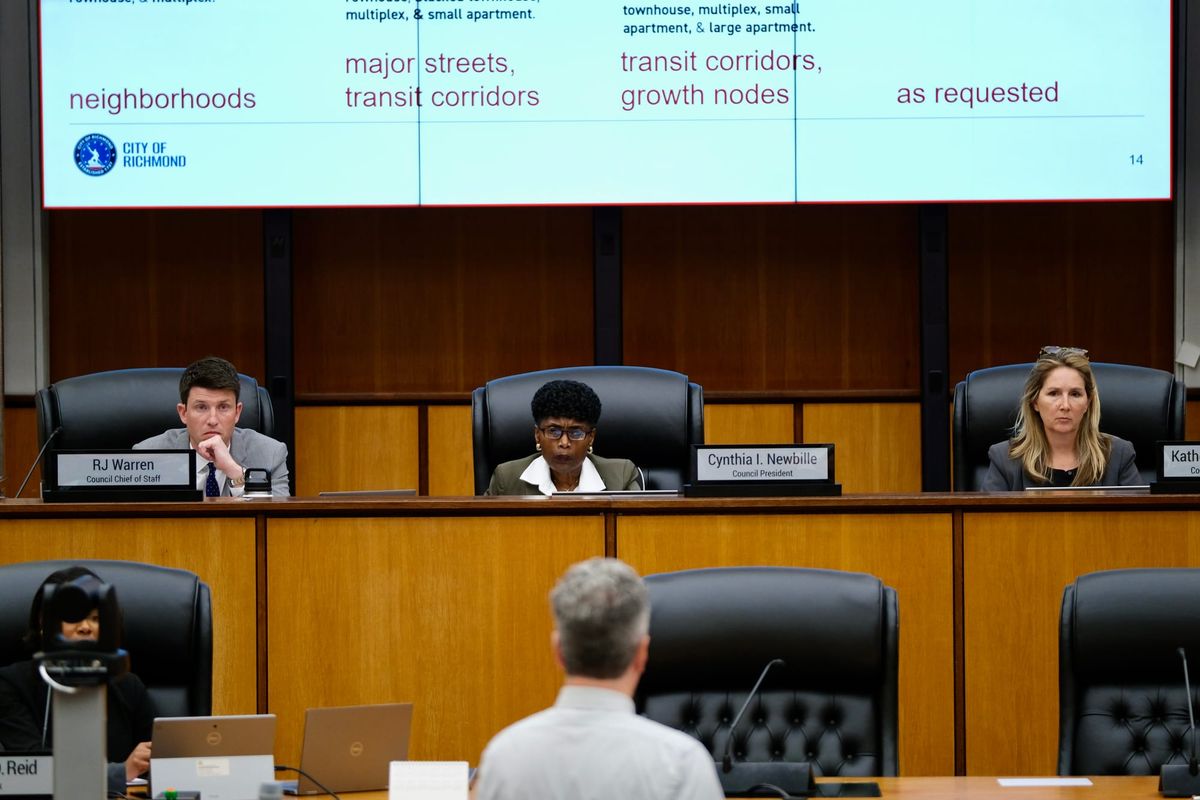
As might have been expected, Richmond City Council’s first public meeting on the proposed citywide rezoning was a freewheeling affair.
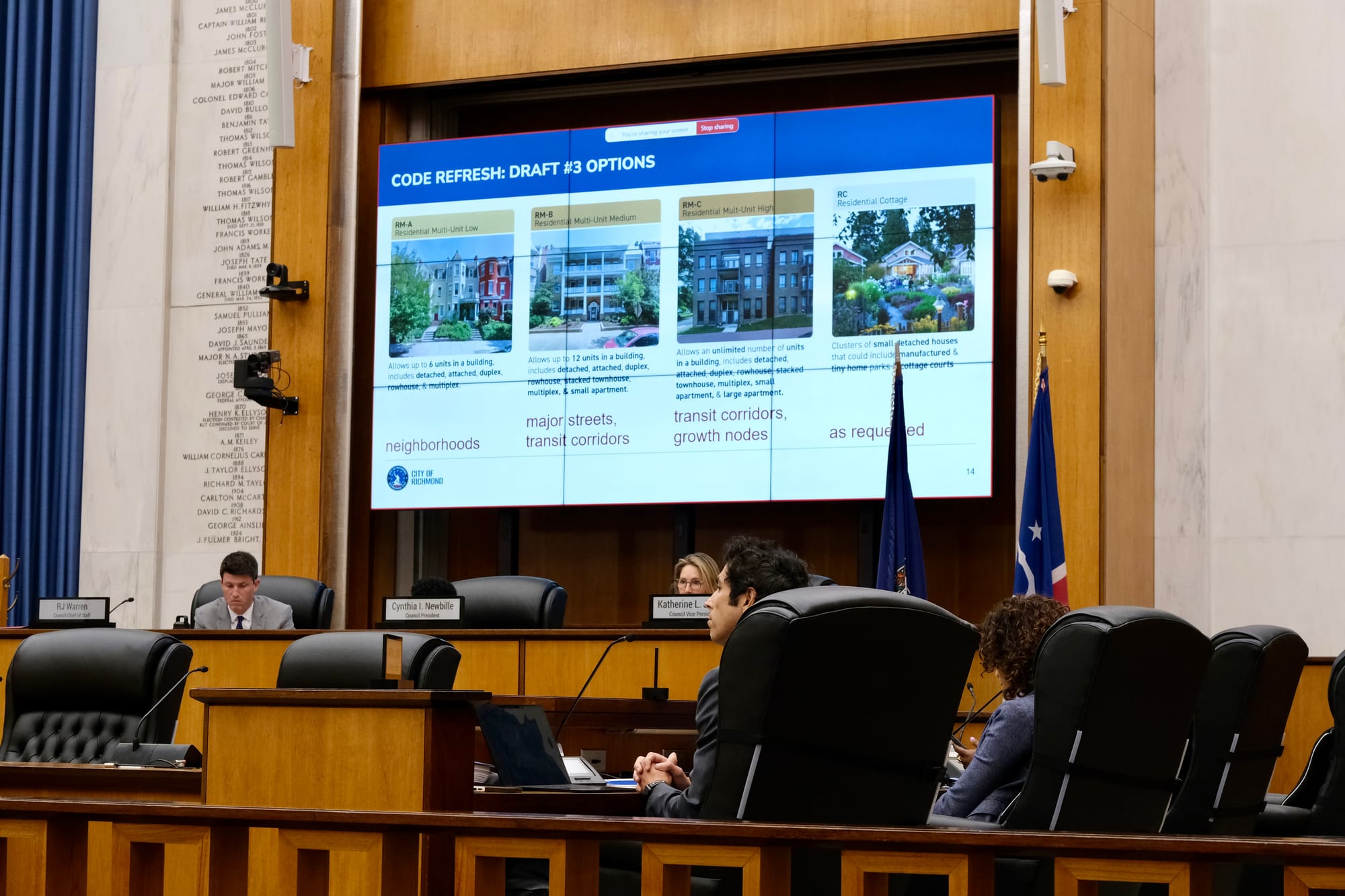
The June 15 work session had been called by Mayor Danny Avula’s administration to get feedback on three major outstanding questions ahead of the release of a third draft of the code refresh: How many unrelated people should be able to live in a single household? How should places of worship be rezoned? And how many housing units should be allowed on a residential lot?
Councilors, however, wanted to talk about much more. There were questions about how the rezoning could help alleviate the city’s affordable housing crisis, how the city is working with Richmond Public Schools to ensure buildings are prepared for potential influxes of students and what growing density could mean for infrastructure like utilities.
Three, including President Cynthia Newbille (7th District), asked about the status of Richmond’s Cultural Heritage Stewardship Plan, a preservation roadmap seen by many as a critical complement to the code refresh that cleared the Planning Commission in November but has never made it to the Council for final approval.
In one impassioned speech, Councilor Reva Trammell (8th District) called the rezoning a “disaster” and promised residents that if it passed, “Your American Dream is going to be gone.” Councilor Kenya Gibson (3rd District) declared that “the affordable housing crisis has been fueled by private equity, and you would be delusional to believe that private equity will get us out.”
Others took a more optimistic tone. Councilor Andrew Breton (1st District) said that in his view, “the broad strokes of what I’ve been seeing are consistent with what I would expect from the Richmond 300 plan,” referring to the city’s master plan approved in December 2020.
“We are legalizing growth in our dedicated nodes,” he said. “We are legalizing more housing types in all our neighborhoods.”
And Councilor Stephanie Lynch (5th District), while decrying what she called “disinformation on both sides” of the issue, expressed confidence the city will end up with a workable overhaul of the zoning code, which hasn’t been comprehensively updated since 1976.
“I think we can do it,” she said, pointing out both Henrico and Chesterfield counties have successfully carried out rezonings in recent years. “We’re behind. We’ll get it together, and I think we will make very common sense decisions that reflect the needs of our communities, because that’s what we’re here to do.”
Still, as Mayor Danny Avula’s administration moves toward finalizing the third draft, tensions remain high between supporters of the proposal, who say it is a critical tool to help increase housing supply and offer more types of housing amid an affordability crisis, and opponents, who say it will destroy neighborhood character, give too much leeway to developers and erode the existing single family fabric of many communities.
Those tensions may not be easing. On Friday, local activist and attorney Paul Goldman announced he intends to explore legal avenues to halt the code refresh, calling it “a plan only real estate developers like President Trump would find fair!” in an email sent out to media outlets.
It’s too early to say where things will land. Planning Director Kevin Vonck said this week that the administration is hoping that the third draft is the final one that ultimately goes to the City Council for its vote. That will almost certainly undergo heavy vetting: “We’ve got a hell of a lot of work to do before we even think about voting on this,” Trammell said at the June 15 meeting.
But both the City Council meeting and work sessions held on the following days with the Planning Commission and Zoning Advisory Council — a nonvoting body that has been helping shape the different code refresh drafts — offered some glimpses of how officials may be thinking.
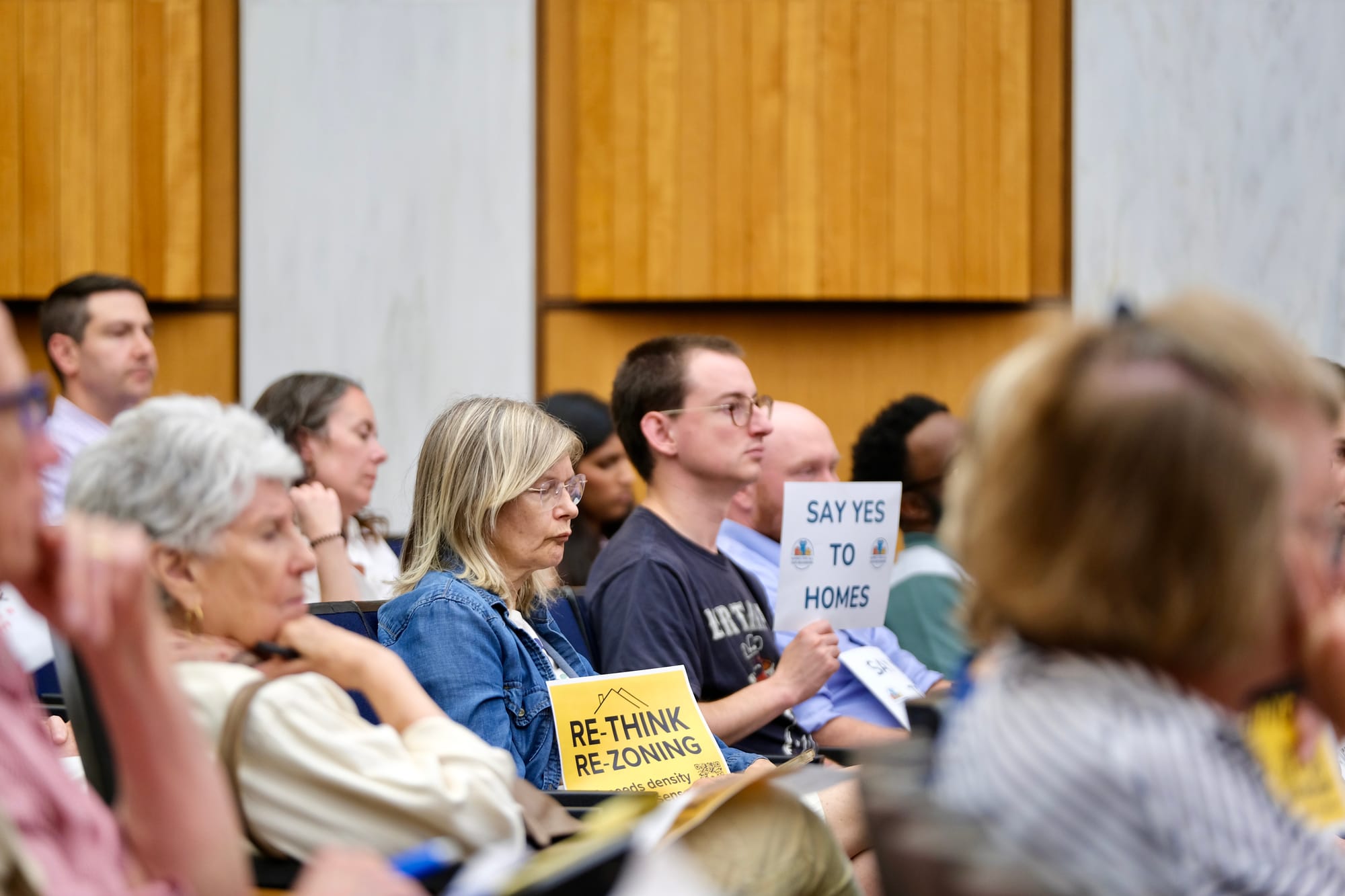
When it came to how many unrelated people should be allowed to live in a single household, many backed the idea of raising the threshold from its current three to five or six or relying on occupancy rules laid out in the building code. Attitudes were generally positive when it came to a proposal to rezone places of worship in a range of ways depending on the surrounding neighborhood rather than zoning them all as mixed use, although confusion was evident about how Richmond’s plans could be affected by the recent passage of “Yes In God’s Backyard” legislation that preempts local zoning when a church develops affordable housing.
Perhaps most striking were conversations around the idea of allowing duplexes on all residential lots by right, a proposal that has been controversial in Richmond as well as numerous other cities. No member of the City Council explicitly either endorsed or denounced the idea at their work session, although it was clear some remain more receptive to it than others.
“People are looking for a way to get their leg into the housing market, and anything we can do to make it easier for people to find those starter homes is something I want to encourage,” said Breton, while Lynch said worries about demolitions means that “for some of our neighborhoods, one principal dwelling and then the [accessory dwelling unit] is probably where we’re going to land.”
But at the meetings of the Planning Commission and ZAC — groups generally seen as more receptive to density — some shifts in thinking were evidently underway, with several members who have supported duplexes in the past recommending that the city hit pause on the idea.
“I don’t want to see us get hung up on a proposal that’s going to bring in so few units … that we slow down the progress of code refresh as a whole,” said Elizabeth Greenfield, who serves as vice chair of the Planning Commission and chair of the ZAC. “I would like to maybe pull that piece back, let’s study it a little more, and keep the bigger prize of overhauling our zoning code, which is so desperately needed, moving forward.”
 Sarah Vogelsong
Duplexes plus ADUs
No issue has been as much of a lightning rod as the proposal to allow more units than one on residential lots.
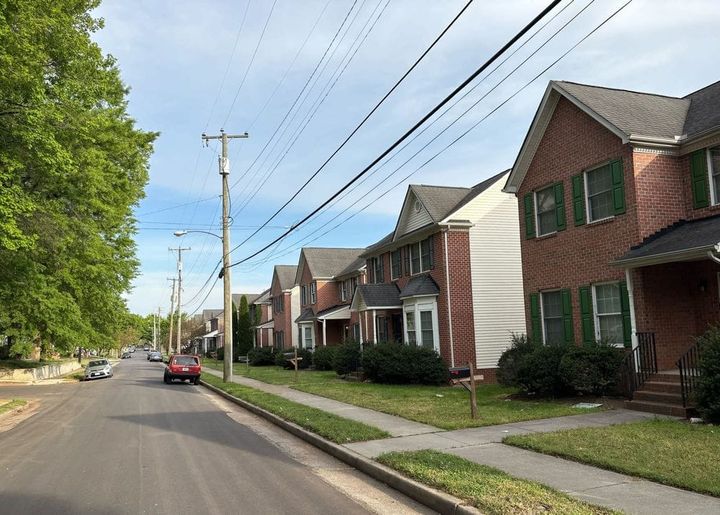
Richmond isn’t alone in its interest in moving away from its reliance on single family neighborhoods. Cities across the nation, facing steep housing prices and smaller households, have been increasingly loosening longstanding rules that restricted most of their residential parcels to single family homes.
In Richmond, the Planning Department has estimated about 59% of the city’s land is zoned for single family residential living. That began shifting in 2023, when the City Council passed an ordinance allowing accessory dwelling units — small structures often called granny flats or carriage houses — on most residential lots. Earlier this year, the state enacted a law requiring all local governments in Virginia to allow ADUs on lots zoned for single family residential.
The first draft of the rezoning would have allowed any residential lot to have two housing units in addition to an ADU. But the idea received furious backlash from many residents either upset at the prospect of more houses in their neighborhood or concerned it would incentivize developers to tear down existing homes and pack the resulting lots with expensive houses.
In response, the Avula administration introduced significant changes in the second draft. Under the new “preservation bonus” approach, a property owner could only build the second unit if they kept the existing structure standing. Someone who knocked down a building would only have the right to construct what they are currently allowed to: a single home and an ADU. At the same time, the Planning Department introduced “contextual” rules limiting how tall new homes in residential areas could be based on the height of adjacent houses.
The contextual rules would “be harder to administer because it's going to require checking things out more closely,” Vonck acknowledged to the Planning Commission Tuesday. “But overall I think it's better for the neighborhood in terms of having more organic growth that fits with what's there today.”
Some residents saw the second draft plan as a reasonable compromise. Others were unmoved, still seeing it as an assault on single family-only neighborhoods. Most of the city’s nonprofit affordable housing developers were also dismayed by the change, but for a different reason. Allowing duplexes, they maintain, is one of the few ways available to bring down construction costs because of the economies of scale it offers.
 Sarah Vogelsong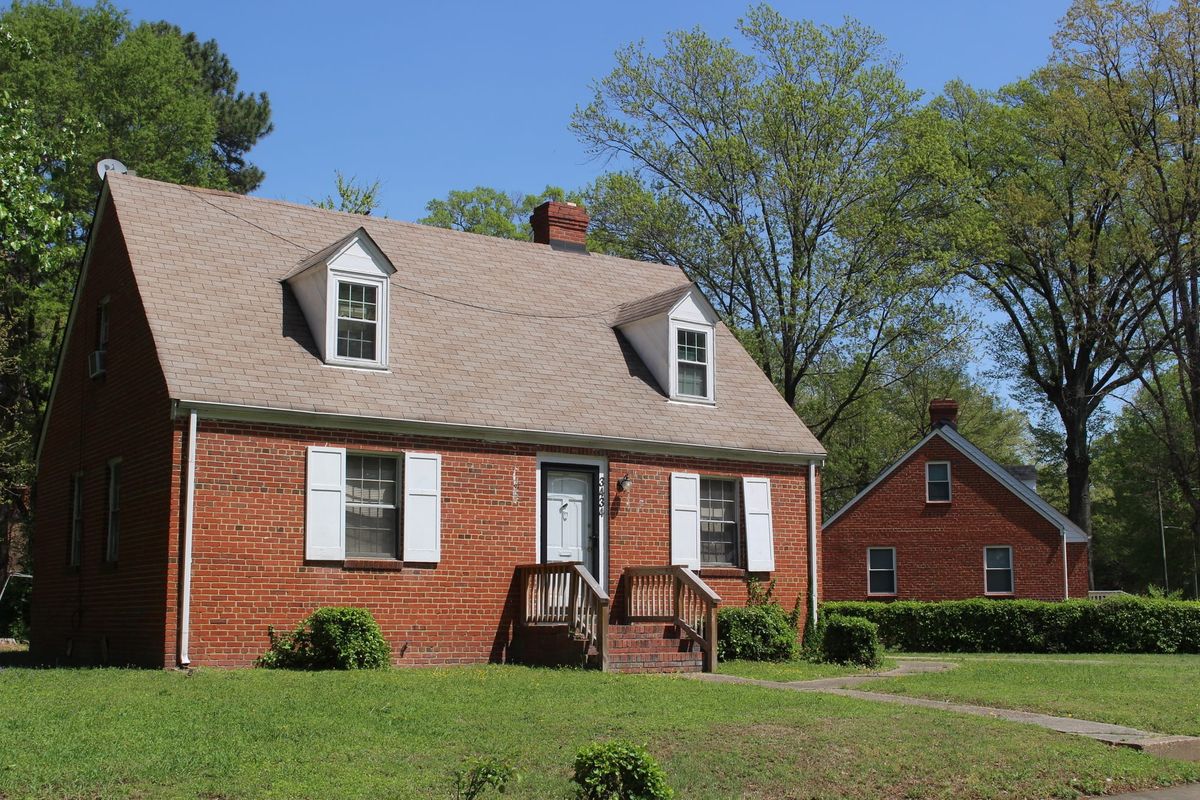
Other groups like Housing Opportunities Made Equal, which offers legal representation to residents in fair housing cases, have further argued that allowing the construction of a greater range of housing types across the city is one of the best ways to ensure that the rezoning occurs equitably. Without the provision, they say, the wealthiest, least dense neighborhoods effectively get to opt out of any changes that could allow residents with more limited financial means to live there.
For more than a year, the duplex issue has been battled at the Zoning Advisory Council, with little change in either side’s stance. At the body’s work session Wednesday, the disagreements were still obvious.
Retired attorney Charlie Menges called duplexes a “nonstarter.”
“Let’s focus on where in the city would you really have to make a difference in terms of generating affordable housing,” he said. “But don’t do it in established neighborhoods that have their own character and have their own contribution to making the city of Richmond what it is.”
Others have held fast to the preservation bonus as a workable compromise that multiple communities can get behind.
“I think it has landed in maybe the best possible place,” said Charlie Wilson. “It could inspire some creative thinking in how we use existing buildings.”
But several of the ZAC’s younger members continued to argue that duplexes provide critical flexibility for families containing multiple generations, older people who want to age in place and younger people facing steep rents and home prices beyond what their wages will support.
“I don’t think that ADUs and duplexes should just be discounted,” said Riley Champine. “I agree that it's probably not the thing that makes a huge dent in affordability, but what it does do is it allows for more flexibility.”
 Ned Oliver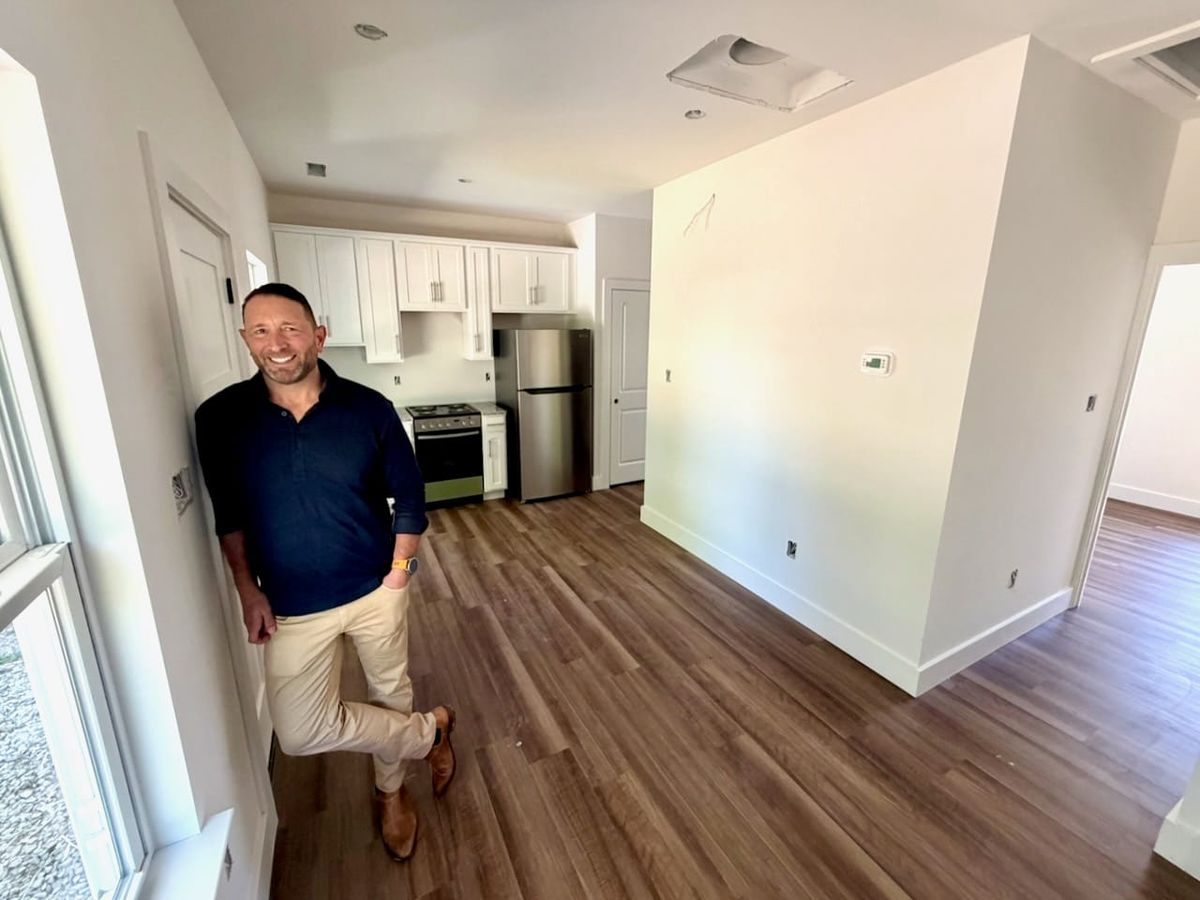
Casey Overton framed the disagreement in generational terms.
“I can almost guarantee that the people with the most concerns, fears, and complaints will not be here in 50 years,” she said. Many younger people, she continued, “tend to be pro-density, pro-flexibility, not because we're short-sighted or because we don't think that there will be any drawbacks, but because we understand that even the drawbacks kind of make up for some of the costs that we would incur from restricting ourselves.”
Still others, however, indicated that while they personally would like to see duplexes in the final plan, they don’t see a clear path forward for it given widespread opposition.
“It feels politically more expedient to just do away with that and move forward and get something passed that allows us to make a difference in the areas where we can truly make a difference,” said Brian White, who sits on both the Planning Commission and ZAC.
Projections and fears
For several of those members, the findings of two studies by consultant RKG on what development is likely to occur in Richmond as a result of the code refresh appeared to be a driving factor.
Those analyses projected that even under the most intense development scenario, residential detached neighborhoods — an estimated 44,000 parcels with unconnected single family homes — would see the addition of just under 300 new units annually. By comparison, areas zoned for mixed use could see between 1,200 and 1,600 new units annually.
“It’s not as scary as folks think it is,” said Greenfield during the Planning Commission meeting. “But the fact that we’ve been spending so much time on it, I’m afraid we’re overlooking some of the larger pieces of code refresh that we really need to move forward.”
 Sarah Vogelsong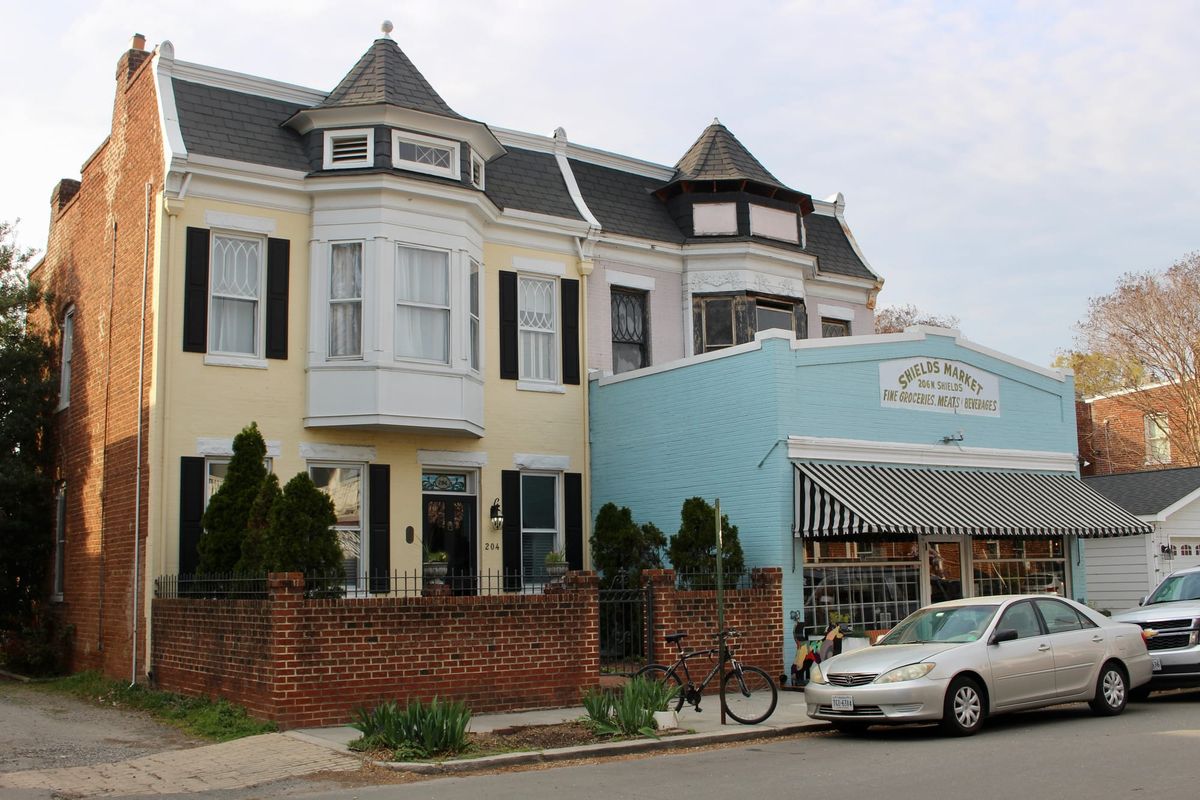
In particular, she pointed to more widely accepted goals of the rezoning, including cutting down on the number of lots where existing development doesn’t comply with zoning (a situation called “nonconformity”), reducing the number of special use permits the city has to process and adding in tree canopy requirements, which don’t currently exist.
Fixing nonconformities has been a major goal of the rezoning from the outset. Because rezonings in the 1960s and 1970s called for larger lots than in many cases already existed in Richmond, thousands of properties became “nonconforming,” meaning that if they burned down today they could not be rebuilt in the same form by right.
Vonck told The Richmonder that roughly 27% of the city’s parcels today do not conform with the lot size requirements of the current code. Far more are likely nonconforming based on their lot width or use, although a citywide analysis hasn’t looked at those factors. Neighborhood-specific analysis found that in some places, as many as 80% of all lots didn’t comply with current zoning.
Throughout all three meetings last week, frustrations were evident among a number of officials at what they described as “misinformation” and “fearmongering” around what level of change the code refresh is likely to produce.
 Michael Phillips
“It needs to be said clearly: ‘No, there is not a rezoning that’s going to put multifamily 10-story buildings on your block next to your single family homes,’” said Councilor Ellen Robertson (6th District). “There are a lot of folks that still believe that’s true. Some of the myths that are out there just need to be said upfront.”
Some of that may be due to the technical language of the zoning ordinance, which “is not a common language to the average person,” she said. “It’s so easy to be misled and confused or believe anything that someone’s telling you, because we’re not painting this picture. We need to paint this picture.”
Lynch urged residents and leaders “to approach the code refresh from a fact basis.”
“Code refresh is not going to be the solvent to our affordable housing crisis. It’s just not,” she said. “Code refresh is not going to poison people in the James and cause boils on people’s skin. It is not going to re-redline Richmond. It is not going to overnight explode a million people into the city, and it also is not going to do really anything demonstrative for people that are truly struggling in poverty in this city.”
Contact Reporter Sarah Vogelsong at svogelsong@richmonder.org.