Developer uses city's ADU law to build 100 backyard cottages
Granny flats. In-law suites. Backyard cottages. We’re still not quite sure what to call them, but they’re starting to pop up all over Richmond.
The city has issued building permits for nearly 117 accessory dwelling units (ADUs) — the official name used by the planning department — since the city’s zoning code was amended to allow them citywide.
Nearly half of those are the work of a single developer, Frank Cava, who is building the units in the backyard of rental homes he already owns. So far, he’s taken out more than 50 building permits and told The Richmonder he ultimately hopes to build 100 of the structures.
Cava, who said his portfolio caters to Housing Choice Voucher holders (formerly known as Section 8), described the pint-sized houses as an affordable, efficient way to grow his rental portfolio and boost housing supply in the city.
“We can build them in 60 to 70 days,” said Cava. “That’s faster than we can get Dominion here to hook up the power.”
ADUs will be allowed statewide
The structures will be legal to build in every Virginia city and county after July 1, 2027, when a law passed this year by the General Assembly takes effect requiring local governments to permit the structures in residential areas, including those zoned only for single family homes.
In Richmond, they’ve been permitted since September 2023, when the City Council voted to allow them by-right in all city residential zoning districts. Before that, owners had to petition individually for project approval – an expensive and time-consuming endeavor that largely limited the structures to existing carriage houses in the Fan and Church Hill.
Granny flats in Richmond, mapped
Accessory dwelling units have started popping up all over the city since 2023, when the City Council voted to allow the structures in all residential zones. Use the timeline below to watch the map fill in, month by month.
Supporters of the change said they hoped the new rules would help ease the city’s housing shortage, specifically by increasing the supply of affordable units.
The city’s ordinance sets a few ground rules for the structures, limiting their size to no more than a third of the floor area of the parcel’s main dwelling unit, or 500 square feet, whichever is greater.
Property owners still must follow all the underlying zoning requirements, such as how far structures must be from property lines and how much of the lot itself can be covered.
In Cava’s case, he calculated that about 100 of the more than 180 mostly single family properties in his portfolio in Richmond have space for an ADU in the rear.
A growing rental empire
Cava said he began assembling his portfolio in Richmond in 2009 after 10 years working for Ryan Homes.
He said many of his tenants pay with Housing Choice Vouchers, which many landlords refuse, despite it being a violation of state housing law. He told the Richmonder he considers it both profitable and a net social good to work with the Richmond Redevelopment and Housing Authorty, which issues the vouchers.
“I think I’m the largest private owner of single-family homes that accepts vouchers,” he said. “I’m cool with that. I think it’s helpful.”
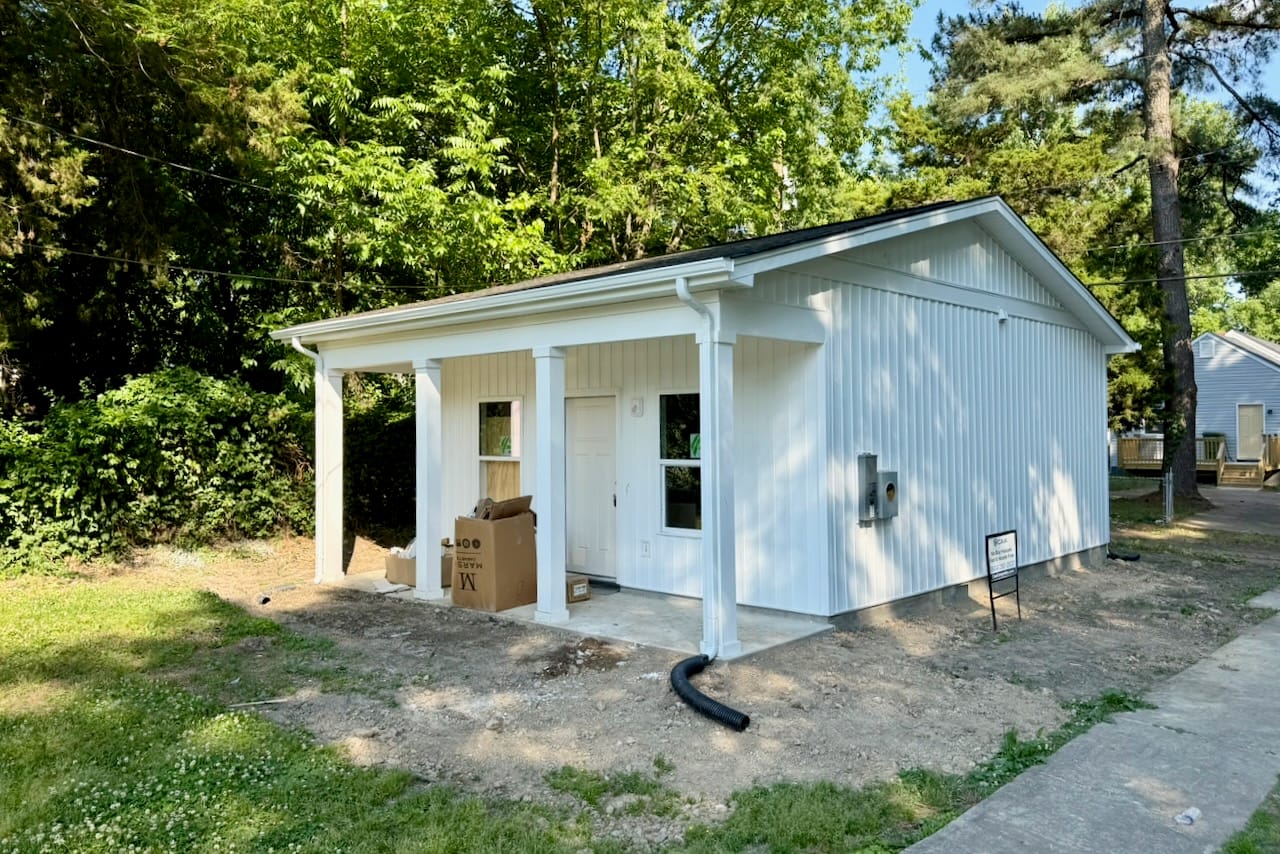
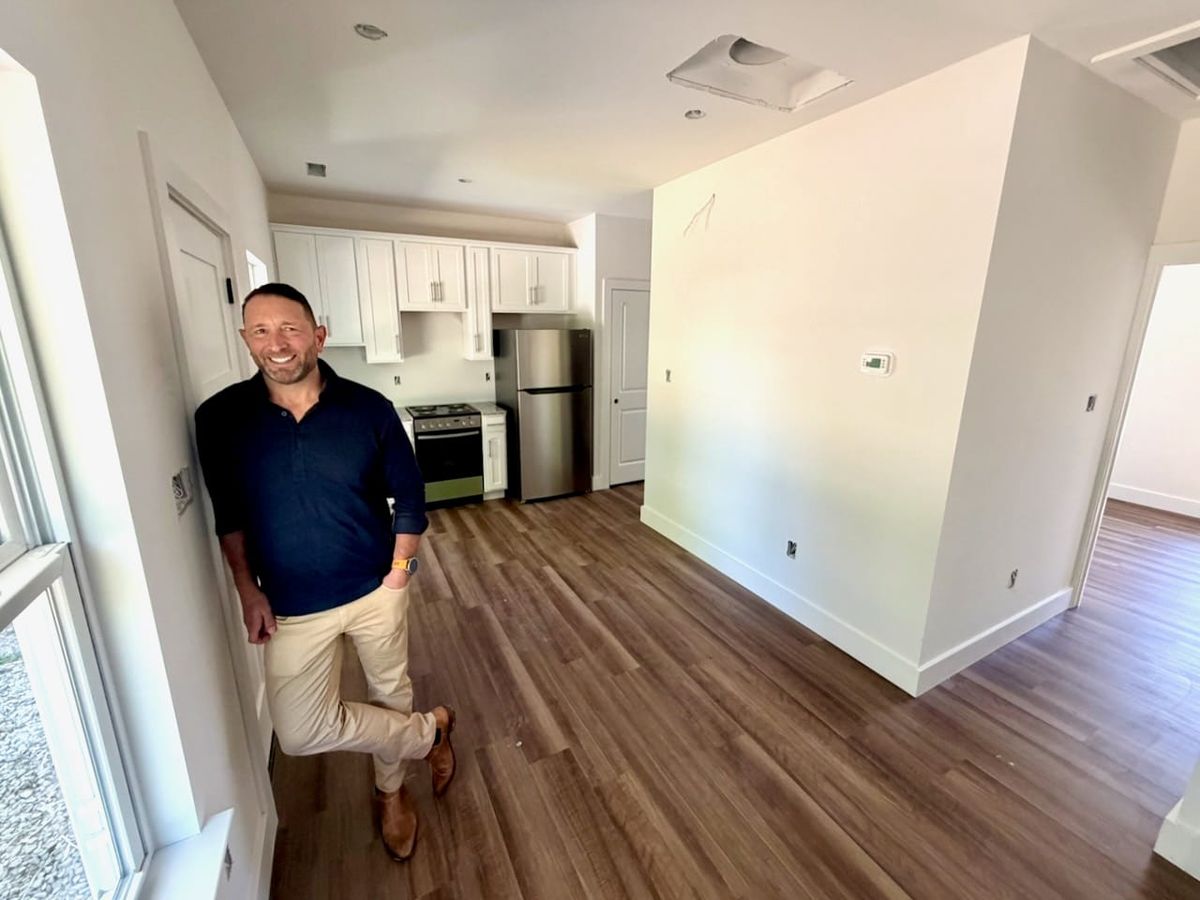
Work is wrapping up on his first few ADUs now. The structures are simple — bright white siding, a columned porch, with 500-square-feet of living space. The unit is broken up into a main room that contains a kitchen on one wall and a living room area on the other. That main room opens to two 10-foot-by-10-foot bedrooms, with a bathroom in the center.
His first unit listed for rent is on Fairfax Avenue off Richmond Highway. It’s priced at $1,609 a month.
He said reactions so far have been split between “that’s way too small” and “my lord that’s amazing.” He’s betting there will be enough people in the latter camp to fill the units, noting many people are happy to trade space for new construction housing with modern finishes and fixtures.
He said for tenants with housing vouchers, his main competition is RRHA, and he thinks even though they’re small, his units compare favorably to the city’s public housing developments.
Mixed reactions from neighbors
Some neighbors are less enthusiastic about the additions.
“Who would want to live in something like that?” asked Judy Hicks, a longtime homeowner whose backyard directly abuts the new units on Fairfax Avenue. She said the alley the building’s front door faces is a magnet for drug activity and thefts.
She also complained about a loss of privacy that comes with having the new structure so close to her backyard. She said she didn’t understand why Cava didn’t just build a duplex or redevelop one of a handful of vacant lots visible from her backyard. “I don’t know who’s going to move in. I don’t know how they’re going to act,” she said.
She said she’s asked Cava to build a privacy fence.
Not all neighbors have a problem with ADUs going up next door. On Delaware Avenue in North Richmond, where a property owner built a two-story ADU in his backyard last year, his neighbor shrugged it off when asked by a reporter how he felt about the structure.
“We don’t really mind,” said the homeowner next door. “It’s just not that big of a deal.”
Contact Reporter Ned Oliver at noliver@richmonder.org. Dominion Energy is a sponsor of The Richmonder but was not allowed to influence or review this story.
How we reported this story
After the General Assembly voted to legalize accessory dwelling units statewide, we got curious how (or whether) property owners in Richmond were taking advantage of a 2023 decision by the City Council allowing the structures locally.
Because the city's online repository of building permits doesn't support searching documents in a way that would turn up ADUs, we used an AI tool to scrape the data, which we then manually verified.
The resulting dataset revealed a spike in interest in the structures recently and that one property owner in particular — developer Frank Cava — was responsible for most of those plans. We contacted Cava, interviewed him about his plans and toured of one of the ADUs he has under construction. We also talked to neighbors of ADUs that were being built or had already been constructed how they feel about the units.