Little resolution in sight in fight over who should handle medical 911 calls
Since February 2025, the Richmond Ambulance Authority and the city’s Department of Emergency Communications have been locked in a struggle over who should field 911 calls for medical emergencies.
More than a year later, a proposal is before the City Council to give the responsibility back to the ambulance authority after it was transferred in 2024 to the city’s dispatch center as part of an effort to centralize services recommended by the Robert Bobb Group consultancy.
But after multiple hearings on the subject, there appears to be little resolution in sight, with both sides committed to their position that they are the best agency to be in charge of medical calls.
“Mayor Avula believes the current model of 911 call response more effectively serves residents than the model proposed by the ordinance, is more fiscally responsible, and is operationally more efficient,” Lawson Wijesooriya, Avula’s chief of staff, wrote to City Council members May 10.
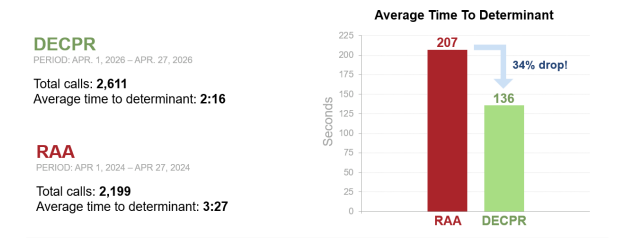
The administration has pointed in particular to a 34% drop in the average time it takes a 911 dispatch worker to categorize what kind of medical problem a caller is facing and how severe it is as proof that Emergency Communications does a better job than RAA.
“A one-minute faster response can be critical in emergencies,” the mayor wrote in a memo at the time.
The ambulance authority, however, continues to argue that Emergency Communications is processing calls incorrectly, leading to confusion and incorrect resources being sent to emergencies.
“It’s not a race; it needs to be accurate,” said Chip Decker, CEO of the authority. “And our data shows we’re more accurate.”
 Sarah Vogelsong
In a memo sent by Decker to the City Council May 18, Decker said that the administration’s emphasis on call processing times is out of step with the standards used by emergency dispatch accreditors to evaluate agencies. Furthermore, he said, those times don’t reflect how long it takes for an ambulance to be dispatched, since vehicles are sent out before the processing is complete.
The accrediting body “does not use raw processing speed as a measure of success,” he wrote. “Speed without accuracy is not the objective of emergency medical dispatch. Accurate call classification, proper resource allocation, and effective caller questioning are the standards by which high-performing dispatch centers are measured.”
In its defense, RAA has marshaled compliance scores from the International Academies of Emergency Dispatch, pointing out that the accreditor classified 29% of the calls handled by Emergency Communications over a six-month period as noncompliant with standards. Over a comparable time period, only 6% of RAA’s calls were classified as noncompliant.
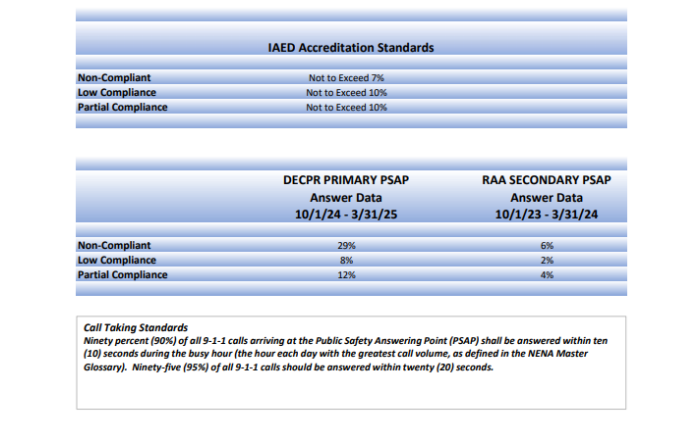
The Avula administration has defended its own stance by saying that the prior system of transferring callers with a medical emergency from the communications center to RAA caused confusion among people in need of aid and was out of step with national trends toward consolidating emergency communications.
Maintaining two call centers, the city says, is costly, requiring investments that “would not be necessary if we move to a fully consolidated and co-located model.”
Studies including the Robert Bobb Group analysis “have emphasized the importance of consolidating rather than dividing call-taking functions, noting inefficiencies and additional cost burdens associated with maintaining two emergency communications centers,” Avula wrote.
RAA has said it is unaware of any data showing that callers struggled with the prior system. Furthermore, it has been firm that returning medical calls to the authority would not cost the city anything, since RAA still maintains a communications center to handle pre-scheduled non-emergency medical services.
To date, the authority has won the support of three councilors — Reva Trammell (8th District), Sarah Abubaker (4th District) and Kenya Gibson (3rd District) — and the Public Safety Committee, which has twice approved the transfer proposal and has engaged in several antagonistic exchanges with the city’s director of emergency communications, Stephen Willoughby.
Whether it can get the support of the full Council remains unclear. Many of the financial figures remain in dispute, and councilors have struggled at times to parse the technical data on response quality.
“I’m still trying to make sense as to is it better,” said Councilor Stephanie Lynch (5th District) on Thursday.
Contact Reporter Sarah Vogelsong at svogelsong@richmonder.org