Up for debate: Major national event arrives in Richmond this weekend
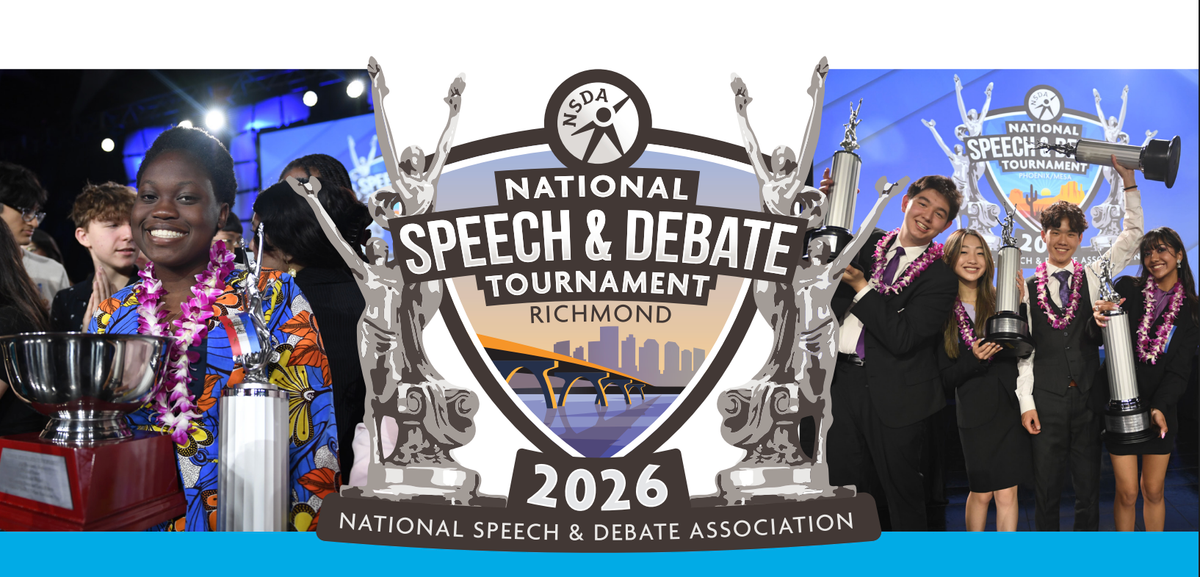
Starting Sunday, thousands of students will descend on Richmond to compete in one of the world's largest academic competitions.
The National Speech & Debate Tournament, hosted annually by the National Speech & Debate Association, will bring roughly 7,000 students representing 1,500 schools to the Richmond area from June 14-19. Competitors will participate in a variety of speech and debate events at schools throughout the area, the Greater Richmond Convention Center and the Altria Theater. The finals will be livestreamed on the National Speech & Debate website, as public tickets are not available. Richmonders can get involved by volunteering to support event operations and hospitality at tournament venues.
This year marks the first time in 26 years that the tournament has been hosted in the Mid-Atlantic – landing the tournament was an initiative led by the Richmond Forum.
Local flavor
Among the competitors will be 16 Richmond-area students representing eight schools.
For Jasmine Franco, a rising senior at Clover Hill High School, qualifying for Nationals came as a surprise.
As a first-year competitor in the Lincoln-Douglas debate event, she was so sure her season was over after her district preliminary rounds that she was already thinking about lunch, and had her phone on silent when notifications for advancing competitors were sent out.
“I laughed so hard because I was like, this is a joke, someone’s pranking me,” she said.
When her name was announced as a Nationals qualifier, she was so shocked she nearly forgot to walk up and receive her award.
For Taylor Thomas, a recent Petersburg High School graduate, qualifying carried a different significance.
This year's tournament marks her third appearance at Nationals and gives her another opportunity to perform “a nite with beau willie brown” by Ntozake Shange, a piece she first competed with as a sophomore.
The piece explores the effects of war and PTSD on veterans and their families, themes Thomas said she believes are important for audiences to understand.
“That's really what my motivation was my whole senior year,” Thomas said. “I want to do justice for this piece (and) justice for myself within this piece.”
While their paths to Nationals were different, both students described themselves as shy before joining speech and debate.
Franco credited her older sister with introducing her to the activity.
“She’s super extroverted and loves to talk,” Franco said. “She joined speech and debate, and she was doing really well. I would hear all of her fun stories of the trips they would go on, and the people she would meet.”
At the time, Franco considered herself “a very timid person” and initially dismissed the idea of participating herself. Her sister, who was leading the club when Franco joined, assured her she did not need to be an expert public speaker to get started.
“I thought it would be a good way to help me kind of break out of my shell, meet people at the club, learn a new skill,” Franco said.
Thomas joined Petersburg High School's speech program – known there as forensics – after encouragement from a friend. Even after that friend left the activity, Thomas stayed.
“My coach always used to tell me, ‘At least your best friend brought me a longtime person,’” Thomas said.
Both students said speech and debate helped them gain confidence.
“I was the type of person to keep my head down in the hallways,” Thomas said.
To both students, the program’s impact extends beyond the classroom.
Franco said speech and debate taught her how to research issues, evaluate evidence and communicate complex ideas. She emphasized the importance of programs that teach students how to think critically and engage thoughtfully with opposing viewpoints.
“It's really important that students have the option and the exposure to learning how to collect data, collect research, and form thoughts and ideas and arguments, and be able to articulate that,” she said.
Franco added that speech and debate encourages students to look beyond their own perspectives.
“Everybody can have arguments,” she said. “You have to understand the other side because … you have to make an argument for both the pro side and the negative side.”
Despite the two competing in different categories, both described their experiences as transformative.
While Franco currently competes in Lincoln-Douglas debate, she didn’t initially want to. When she moved to Virginia, she hoped to continue doing Public Forum, a two-person team debate format. When she couldn’t find a partner, her coach suggested the “pretty similar” Lincoln-Douglas format.
The transition was so difficult, she told her dad she wanted to quit.
“I remember my dad telling me, ‘You need to let yourself fail, and you need to keep going,’” she recalled.
Thomas faced challenges of her own. One obstacle involved adapting the delivery of certain words to meet competition expectations. Since pronunciation can affect scoring, she worked closely with her coach and teammates to practice words that consistently gave her trouble.
Both competitors said they’re excited to have this year’s tournament in Richmond. Franco said she’s most excited to watch the final round.
“I'm honestly really excited about that more than my own debating,” she remarked.
Thomas said she’s most excited to see fellow seniors she’s competed with since they were freshmen.
“We’ve also built connections with each other that give us ways to rely on each other,” she said. “We might practice with each other while we're at the tournaments, we might go off, do fun things, play games on our phones, take our minds off of the competition.”
While both students are proud of how far they’ve come, they acknowledge other people’s hesitance to join speech and debate, especially if they believe they’re not outspoken or skilled enough.
However, Franco believes that’s even more reason to join.
“You only get better at public speaking by doing it more often,” she said. “We always have these mental constructs of what we can and can’t do, but you don’t really know what you’re capable of until you’ve pushed yourself past that.”
Thomas said speech and debate is about more than public speaking. She encourages hesitant students to view it as an opportunity to build relationships and open doors for their future.
“Speech has opened so many doors for me, not just as a person,” Thomas said. “It's (opened) gateways for myself, going into college and going out into the real world now.”
Contact Intern Haidyn Brockelman at hbrockelman@richmonder.org.