Move over, Scott’s Addition. Manchester could be getting its own urban trail and park.
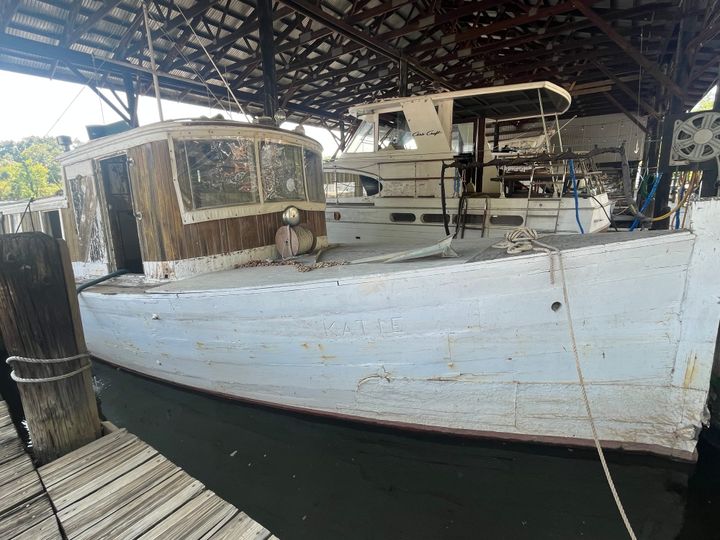
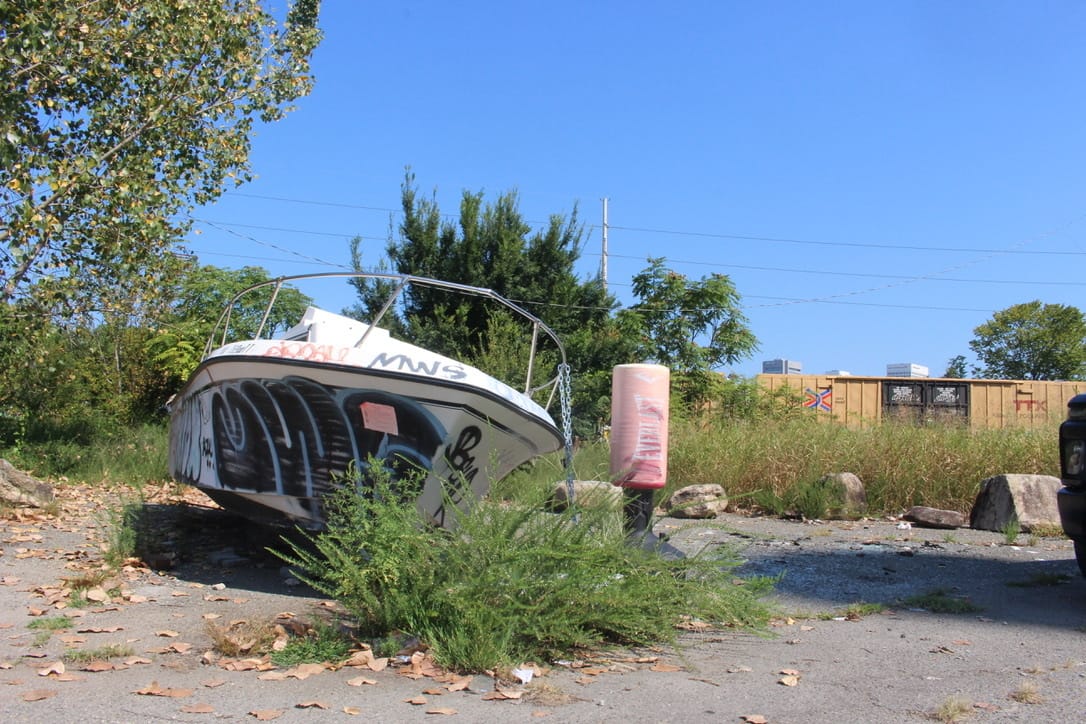
For some years, the most distinctive landmark of the scrubby, car-filled stretch of land that lies just south of the Norfolk Southern lines in Manchester was an abandoned boat, emblazoned with graffiti and cozied up next to a punching bag.
The boat “is a perfect personification of the hiddenness of Manchester’s waterfront,” said Tyler Silvestro, a partner at landscape architecture firm Marvel.
The whole area “looks like the back-of-house for a lot of buildings,” said Silvestro. “But if we open it up, it will become something that is highly useful for people to get to and from the James River.”
Now, plans are moving forward to do just that by transforming a string of parcels and right of way between roughly Perry and Hull streets into an urban trail for bikers and pedestrians and a brand-new public park.
“We started thinking: We’ve already got this kind of magnet over here with the T-Pot Bridge and the Fall Line Trail,” said Drew Wiltshire, a principal at Thalhimer Realty Partners, referring to the popular T. Tyler Potterfield pedestrian bridge. “We’ve got this other magnet over here with the Mayo Bridge. How do we connect them?”
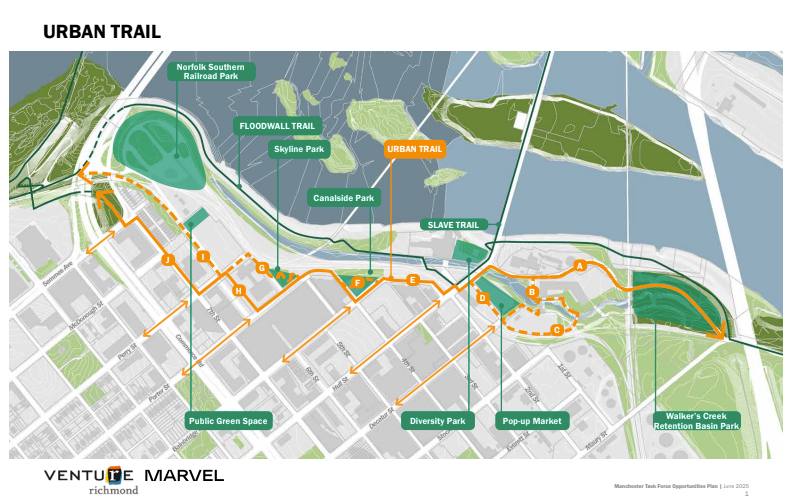
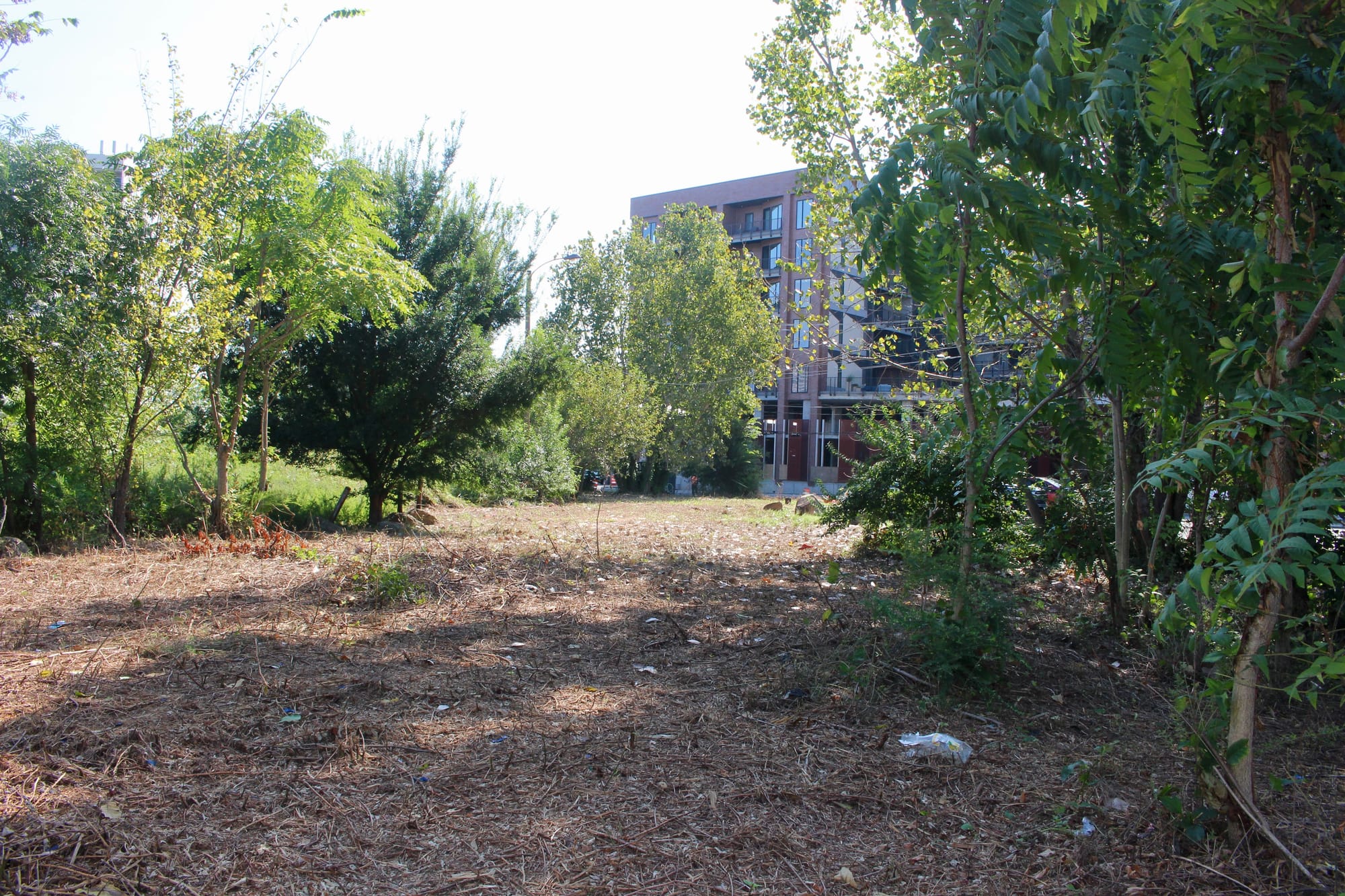
While the project is in its early stages, the public-private collaboration between Thalhimer, the city of Richmond, the Manchester Alliance neighborhood association and Venture Richmond aims to rework underused city-owned land at 311 Bainbridge St. into a roughly half-acre public park and transform the surrounding area into a formal urban trail that will eventually allow bikers and walkers to go from the Mayo Bridge to the planned Fall Line Trail across the Manchester Bridge.
Brantley Tyndall, director of Bike Walk RVA, said he was “thrilled” to see plans for more bike and pedestrian infrastructure in “a part of Richmond that particularly needs it.”
“It will be a natural connection between the future Fall Line and the Capital Trail via the Mayo Bridge,” he said. “It’s going to get a ton of use and be really popular.”
Janet Woodka, president of the Manchester Alliance and one of the key figures spearheading the effort, said the project “is what can happen when the neighborhood, developers and the city all work together.”
While the Richmond City Council will need to sign off on several parts of the project, including a long-term lease of the Bainbridge land and the abandonment of some stretches of right of way, the plans have already gained the enthusiastic support of Mayor Danny Avula’s administration.
“This is a really great example of where the city owned land and we had an inquiry from a private sector person who owned land around it and were actually willing to step forward and say, ‘We will build the trail, we will maintain the lot,’” the mayor told The Richmonder.
When complete, “it will create bike-walk access and the kind of livability you want to see” in Manchester, he said.
‘Underutilized’ assets
Like Scott’s Addition, Manchester has seen explosive growth over the past decade as its once-industrial blocks were redeveloped into densely arranged high-rises with thousands of residents and ground-floor retail.
An October 2025 analysis of the neighborhood by Marvel commissioned by Venture Richmond and the Manchester Task Force calculated that 4,700 residential units had been built in the past 20 years, with an additional 2,800 in the pipeline.
Many of them were drawn to the neighborhood by its proximity to the James River and the natural resources it offers, said Wiltshire.
But, he added, those assets are “underutilitized.”
Right now, the primary recreation area for Manchester is the Floodwall Walk, a narrow elevated walkway that overlooks the James River from the top of the floodwall. While the trail is popular, it is cut off from much of Manchester and is not accessible to many people with disabilities.
Overall, the October 2025 report concluded that “existing park spaces are few and some difficult to access” and made an impassioned case for building out the neighborhood’s urban trail network.
“To live or work within walking distance to the James is an incredible thing and therefore, access to it must remain a priority for the Manchester community,” the analysis found. “A connected and uninterrupted pedestrian experience that spans the James River through public parks, shared-use paths, pedestrian bridges, and retail-heavy urban areas is one that will attract millions of visitors and be of value to businesses, residents, and others.”
Development in Manchester, as in Scott’s Addition north of the river, “happened so quickly and without enough of a planning focus on what do people actually want in these communities,” said Avula. “Thankfully, we have really activated neighborhood associations in both.”
 Payton Kifus
Unlike some of the trail investments envisioned for Scott’s Addition, the Manchester plans will rely on the collaboration of a developer. Thalhimer, which has about 750 residential units and 15,000 square feet of retail in Manchester, is not only putting forward land it owns for the project but has pledged to improve and maintain the Bainbridge park through a long-term lease it is seeking with the city.
Right now, the developer has begun some cleanup of the land through a short-term agreement signed this August with the city, although the longer lease will require City Council approval and is expected to come before that body later this fall.
A copy of the short-term lease shared with The Richmonder explicitly states that Thalhimer would be permitted to use the property “for the design, development, and maintenance of a public park.”
But while Thalhimer will be on the hook to make the park happen and keep it in good working order, Wiltshire said the company will work closely with Richmond’s Parks and Recreation Department for planning and programming. Marvel, which is also involved in the city’s Dock Street, Mayo Island and Belle Isle parks, will do the landscape design.
“With leadership from Mayor Avula and Thalhimer, we are taking an area that is blighted and derelict, with trash, abandoned vehicles and boats, and turning it into a linear park where people can walk their dogs, stroll with their children, ride their bikes and connect” to all of the area’s current and future destinations, said Woodka.
The urban trail along which the park will sit will be a more complicated exercise, requiring the city to cobble together different parcels and right of way to produce a corridor that will allow pedestrians and bikers not only a safer path through the neighborhood but a pleasanter, leafier one.
When complete, the route will be clearly marked and signed, with plantings and places for people to sit and gather.
The intended path is “kind of building on what people already do. If you’re here on a Wednesday night or a Thursday night, you see bikers coming this way already,” Woodka said, gesturing toward the maze of parking areas, city blocks and plain unused land that they currently ride through. “It’s maybe a great bike ride for somebody who’s a true urban biker or warrior trail rider, but it’s not great for a dad and his 6-year-old.”
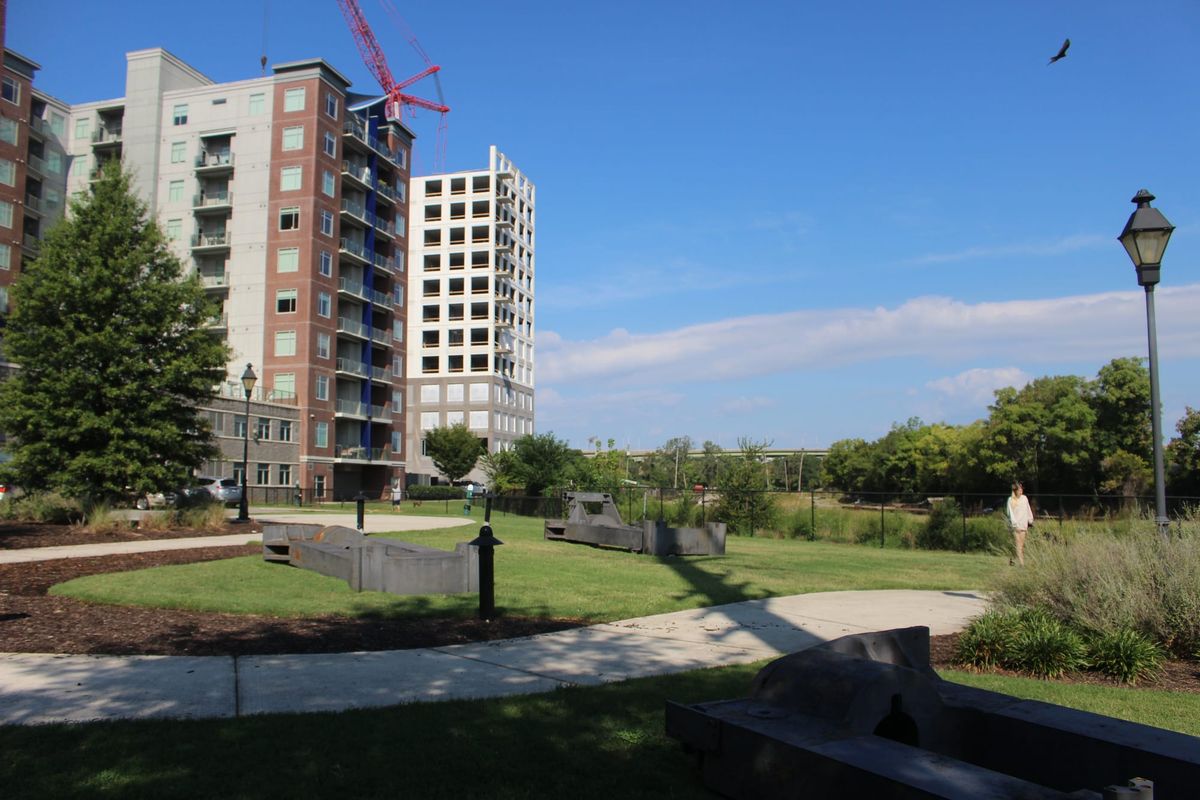
Among the plots of land that will be converted along the route are two owned by Thalhimer: a small dog park and “Skyline Park,” a small triangle of land with repurposed presses from the former Reynolds South plant that sits next door.
Wiltshire hopes that when complete, the new park and trail will become a draw for both residents and visitors, with a small stage for concerts and potentially even some small-scale businesses to serve users.
Right now, “there’s really nothing that signifies Manchester,” he said. “What can we do on our side of the river to kind of serve as a place for people to gather, that would attract folks that live here and people that are coming from different parts of the city?”
Once the infrastructure is in place, he said, “people are going to actually just come and I believe kind of take it over and figure it out themselves. I think there’ll be some organic growth that just happens after we create this nexus point.”
Contact Reporter Sarah Vogelsong at svogelsong@richmonder.org. Venture Richmond is a sponsor of The Richmonder but was not allowed to influence or review this story.