Local author Rachel Beanland’s newest book revisits a childhood home in Italy
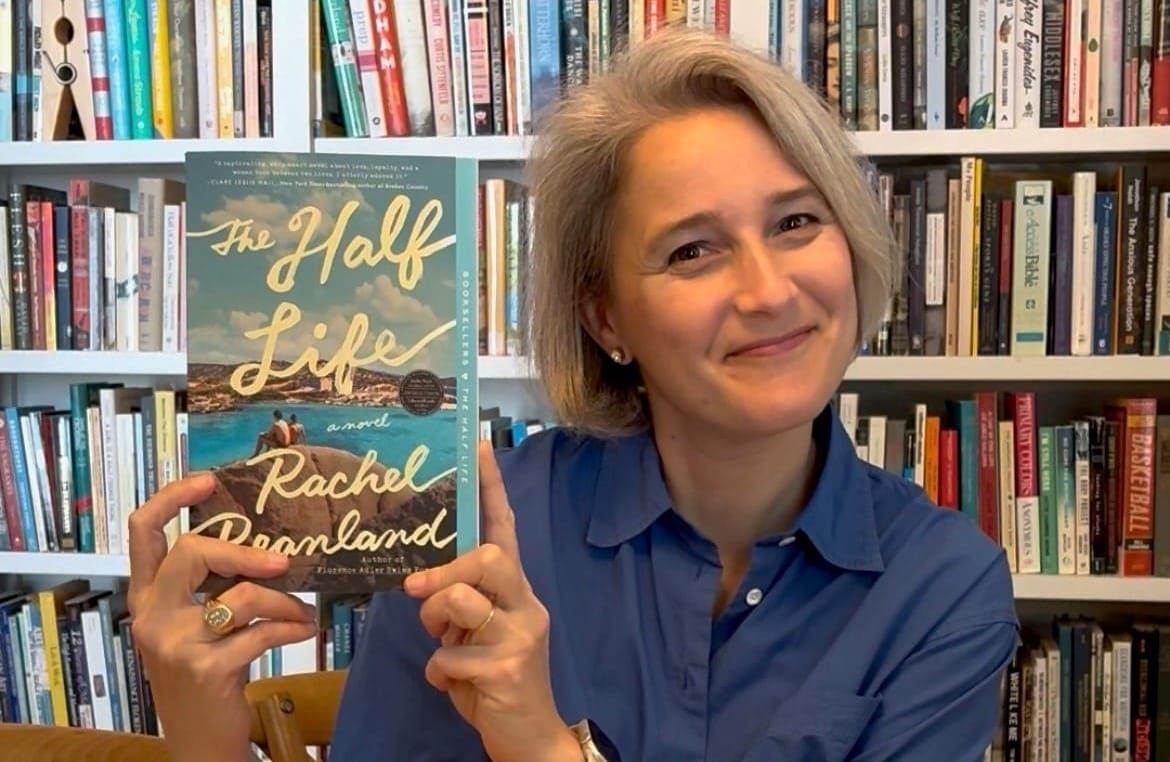
The idea for local author Rachel Beanland’s new novel, "The Half Life," first came to her in 2019 as she was wandering with her family around an abandoned elementary school. The school, which sits at the edge of the Italian island of La Maddelena, was crumbling and dilapidated.
Decades earlier, Beanland was a student in that building.
Beanland’s father was in the Navy, so as a kid, Beanland moved around a lot, including to La Maddelena. The American Navy held a presence there for more than three decades, and Beanland lived on the island for two years in the 1980s. When she returned decades later, she found the place both familiar and not.
“We kind of had to sneak onto the old officers quarters’ area because it wasn’t open to the public anymore,” Beanland said. “By then, the U.S. Military was not in La Maddelena anymore. And I was kind of wandering around the island looking for evidence of our old life. And there were places where I could see it and places where I couldn’t.”
Her memories of her time on the island were of an idyllic childhood — swimming in crystal clear waters, collecting pine nuts and sea urchins. But all this time later, sitting at the crumbling elementary school with her new family, she found herself thinking differently about the American presence on the island.
“I started to think, I really experienced this place at a particular time in its history,” Beanland said. “This 36-year period when the Americans were here was fascinating. And the more I read about it after the fact, the more I realized, I think there is a story here. So I started to daydream about writing a novel set on a Sardinian island.”
Beanland moved to Richmond in 2007, when her husband got a job teaching math at VCU. Soon after, Beanland enrolled in VCU’s MFA program in creative writing, and she wrote the entire draft of her first novel while a student in the program. That novel, "Florence Adler Swims Forever," went on to be named one of USA Today’s “Best Books of 2020” and was a New York Times Book Review Editors’ Choice Pick.
The book launch event for "The Half Life" will take place at the James Branch Cabell Library on Tuesday, July 14 at 6:00 PM. A ticket comes with a signed copy of the novel. The novelist Kevin Powers, who grew up in Richmond, will interview Beanland as part of the event.
“VCU Libraries is certainly a special place to be hosting this,” Beanland said. “I have a lot of love for VCU.”
Richmonders may know Beanland best from her 2023 novel, "The House Is on Fire," which is set in early-1800s Richmond. The novel depicts the day the Richmond Theater burned down and follows four characters in the aftermath of that terrible event.
And although the time, place, and characters, are radically different, "The Half Life" also interrogates important political issues of our day.
"The Half Life" follows 23-year-old Eileen O’Malley as she meets and falls in love with the charming naval officer Paul Archer, in Charleston, South Carolina. When Paul is assigned to La Maddalena, she accompanies him there, and the rest of the novel explores Eileen’s tumultuous time on the island. She navigates a host of challenges — finding acceptance and friendship among the naval wives, learning the language, a strained marriage, and a growing intimacy with an attractive local reporter. Lurking in the background of Eileen’s life is the expanding local resistance to the American presence on the island, largely to do with environmental concerns caused by American submarines.
Of course Beanland hopes readers find the plot and characters compelling, but also acknowledges there are some broader takeaways that pertain to the present day.
“There are certainly maybe people who walk away and think, you know, I didn’t really think about American expansionism before in this way, or the U.S. military’s presence in foreign countries, or environmental concerns pertaining to the military-industrial complex,” Beanland said. “So there’s lots you can take away. But I am in less control of how people process that. I never want to preach.”
"The Half Life" is the product of mountains of research, time, and energy. And although the U.S. military no longer has a presence on La Maddalena, Beanland’s research process was filled with false starts and dead ends.
“One of the issues is, talking to people about nuclear submarines is really tricky because it’s top secret,” Beanland said. So she had to be creative about finding information on military operations on the island. Her American sources seemed more willing to divulge information about what happens on a Russian sub, for instance, and she could extrapolate from that.
“And even figuring out the CIA’s involvement in Italian politics. More and more is coming to light with every passing year, but there’s still so much we don’t know about what we as Americans were and weren’t supporting in Italy during this time,” Beanland said. “So that was certainly a challenge.”
But "The Half Life" is not merely a political book. It is also a novel about love, learning, grief, and trying to do the right thing under incredible pressure. For Beanland, the story is profoundly personal.
“I tend to think about it in terms of the ingredients that I’m kneading into the dough,” Beanland said about her writing process. “My own grief, and my own worries about the future, and my own politics. All of these things.”
Beanland’s father, who worked on submarines when he was stationed at La Maddalena, had prostate cancer in his early fifties and died of pancreatic cancer in his late fifties.
“You know, there are a number of reasons that he could’ve ended up with two forms of cancer in his fifties,” Beanland said. “He smoked a pipe, he drank, he didn’t love exercise. But also he worked on subs. I’ve always wanted someone to sit down and tell me why he died. And I’m never—no one’s ever going to do that because there is not an answer. But I liked envisioning that someone had that potential to sit down and explain something to me.”
While her father didn’t work in nuclear repair or radiological controls as some of the characters in the book do, Beanland’s father would sometimes come home and express concerns about his workplace.
“He did have stories about working on subs and times when he felt like he was unsafe or potentially exposed to something, and never got any answers,” Beanland said.
But more than the military, "The Half Life" centers the community forged among the naval wives in part because that was the community Beanland witnessed growing up on La Maddalena.
“My day-to-day life was following my mom around and sitting at the kitchen table while my mom and her friends gossiped,” Beanland said. “So it was very natural to write those women. And of course my mother had her own network of friends that I could draw inspiration from.”
Careful readers will also find a few references to Richmond. “I have a few little Richmond Easter eggs,” Beanland said.
And portions of the book are set in Charleston, which Beanland feels Richmonders might relate to. “I think Charleston and Richmond have some similarities,” Beanland said. “Both Southern cities, deep histories, history of slave trade, some history of military presence. Southern cities that are experiencing changing identities.”
Having lived in Richmond now for almost 20 years, Beanland believes the Richmond arts scene is responsible for making her life as a novelist possible. On top of the resources Beanland found at VCU, she’s also enjoyed several James River Writers conferences and working for four years at the Visual Arts Center of Richmond. “It was so inspiring to be working there and be surrounded by artists and writers and people that were really trying to make a go of art-making,” Beanland said.
“I started with very little experience and a deep desire to write, and I feel like so much of my growth as a writer has happened here, in this city, thanks to a lot of cultural institutions,” Beanland said. “I don’t think I would be a novelist without being a Richmonder.”
VCU is a sponsor of The Richmonder but was not allowed to influence or review this story.