Hibachi at home? These chefs make it a reality.
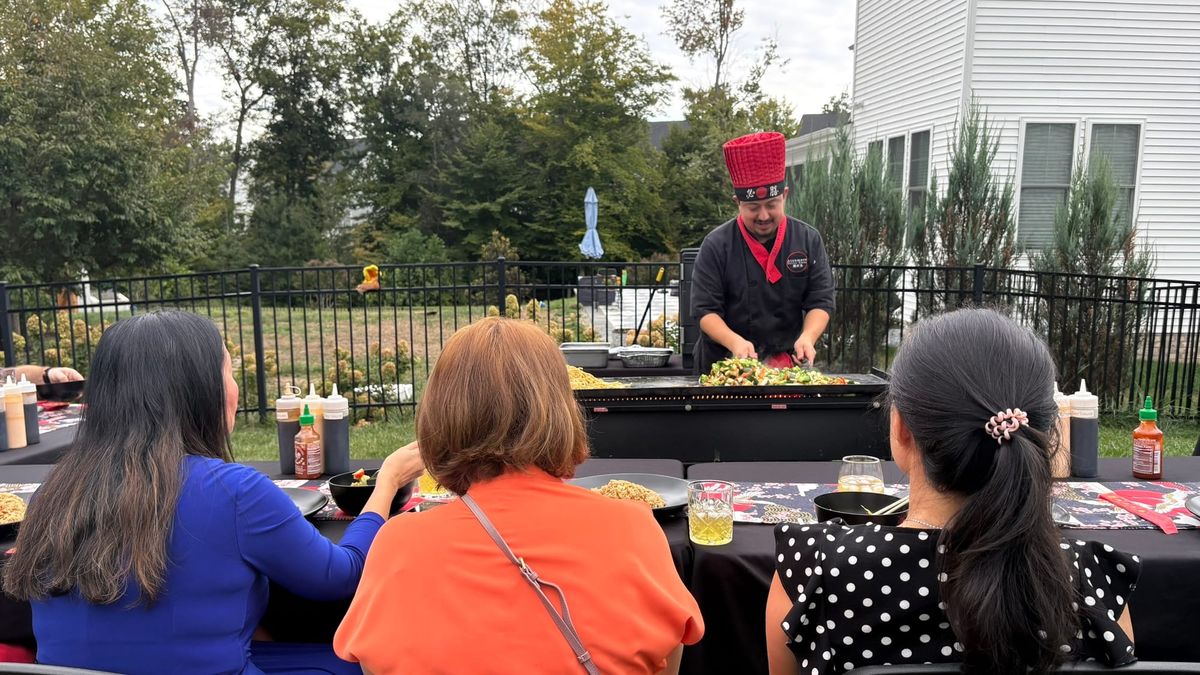
There is nothing like the thrill of having a teppanyaki chef feed you by flipping a shrimp bit off his spatula. Calculating the speed and arc of a catapulted crustacean, then adjusting your jaw accordingly, is one of the greatest at-table experiences.
And yet, Richmond area Japanese steakhouse fans may have discovered something even better.
“He threw the shrimp to me and I catched it with my mouth!” a 7-year-old guest at an Atsumaru Private Dining event yelled up to a friend who was watching the proceedings from his second-floor bedroom window.
Being able to immediately share culinary milestones with next-door neighbors is just one of the perks of at-home hibachi, a private dining format that’s surged along the eastern seaboard since 2021. According to Google data, while interest in “hibachi” has been flat over the past five years, searches for “private hibachi” have doubled, with several catering operations now hawking backyard setups to local diners.
Atsumaru Private Dining chef-owner Carlos Garcia, who books birthday parties, microweddings, and casual get-togethers from Charlottesville to the Outer Banks, said Richmond is the epicenter of his thriving business. Think of it as the flame in the onion tower, with some faithful customers calling on Garcia three or four times a year. “That’s why with my show, I make sure I don’t do everything the first time,” he told me while setting up his station behind An Bowen’s Mechanicsville house.
Prior to the pandemic, Japanese steakhouses were among the few Southern restaurants where strangers from different racial and ethnic backgrounds sat around the same table, a reflection of hibachi’s standing in the region. While the big portions-big laughs format popularized by Benihana is known from Tacoma to the Taconic State Parkway, the genre has long loomed largest in the American South, home to 19 percent of the U.S. population, but 29 percent of its Japanese steakhouses.
The Richmonder’s analysis of Google Maps listings further shows that Virginia’s hibachi density is about 1.3 times the national rate—meaning it lags the Carolinas but still comfortably puts away more yum-yum sauce than the average American state.
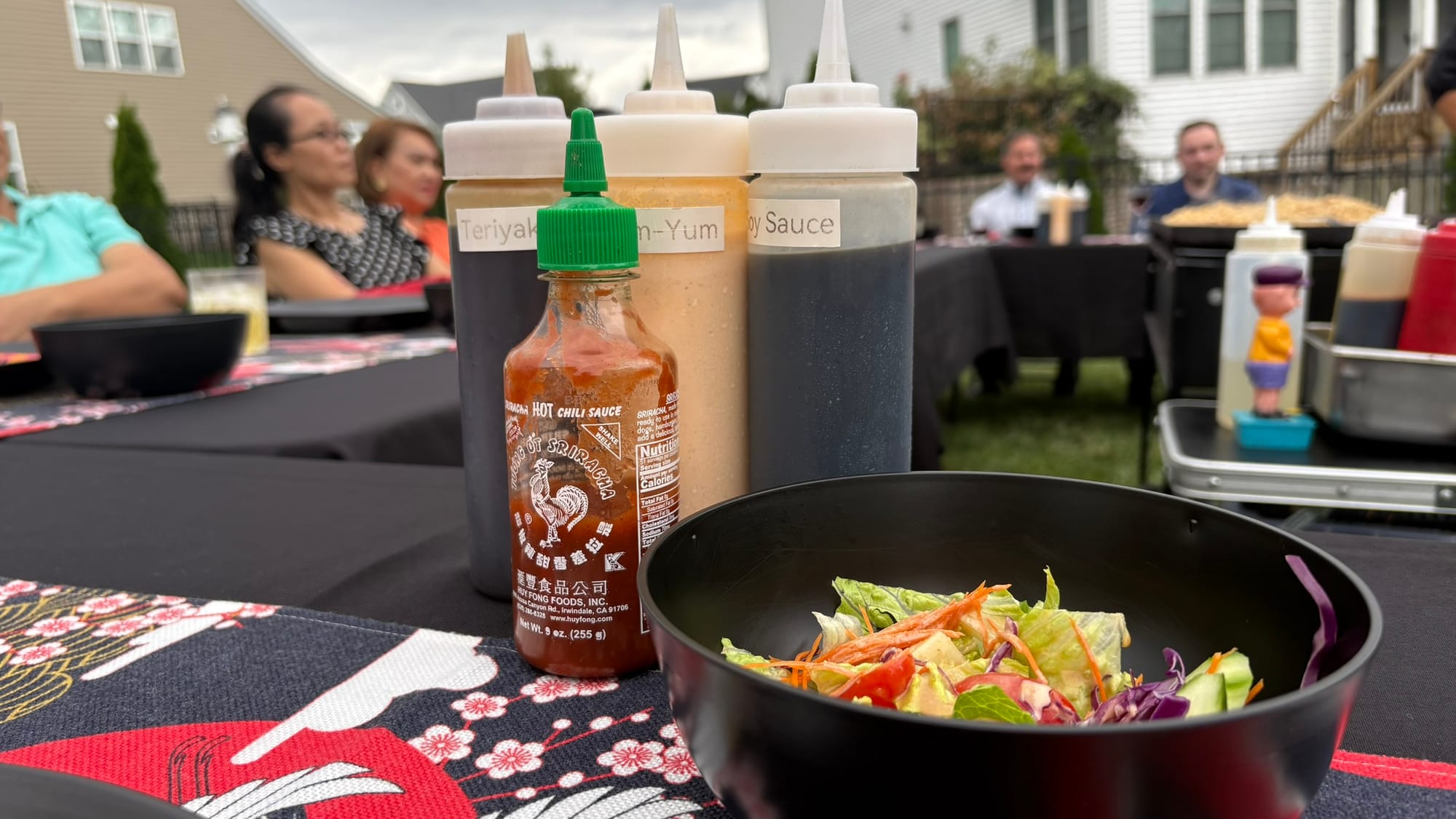
That magnetically pinkish mixture of sugar and mayonnaise has traditionally been a bigger draw for Japanese steakhouses than the prospect of a multicultural meal. Still, as the practice has gone behind residential doors, it’s hard not to think that this century’s version of “bowling alone” could be “private hibachi.”
'You have to have connection with the customer'
Like most hibachi professionals, Garcia, 38, didn’t grow up with Japanese cuisine. Before one of Bowen’s guests chose her spot at his folding tables, dressed in black tablecloths and arranged in the customary u-shape, she quietly asked Bowen whether he was planning to grill Mexican food. Garcia laughed when Bowen told him.
“She was thinking it’s going to be Chipotle, right?” Garcia said. “They also cook in front of you!”
A native of Newport News, Garcia started working at the city’s Hayashi Sushi & Grill while still in high school. Hired as a “sushi helper,” he picked up some raw bar arrogance along with knife skills.
“I thought sushi was better than hibachi: More of an art,” he recalled. That conviction was among the reasons why Garcia initially declined to take over a teppanyaki table when one of the restaurant’s chefs quit. Also, he was shy.
Before long, though, Garcia agreed to the promotion. Every night, he fried rice, rolled eggs, and cracked anodyne jokes, most of which remain in his repertoire. “Is this your first time for at-home hibachi?” he greeted a guest in a party dress. “Yeah, me too!”
Along the way, he developed a new respect for what a successful hibachi performance requires.
“Now I realize you have to have connection with the customer,” he said.
When guests request it, Garcia will give a quick lesson in his teppanyaki tricks, but some skills take time to master.
His regular customers included Bowen, who thought Garcia was “hilarious.” Four years ago, that kind of feedback propelled him to give up his head chef job and start his own hibachi business. He knew there was growing interest in the service, and he was eager to set his own schedule so he could spend more time with his infant daughter. Plus, the hostile attitudes and financial distress that contaminated restaurant dining rooms in the 2020s were starting to spoil the Japanese steakhouse model, built on carefree collegiality.
“We had a lot of situations where people would complain and try to get something for free,” he said, adding that families seated at the same table would spat when he had to dole out food in a certain order to protect guests with allergies.
Garcia named his new company Atsumaru, because the Japanese word means “to come together.”
At first, Garcia wasn’t sure he’d land enough gigs to keep Atsumaru going. But within two years, he was booking up to three parties a day. These days, so many people are coming together for meals that range from tofu ($50 per person) to filet and lobster ($90 per person) that he’s planning to have four chefs on staff this summer.
Good times with friends
In addition to the meal cost, which has to meet an $800 minimum, Atsumaru charges a travel fee, taxes, and gratuity. But Garcia takes pride in providing everything for that price; as the sector becomes increasingly competitive, he feels like hosts appreciate being responsible solely for music and beverages.
On both fronts, “responsible” might not be the right word. Especially when the reservation involves a summer beach rental, Garcia’s clients like to turn up the volume beyond what restaurateurs permit, and drink more than driving laws allow. By the end of a recent dinner in North Carolina, a good-timing guest was wearing Garcia’s hat and slurring, “I want to do the egg trick.”
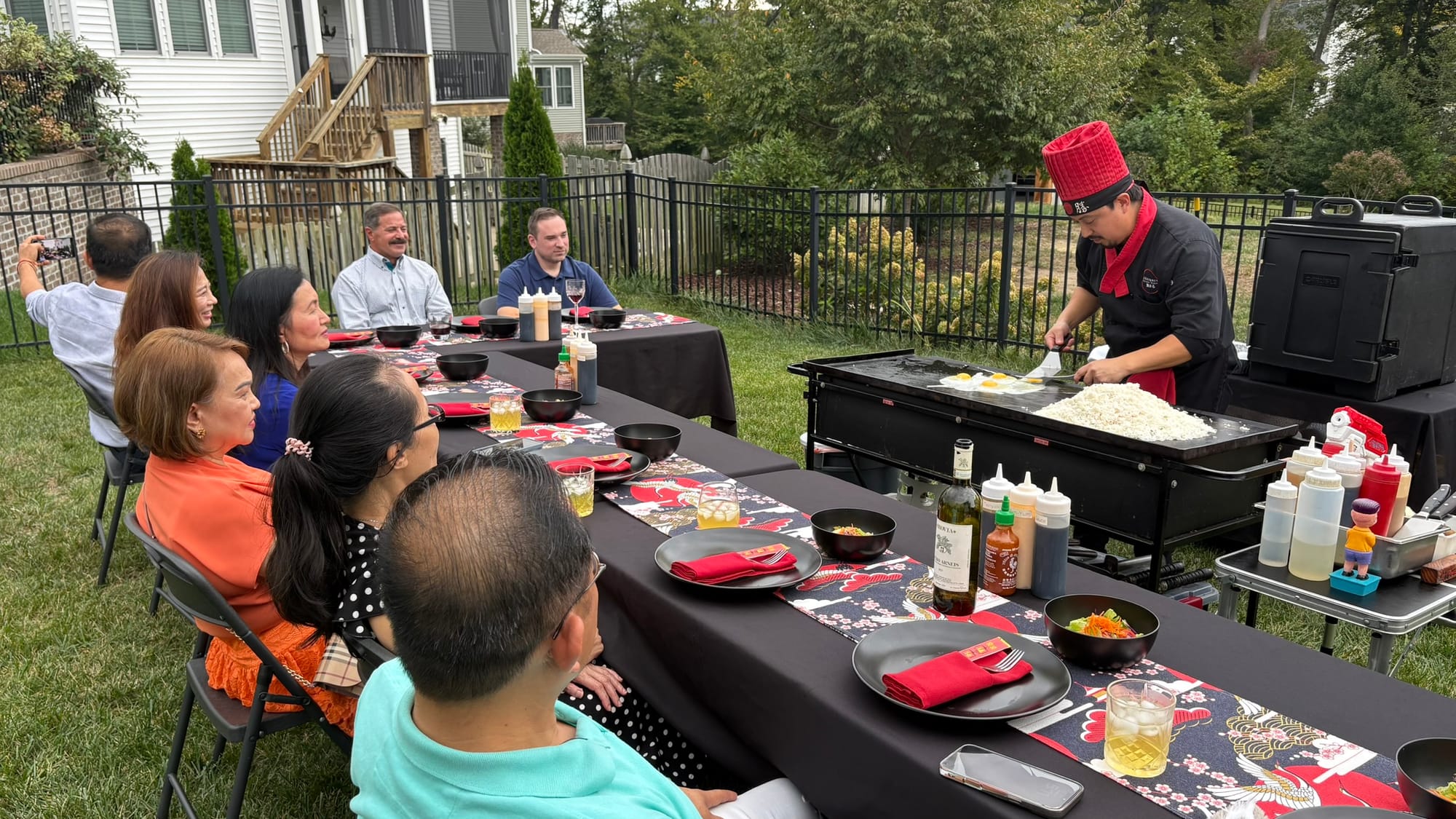
As much as he can, Garcia indulges requests. Sometimes though, as at Bowen’s house, diners prefer to sit quietly, demurely shaking their heads “no” when Garcia offers to shoot sake into their mouths from a squeeze bottle. The only taker was Gerard Shaia, who after the party said he’s now thinking of his backyard as a potential hibachi venue. “When you sit around with friends, you can’t go wrong,” he concluded.
Bowen agreed. “This is nice, because after we eat, we can just hang out: You want to have friends over, but you don’t want to do the cooking.”
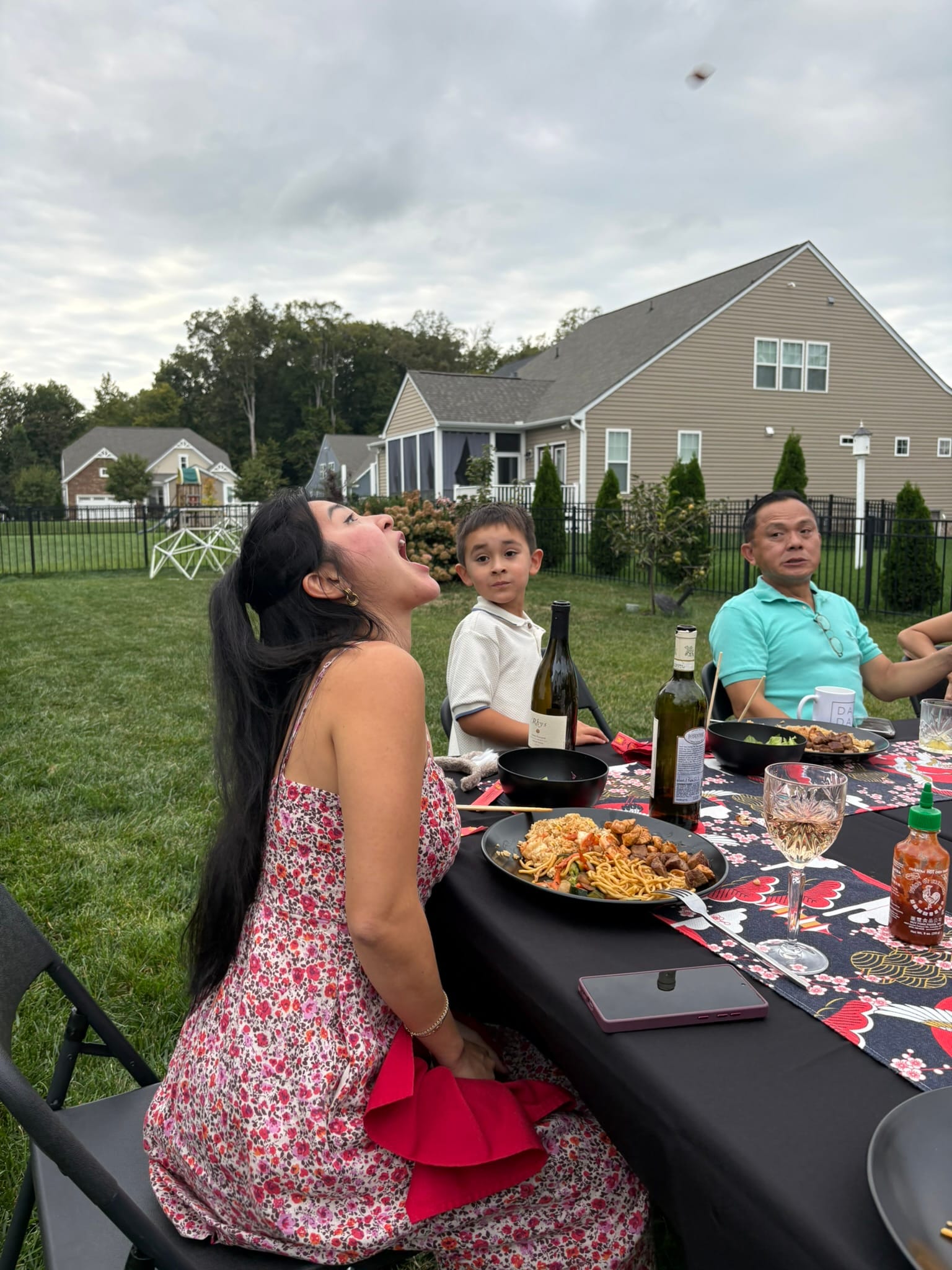
Of course, Garcia isn’t just cooking. He’s slicing, dicing, and tossing stray shrimp to the crowd. Unlike at a hibachi restaurant, when at-home diners fail to snag food launched toward them, the missed catch often goes to the family dog. Bento, Bowen’s Havapoo, didn’t respond to interview questions, but seemed happy with the setup.
Even though the typical private hibachi customer is wealthier than someone whose entire Japanese steakhouse investment is the $23 that Kabuto Japanese House of Steaks charges for a teriyaki chicken dinner, Garcia’s patter is still pointedly middle-class. “This is Japanese Chick-fil-A sauce!”; “This gas is from Wawa!”; “These vegetables are from Walmart!” he teases as he introduces each item.
In Garcia’s spiel, soy sauce is “Richmond water! Brown and salty!”
Nobody joked back.
“We need to give him a hard time!” Bowen told her friends and relatives. “Don’t be so easy on him!”
While cleaning up, Garcia characterized Bowen’s group as uncommonly staid. “A lot of times it has to do with different cultures,” he said. “Every group is different. Everyone has fun in their own way.”
In other words, perhaps at-home hibachi isn’t the same as what unfolds in a restaurant. But from a pluralist perspective, it’s hard to find fault with a Mexican chef serving quasi-Japanese food to guests of Vietnamese ancestry. And in the wake of the pandemic, it’s entirely possible that backyard teppanyaki doesn’t represent a retreat from shared dining spaces so much as a ginger step back toward them.
Hanna Raskin is founder of The Food Section. Follow her on Instagram, LinkedIn, or BlueSky.