Contentious meeting ends with approval for Shockoe Valley street plan
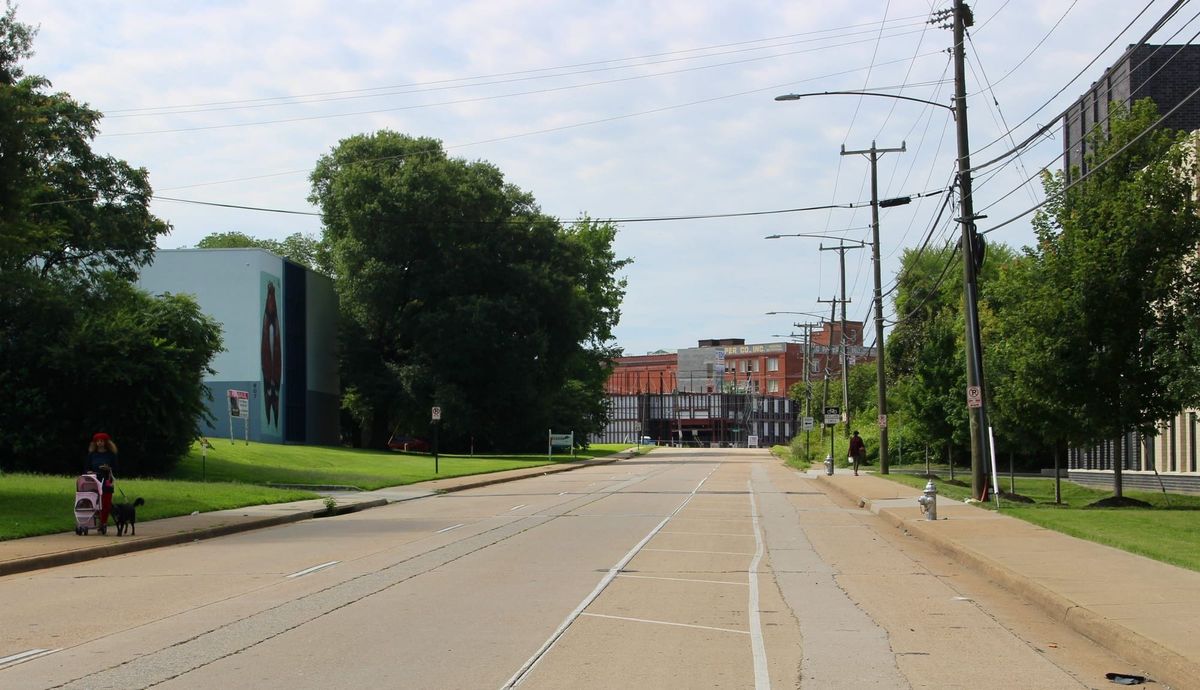
A more than $50 million set of improvements to streets in and around Shockoe Valley got the approval of Richmond’s Planning Commission Tuesday, clearing a path for the city to begin acquiring the right of way it needs for the project to move forward.
Quoting the adage, “Don’t let the perfect be the enemy of the good” — a phrase used by several people during a three-and-a-half-hour meeting on the proposal — Commissioner Victor McKenzie concluded, “I think this is a good project.”
“We’ve seen the team at multiple points be willing to bend and adjust and accommodate, and I believe that will be the case going forward,” he said.
Commissioner Rebecca Rowe too said she believed that “these improvements long-term will bring up the whole area.”
But, she continued, the nearly 10 years of project development and seven years that have stretched between the Planning Commission’s review of a conceptual version of the plan and Tuesday’s final review had posed unusual challenges.
“It’s not the same project. It’s not the same budget. It’s not the same anything,” she said. “I will support this project, but I feel held hostage in a lot of ways, and I resent that.”
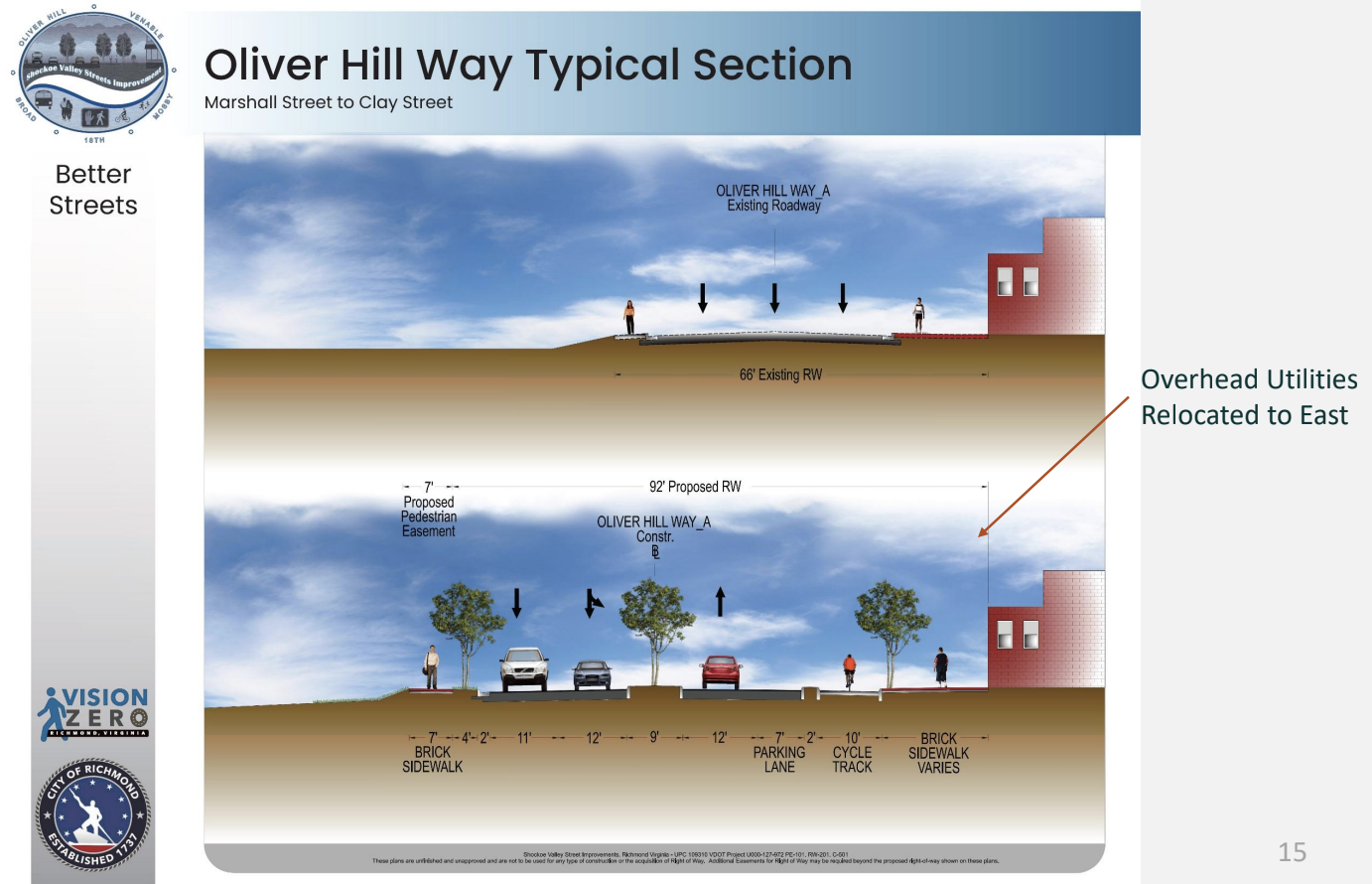
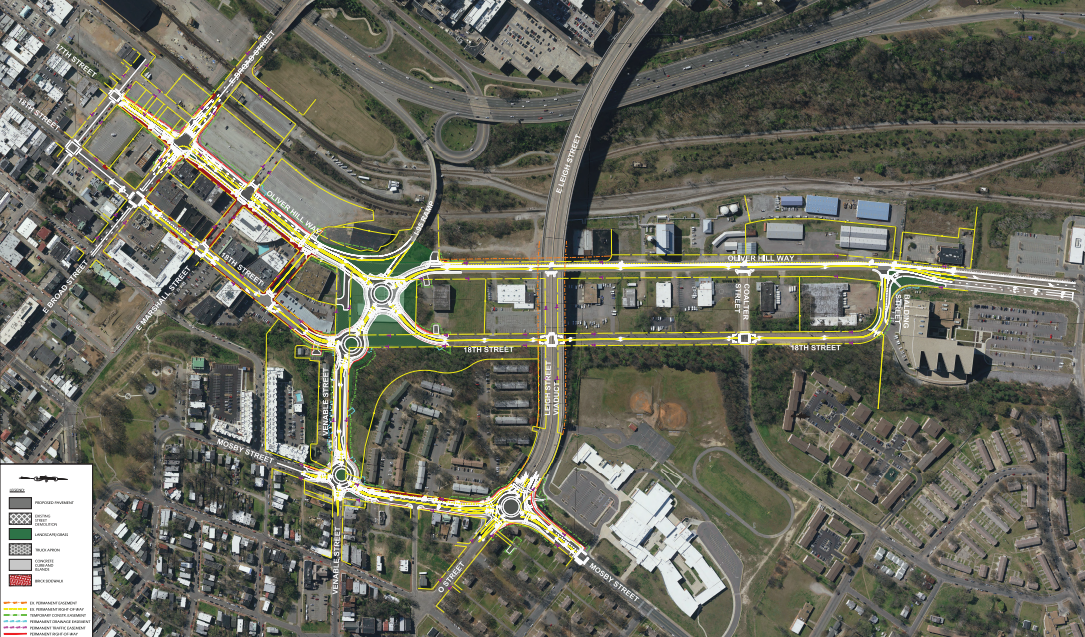
Through the Shockoe Valley Streets Improvement Project, Richmond’s Department of Public Works will convert North 18th Street and Oliver Hill Way to two-way arteries and add four new roundabouts at Oliver Hill Way and Venable Street, North 18th and Venable streets, Mosby and Venable streets and Leigh and Mosby streets.
Bike lanes — including two-way cycle tracks along some corridors — as well as new sidewalks will be constructed, and street trees, lighting, signage and public art will be incorporated throughout the project area.
Two of the new roundabouts are intended to improve the flow of traffic exiting Interstate 95, which currently has a short merge into Oliver Hill Way before being routed onto East Broad Street.
Under the new plan, drivers will be able to either continue onto Oliver Hill Way or enter the roundabout to access the Union Hill and Church Hill neighborhoods via Venable Street.
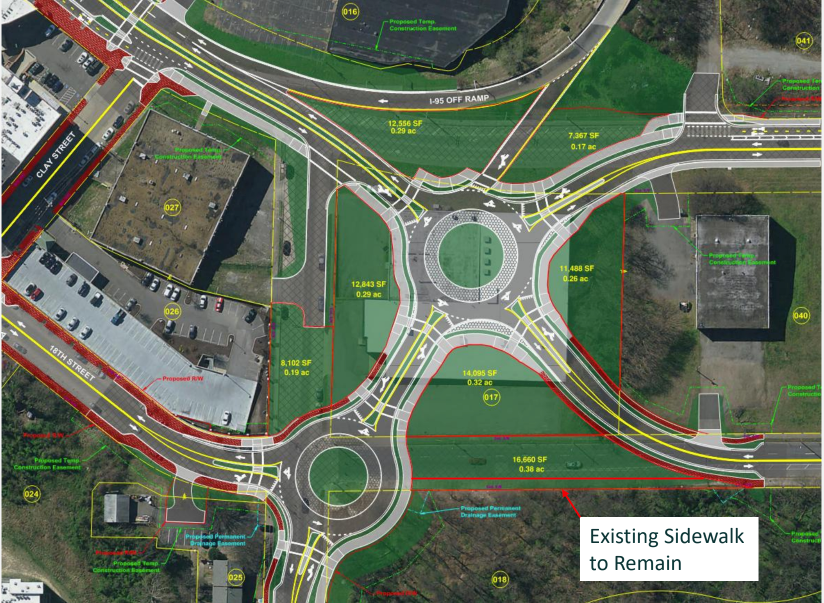
To accommodate the new traffic circles at Oliver Hill Way and Venable Street and at North 18th and Venable streets, the city intends to acquire a formerly industrial lot in Shockoe Valley. Richmond will also need to acquire right of way throughout other parts of the project footprint, which DPW officials have estimated will take roughly two years.
Supporters turned out Tuesday to praise the plans, which they said would improve traffic safety, offer much-needed bike and pedestrian infrastructure and significantly spruce up the look of an area that DPW Director Bobby Vincent described as “a concrete wasteland.”
“It’s essential to not lose this opportunity to create a huge part of the network in this part of town that doesn’t have much,” said Brantley Tyndall, director of Bike Walk RVA, who urged approval of the plan even while he suggested that further improvements could be made.
Chad Sanders, executive director of RVA Rapid Transit, called the project “a direct step towards more people-centered development here in Richmond” and said it would help the city meet its Vision Zero goals of eliminating traffic fatalities and severe injuries.
“When we make the environment more inviting to people on foot, we can unlock the true social and economic potential of our city,” he said.
And Jewel Trent, a young member of the Just C organization that operates a community center near the intersection of Mosby and Venable streets, said the addition of a roundabout at that crossing would significantly improve safety.
Right now, she told the Planning Commission, “me and my peers are forced to dodge cars at times because of the current traffic situation.”
A complex plan
Despite the turnout in favor of the plan, the Shockoe Valley project has had a bumpy path to approval, and it was not clear for long stretches of Tuesday’s meeting whether it could get the endorsement it needed from the Planning Commission.
Critics, which have included the city’s Urban Design Committee, Historic Richmond, the Shockoe Partnership, the Church Hill Association and the Partnership for Smarter Growth, have uniformly backed a large portion of the improvements, particularly the addition of bike and pedestrian infrastructure and the conversion of Oliver Hill Way and North 18th Street into two-way roads.
But they also argued other aspects of the project are flawed and in need of major revisions.
Concerns have varied between groups. Some have worried the plan will convert too much potentially developable land to roadways in an area already constrained by the floodplain but beginning to see residential growth. Others have criticized the addition of an extra right turning lane off Oliver Hill Way onto East Broad Street, questioned whether the roundabouts being constructed are too large and asked why the city is putting forward a design that doesn’t follow its stated goal of restoring the historic street grid in places where it has vanished.
“It is clear that the primary motivation for this plan is to move cars expeditiously off [Interstate] 95N and up to the Leigh Street Viaduct,” Spencer Grice, head of the Shockoe Partnership, wrote in comments to the Planning Commission.
“A lot of this — and I think in the dimensions you see it — is about moving cars,” said Stewart Schwartz, speaking on behalf of the Church Hill Association.
The Department of Public Works and its consultants from RK&K Engineers and VHB vigorously contested many of the criticisms.
“This is a pedestrian and bike multimodal-oriented project,” insisted Chris Daily, a traffic engineer on the consulting team, in one lengthy rebuttal during which he called various arguments “factually incorrect.”
Among the biggest concerns were those flagged by Planning Department staff and the Urban Design Committee, both of which recommended the project be denied in its current form.
 Sarah Vogelsong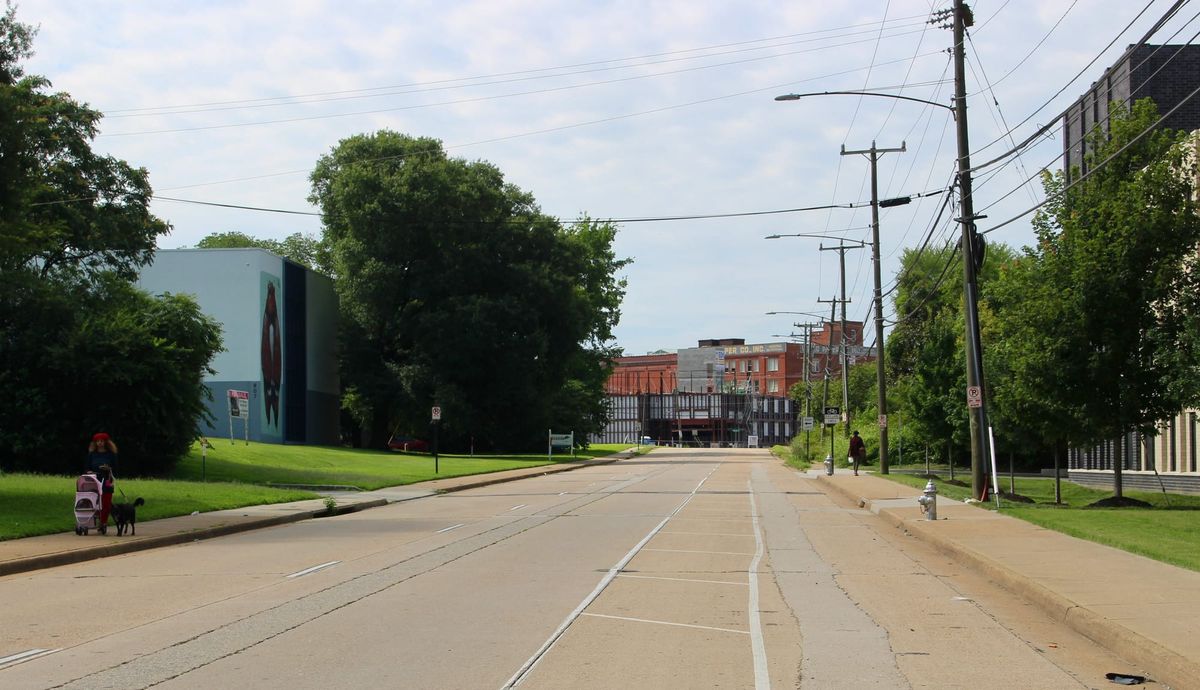
For Planning staff, the key concern was the configuration of the two traffic circles around Oliver Hill Way and North 18th Street, which planners said would produce too much “residual” land that couldn’t be easily used by the public. That worry was echoed by the UDC, which also objected to the inclusion of a dedicated turning lane for vehicles off the Leigh Street Viaduct onto Mosby Street, which some members said runs counter to traffic-calming efforts.
Public Works has contested both conclusions. DPW Deputy Director M.S. Khara and Daily have said that the turning lane is needed to keep cars from stacking up along Mosby Street and that neither roundabout can reasonably be shifted if they are to effectively slow down cars exiting the interstate.
“We’re the engineers. We have determined that that just can’t work,” said Daily at one point, while Khara argued that the operational needs of the roundabout design should trump the Planning Department’s concerns about the residual land produced by the roundabout.
“Let’s not have green space drive this rather than the roundabout drive the green space,” he said.
Exactly what the administration’s stance on the project was became a significant point of confusion during the meeting after Sharon Ebert, who serves as Richmond’s deputy chief administrative officer for economic and community development and sits on the Planning Commission, offered a firm endorsement of the plan.
“There’s more positives than negatives,” she said. “Is it perfect? No. But we are getting two lanes on Oliver Hill Way and two lanes on 18th Street. We are getting safe bicyclist paths. We are getting better sidewalks. We are getting trees. We’re getting medians so people have a place to have refuge.”
City Councilor Ellen Robertson (6th District), who also serves on the Planning Commission, questioned how it was possible that Ebert was in favor of the project when staff with the Planning Department, which she oversees, were recommending denial.
“Who is who in the city of Richmond that is making this decision?” Robertson asked.
Leo Mantey, senior deputy director of the Planning Department, sought several times to clarify the stance of his department, indicating that while planners had concerns with the layout of the traffic circles off Oliver Hill Way, they acknowledged engineering constraints could limit the fixes that were possible.
The recommendation for denial was simply a recommendation, he said: “I don’t want that to be a stigma on us. … If there’s any physical constraints on site that will not allow us to do that, I don’t think we should be opposed.”
“How do we get to the point then that this comes before the Planning Commission where staff is saying we’re not recommending denial but we’re not recommending approval?” a visibly confused Rowe asked.
Mantey replied that Planning staff “still have to do our due diligence and let you know that [the department] took a very critical look at it, and this is our recommendation.”
‘Progress the project forward without additional delay’
Ultimately the Planning Commission decided that the project benefits outweighed any concerns raised by city staff, the Urban Design Committee or other groups and greenlit the plan.
“There is such a wonderful opportunity and such a sensitive and valued history in this neighborhood that has been disinvested in a huge way,” said Robertson, who along with City Council President Cynthia Newbille represents the project area. “Knowing Mr. Khara, knowing the staff that we have and their dedication and their willingness to continually go back to the table and come back with additional options to be responsive to the people’s interests and concerns — I’m confident that they will continue to do that.”
Only one commissioner, Chair Rodney Poole, voted against the plan.
“I read the English language pretty literally, and the professional staff said they were opposed or wanted to deny, and our commission that advises us on these issues said they urge denial. … I want to take their recommendation,” he said.
While the Planning Commission’s decision was based on its assessment of the appropriateness of the project’s “location, character and extent” — criteria laid out in the city code — it was clear that for at least some members, the potential loss of funding that could result from further delays was a factor.
Begun a decade ago, the Shockoe Valley project’s timeline has extended far beyond what was initially envisioned, and its price tag has ballooned. Officials have said much of the holdup has been due to extensive archaeological and cultural reviews required by federal law because of the number of historically significant sites in and around the project footprint.
When the conceptual plans came before the Urban Design Committee and Planning Commission in 2019, the cost was estimated at around $28 million. Figures presented by DPW Tuesday put the price at about $50 million in 2025; a project dashboard operated by the Virginia Department of Transportation estimates it at over $54 million.
Most of that funding has been secured: Richmond received $33 million for the project through the state’s Smart Scale program, and the Central Virginia Transportation Authority has also committed to putting up $14 million.
At both the UDC meeting last month and the Planning Commission this week, Khara warned officials that the Smart Scale funding is at risk if the project is delayed and told them Public Works had received a “notice” to that effect.
City spokesperson Jensen Gavulic told The Richmonder communications staff have been “unable to identify what was being referenced” during the July meeting.
Two hours before Tuesday’s meeting, however, VDOT sent an email to Public Works in response to a request from city staff that Gavulic said was “in preparation for their presentation with Planning Commission to have a full and accurate understanding of the project.”
Noting the delays that had already occurred, Larry Hagin, a director with VDOT’s Richmond district, wrote that “depending on the outcomes of the pending decisions and considerations before the Planning Commission and/or City Council, VDOT is prepared to make a recommendation to the [Commonwealth Transportation Board] regarding the continued advancement of this project, including potential de-allocation and repayment of expended funds.
“We encourage the City to progress the project forward without additional delay,” he concluded.
Funding increases aren’t the only complication the delays have posed. Many commissioners expressed confusion Tuesday about how they were supposed to proceed given that the conceptual plans had been approved in 2019; since then, much of the body’s composition has changed and the city has adopted a new master plan to guide land use and other decisions.
“We haven’t seen this project in seven years, and to just say outright, ‘Let’s do it,’ I think that’s a very hard line for us to do, given all the changes that have happened along those seven years,” said Commissioner Dakia Knight.
Still, said Commissioner Burt Pinnock at one point, “it seems to me kind of challenging to pull it back.”
Contact Reporter Sarah Vogelsong at svogelsong@richmonder.org