Urban Design Committee recommends denial of Shockoe Valley road revamps
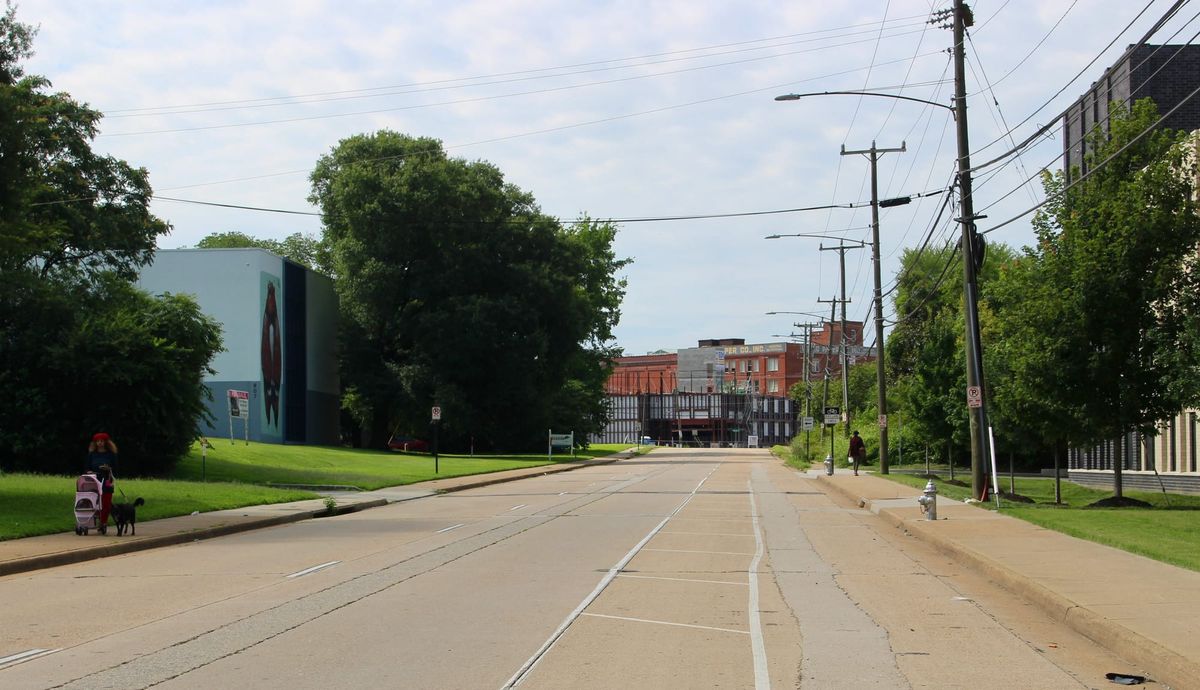
Richmond’s Urban Design Committee has recommended that a major revamp of streets in and around Shockoe Valley be denied in hopes that city officials will revise the plan to address concerns about pedestrian safety at a roundabout near Martin Luther King Jr. Middle School and the use of public space off Oliver Hill Way.
“I would not want to go on record saying I approve of this as it is, whether or not it's overruled by the Planning Commission,” said UDC member Erik Bootsma. “I would want my objection to be known.”
Throughout a more than two-hour discussion at its July 16 meeting, members of the committee, public and Planning Department staff made it clear that they believed much of the final plan for the Shockoe Valley Streets Improvement Project put forward by Richmond’s Department of Public Works and its consultant, RK&K Engineers, was a big step up from what currently exists.
“99% of this project, we are ecstatic to see. It is a vast improvement,” said Ray Roakes, a city planner and secretary for the UDC. “We’re taking an industrial neighborhood that's getting a lot of residential development and making it actually a much more livable and safe space to exist in.”
Under the almost $50 million plan, which has secured over $33 million in state Smart Scale funding, both North 18th Street and Oliver Hill Way would be converted to two-way roads from the one-way arteries they currently are. Four new roundabouts would be constructed at Oliver Hill Way and Venable Street, North 18th and Venable streets, Mosby and Venable streets and Leigh and Mosby streets. Bike and pedestrian infrastructure would be built throughout the network, and street trees and new lighting would be installed.
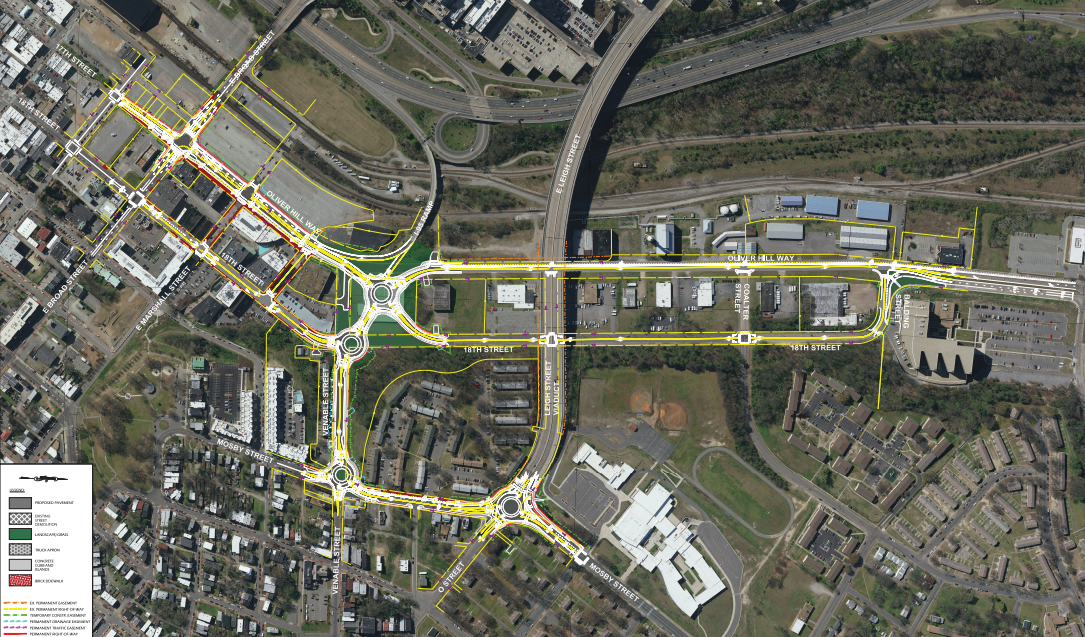
The improvements have drawn praise from groups including the National Association of City Transportation Officials, Bike Walk RVA, the Children’s Hospital of Richmond at VCU and RVA Rapid Transit, which in 2024 wrote letters of support in their favor.
If the project “was just simply a matter of improving public safety and traffic flow and all those things, it’s marvelous,” said Bootsma.
But on two issues, there were serious qualms.
The first concerns the conversion of roughly a city block worth of land for the roundabout at Oliver Hill Way and Venable Street that would give local drivers or those exiting Interstate 95 easier access to the Union Hill, Mosby and Church Hill neighborhoods. The construction of the traffic circle, which would sit on a formerly industrial lot the city intends to take using eminent domain, would result in a patchwork of “residual” green space. Another roundabout would be sited immediately adjacent to the primary circle, at North 18th and Venable streets.
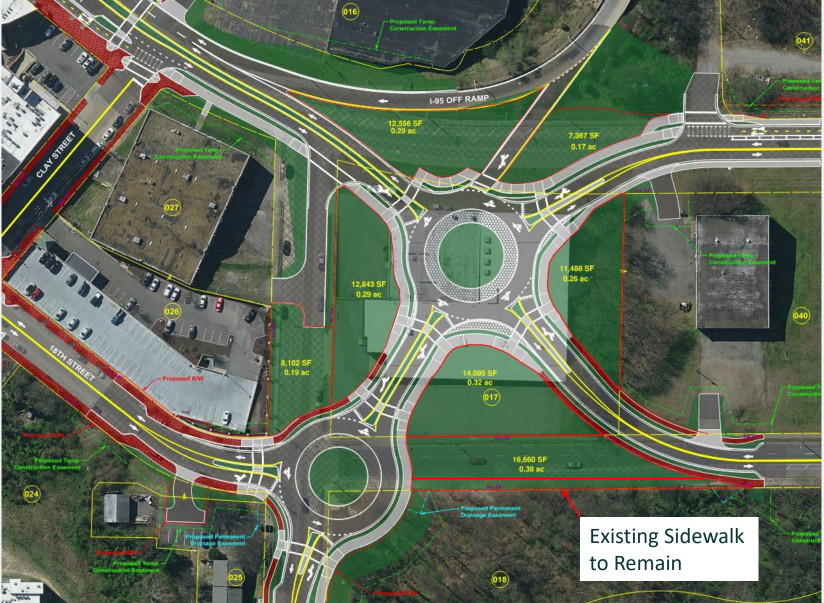
Owen Peery, RK&K’s transportation director, said engineers “don’t know yet” how the land around the Oliver Hill circle would be used, although he added, “We are working with staff on that to resolve what those spaces become.”
The issue was flagged by the UDC and Planning Commission at a review seven years ago, when they directed Public Works to do a study of the residual land.
Both Planning Department staff and UDC members remained unhappy this July with the amount of leftover space the new roundabout would produce, recommending that the design be reexamined.
“The remaining areas would be very difficult to use for anything other than a green space area, and even then, still very difficult to access green space,” said Roakes.
UDC member Eva Clarke noted that the traffic circle would be the first thing drivers exiting Interstate 95 would encounter in the city.
“You’re in a roundabout with green space that’s nothing really,” she said. “It could be a beautiful thing, but it could end up just being weed lots.”
DPW Deputy Director M.S. Khara told the committee that the department agreed the residual space needed to be put to “the highest and best use” and said a separate initiative could determine what that was. But he discouraged any relocation of the roundabout, whose configuration RK&K Transportation Director Owen Peery said was the result of both engineering constraints and an effort to impact as few privately owned parcels of land as possible.
“With the grades and everything that’s going on in that area, we feel like we have the correct solution, even though the individual land maybe is not what you would like,” said Peery, who told the committee engineers had “looked at 18 other options probably.”
A 2019 white paper by RK&K included in a review of plans at the time assessed four of those possible configurations.
In one exchange about the layout, UDC member Amelia Wehunt told the body, “I don’t think it’s right to push them into buying more parcels and taking more property.”
“I don’t know that the recommendations, the ways to change the design, though, are possible without taking more private property,” she continued.
But Bootsma said he wasn’t “sure that that’s necessarily true without having seen alternatives.”
Leigh and Mosby roundabout
Plans for the roundabout at the intersection of Mosby Street and the Leigh Street Viaduct also caused unhappiness among numerous UDC members, who said that the inclusion of a bypass lane for traffic turning right from the viaduct onto Mosby Street would allow unsafe speeds that put pedestrians at risk.
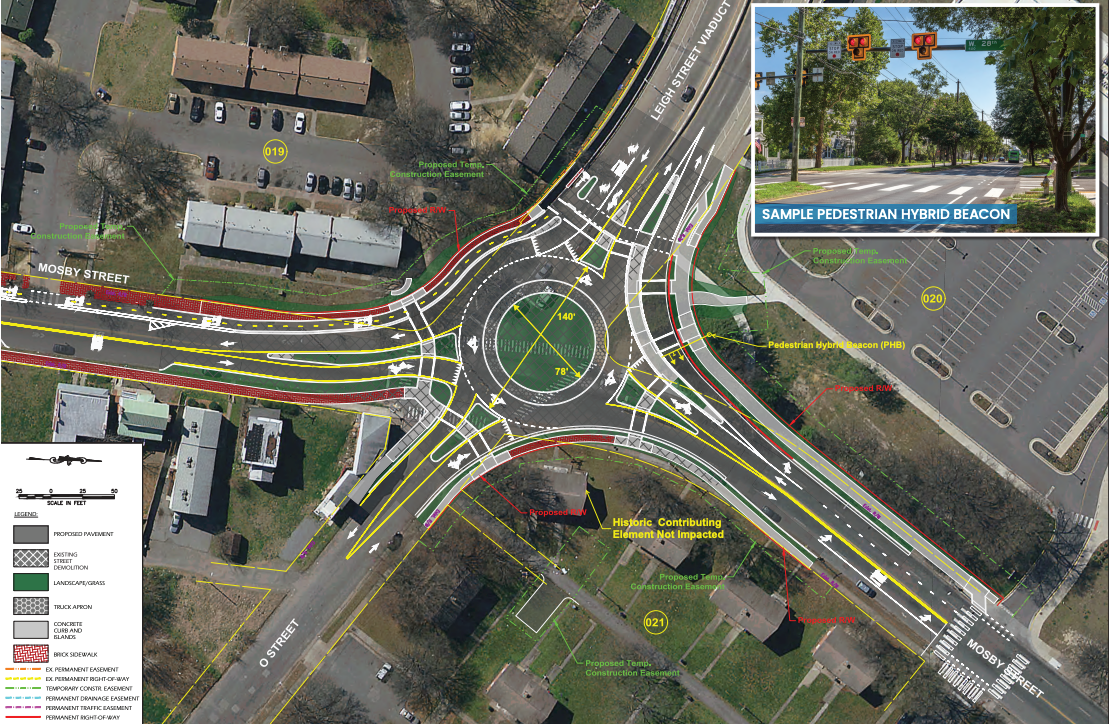
“If we’re supposed to be prioritizing pedestrians and other means of transit over cars, why is there a bypass lane?” asked member Keith Van Inwegen.
Chris Daily, a traffic engineer with RK&K, said the plans had sought to produce “a balance of all the modes” of transportation.
“We still need to get vehicles through this intersection,” he said. “It’s a busy intersection.”
Daily told the committee that traffic modeling had shown that without the bypass lane, cars would stack up several blocks to the north of the intersection along Mosby Street, making it less safe for pedestrians to cross along that stretch. And he and colleague David Beale said the design of the road would force cars to slow down even within the bypass lane.
“This notion that this is a speedway is incorrect,” said Daily.
UDC members remained skeptical, however. Slowing cars down along Mosby could make it safer for pedestrians, several averred, while Timothy Hamnett called the way the roundabout routes pedestrians and bicyclists “really disjointed” and said it “asks for people to move in ways and bicycles to move in ways that they don’t.”
Others objected to engineers’ statement that cars in the roundabout would yield to pedestrians in crosswalks.
“I've lived here my whole life. Nobody stops for pedestrians unless the car in front of you does, or an out-of-towner is doing it,” said Jessie Gemmer. “It's just a really bad habit the city has.”
While the majority of debate at the July 16 meeting focused on concerns about the two roundabouts, other issues also arose. Gemmer said the project was missing “human-scale design thinking.” Cyane Crump, executive director of Historic Richmond, argued that the roundabout-heavy design and the widening of Oliver Hill Way “extend the highway into the city, create a sinuous suburban-style road in place of the historic rectilinear grid and gives large amounts of land over to the automobile.” And Emily Schreer of Bike Walk RVA praised the overall project but asked for an evaluation of some of the bike infrastructure, including a two-way bike track envisioned on Mosby Street.
A long timeline
The seeds of the Shockoe Valley project date back to a 2013 state interstate study that suggested the one-way North 18th Street and Oliver Hill Way be converted into two-way roads and a series of roundabouts be built throughout the area.
Other transportation problems have long been evident. Drivers have complained about the poor condition of North 18th and Oliver Hill Way, and their long, straight stretches have encouraged speeding. Bicyclist and pedestrian infrastructure is lacking. One crossing at the intersection of the Leigh Street Viaduct and Mosby Street, which borders both MLK Middle and Mosby Court South, requires pedestrians to traverse 120 feet of road.
“The area where I come and go every day is extremely dangerous,” said Craig Martin of Shockoe Records. “So anything we can do to improve that, both for pedestrians and also for cyclists, is important to me.”
In 2019, a conceptual plan for the improvements by the Department of Public Works got the blessing of both the UDC and the Planning Commission, which has the ultimate say on whether the “location, character and extent” of public projects are appropriate.
But the long gap between that approval and the bringing of the final plans to the UDC appears to have complicated the process.
“Plans were made six years ago, reviewed here six years ago,” said Bootsma. “The situation has changed, personalities have changed. The opinions of people in the city, I think, have changed.”
Still, some members of the committee worried about the implications of recommending a denial so late in the game.
“Going back to undo something that was approved conceptually without conditions — those two roundabouts — I think is bad governance,” said Van Inwegen, who ended up casting the sole vote against the denial recommendation.
Khara of the Department of Public Works attributed the delays to archaeological and environmental studies the city has been required to do.
Throughout the July hearing, he urged the UDC to move the project forward, saying it was “at a very critical stage” and indicating some funding could be at risk.
“Is there a chance that if they lose the funding, this project just doesn’t happen?” Gemmer asked at one point.
“Yes,” Roakes replied.
“I can say this project has changed over the years from the original Smart Scale application, so it is possible to change,” he continued. “But we've already changed it so much, it's going to start becoming somewhat embarrassing if we continue to change it. So that’s not ideal. But our job is not to deal with the intricacies of the funding. ... Our job is to decide: Is this good from the master plan?”
Jensen Gavulic, a spokesperson for Richmond’s Department of Transportation, which is part of DPW, told The Richmonder the state had confirmed “there is not a specific SMART SCALE deadline requiring construction to begin by a certain date.”
However, she noted, “moving projects forward in a timely manner helps ensure these investments are delivered as planned and provide the intended benefits to the community.”
The project will now go to the Planning Commission, which will have the final say on its design.
Contact Reporter Sarah Vogelsong at svogelsong@richmonder.org