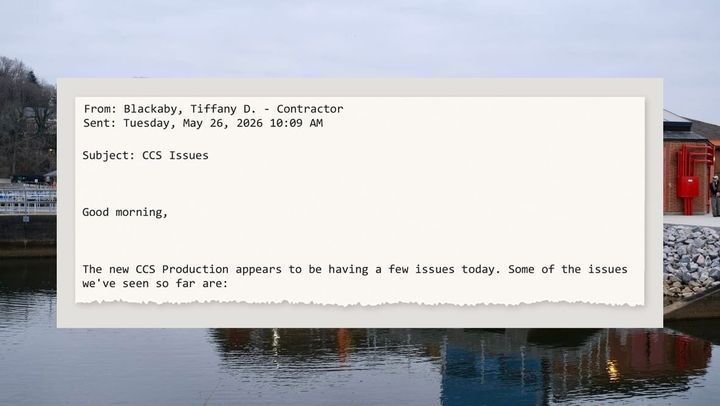
The Richmonder tried to dig deep on DPU billing issues. The city sent a $14.7K FOIA bill
As thousands of city residents were having trouble with utility bills this summer, The Richmonder filed a public records request to try to find out what went wrong with a planned overhaul of the customer account system that generates monthly bills.
The city said the information would cost $14,784. If the fee was paid, officials warned, it would probably only lead to “highly redacted” documents.
The Freedom of Information Act request was broad, seeking emails between the Department of Public Utilities and two prominent IT vendors, Oracle and KUBRA, about the billing system project over roughly three months.
The date range for the request was May through Aug. 5, a window that covered the immediate run up to DPU’s “Project Synergy” system transition and the time when residents were having the most problems with bills.
According to the city’s FOIA office, more than 10,000 emails fell within that scope. Reviewing them for public release, the city said, would cost $44.80 per hour.
Public bodies are allowed to charge for time spent processing FOIA requests, but it’s not required.
Efforts to narrow the FOIA request cut the bill some, but not much.
Limiting it only to DPU officials with “director” in their job title lowered the cost to $8,960 for around 6,000 emails, the city said.
Cutting out the entire month of May only dropped the cost to $7,884.
 Graham Moomaw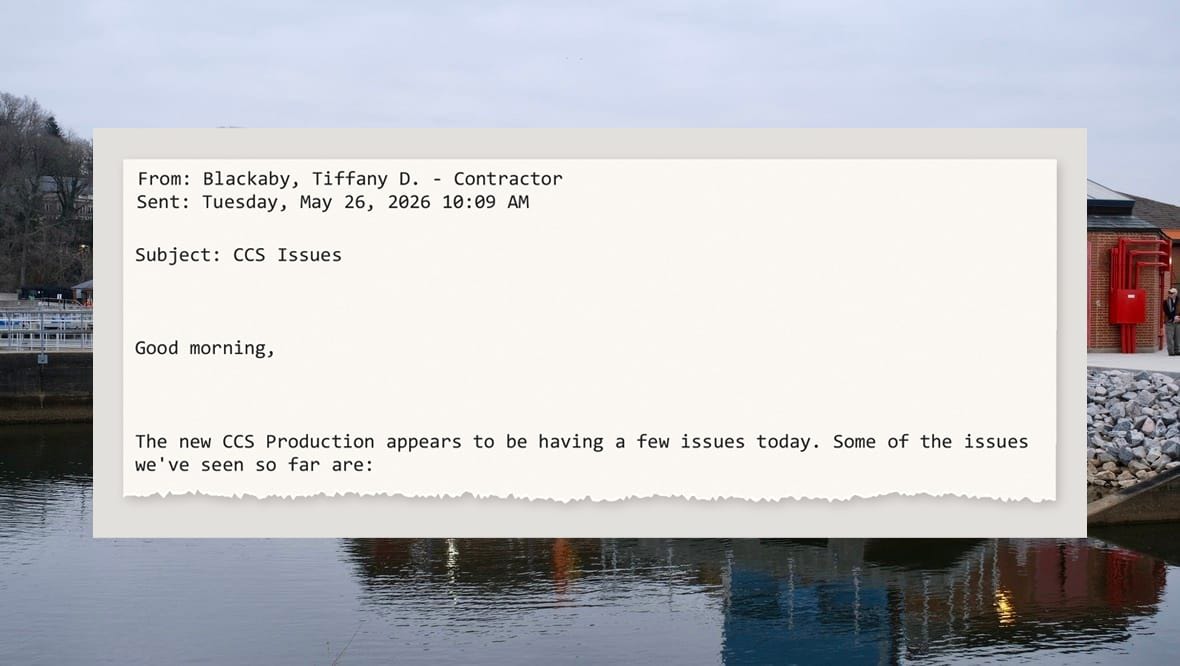
The Richmonder asked if emails were being counted several times because they might be duplicated across multiple inboxes and repeated with each new reply to an email thread.
Duplicates are a common issue that can drive up costs for FOIA requests involving emails. Officials can reduce processing times by de-duplicating records, allowing each email to only be reviewed once.
The city said “clearly identifiable” duplicates had been excluded from the count, but there could be more.
Asked if there was a way to weed out routine troubleshooting messages, the city said it had to go through each individual email. The counts represented “actual emails,” the FOIA office said, not “system generated notifications.”
Reducing the scope to only the week of the new system’s launch in late May and early June had a more dramatic cost impact.
The final estimate was $585, based on 392 emails. That worked out to about $1.50 per email.
After the fee was paid, the city released 635 pages filled with duplicate copies of the same emails. One email from the morning of May 26 flagging “a few issues” with the new system shows up 21 times.
A significant portion of the records were automated Oracle error messages that were filling inboxes as DPU’s systems malfunctioned. The phrase “This is an automated mail. Do not reply to this message” appears on nearly a third of the pages the city released. Those emails came from the same sender, “OIC Mail Service,” and had the same subject line saying an error had occurred.
An AI-assisted review of the 635-page document indicates most of the emails were automated error notifications, with somewhere around 150 messages written by humans.
The city also overestimated the cost, guessing it would take 13 hours to review 392 emails. The actual time was nine hours, officials said, which means the city owes a 30% refund of nearly $180.
It’s unclear if the original estimate of nearly $15,000 was similarly inflated.
Ross Catrow, the city’s communications director, said he couldn’t answer specific questions this week about how the FOIA request was processed, because the DPU employee who handled it was out of the office.
“Generally, the City’s FOIA Officers try to balance de-duplicating responsive records, keeping review costs down, and ensuring all unique responsive records are produced,” Catrow said in an email.
Catrow said he could not say if DPU attempted to de-duplicate the emails before giving the first cost estimate, and could not describe any steps taken to identify and exclude auto-generated error messages.
The city didn’t use an email de-duplication feature included in its new FOIA software, JustFOIA, Catrow said. The software company advertises that feature as a way to avoid “reviewing the same emails multiple times.”
“Just four months in, the City’s FOIA Officers are still getting comfortable with the platform. We will definitely look into this feature to see if it can help us improve both the efficiency in how we handle requests and the costs of those requests to residents,” Catrow said.
During the process, The Richmonder asked if the city would consider waiving the charges due to the high public interest in the DPU billing issue. The city didn’t grant that request.
At a press conference about the DPU billing problems this month, Mayor Danny Avula stood by the decision to charge for the records. He said his team is continually trying to improve the FOIA process and work with the media to make requests manageable.
“We’re not trying to make money off of it,” Avula said. “We don’t want to have to charge you for it. But it does take a significant amount of time that ultimately we're accountable to the taxpayers for.”
Before the city gave the first cost estimate, the FOIA office indicated the requested records would be filled with sensitive or confidential information that would require extensive review. FOIA Officer Julia Holmes said the resulting emails would be “highly redacted to protect proprietary and/or confidential information.”
“The redactions would be taken to protect information that would jeopardize the safety or security of a government facility or operations,” Holmes wrote.
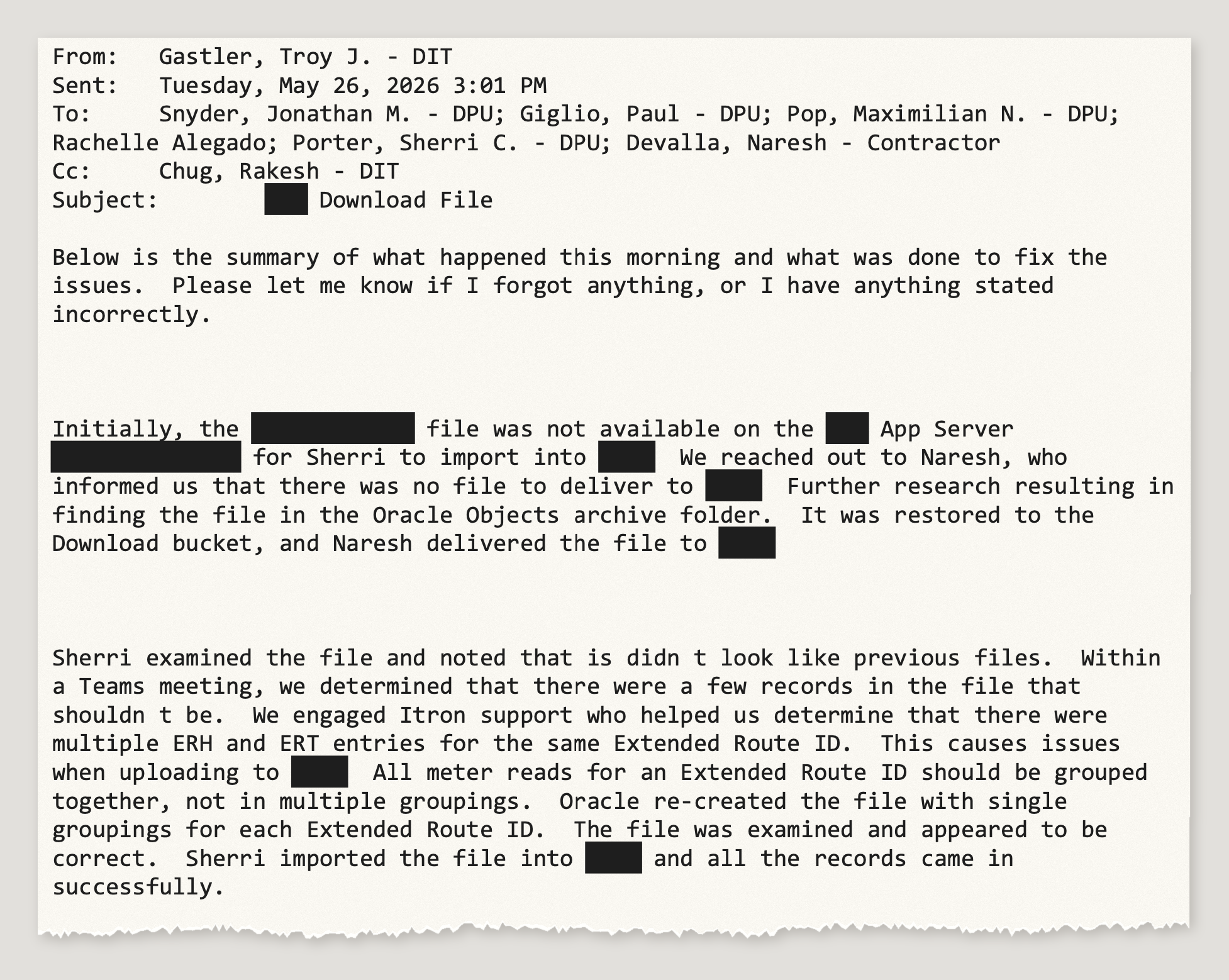
The smaller set of emails the city eventually released — about a month and a half after the request was filed Aug. 5 — had fairly light redactions.
During the nine-hour review, officials blacked out a few customer account numbers and relatively basic IT information like the names of servers, files and data formats, invoking a FOIA exemption related to “cybersecurity threats.”
That exemption covers “information not lawfully available to the public regarding specific cybersecurity threats or vulnerabilities.” The emails contained no discussion of cybersecurity threats.
Contact Reporter Graham Moomaw at gmoomaw@richmonder.org