Know your audits: Why some RPS watchers want more than the district is currently providing
Ever since Richmond Public Schools Superintendent Jason Kamras introduced his proposed budget for the upcoming 2027 fiscal year in January, there has been grumbling from school watchers about the division’s fiscal management.
Even the unveiling was rocky. The budget was adjusted at least three times before it even got to School Board feedback, causing critics to label the process as lacking transparency. The Richmond Times-Dispatch recently reported that senior salaries were removed from the division’s public pay schedule for the upcoming school year. And a recent investigation into Bobby Hathaway, former director of facilities, alleged that he misappropriated school funds.
Between January and July, public commenters told the Board that the budget needed a forensic audit nearly 20 times. City Councilor Kenya Gibson (3rd District) has sought budget language requiring an outside audit on the school’s budget.
But in response to those demands, school officials have said the division’s audits can be found online, showing that the schools are in good fiscal standing.
“Not only do I commit to it, we already do it,” Kamras told The Richmonder in February. “We get audited every single year by an independent accounting firm and the results are presented to the School Board and the public, and those are available on Board Docs for anyone who would like to see.”
But not all audits are created equal.
“We have been calling for a forensic audit to closely analyse and assess the mismanagement of funds,” said Roslyn Anderson, vice president of the Richmond Education Association, the union representing many RPS employees – to Board members at a July 7 meeting.
It begs the question, what is a forensic audit, and how does it differ from the other audits?
Financial statement audit
State law requires local governments, including school divisions, to go through a yearly financial statement audit, and the results are published in a document known as the Annual Comprehensive Financial Report. The audits are always performed by an external certified auditor and they review financial statements prepared by a school division that year, including balance sheets and income statements, to ensure that they are in accordance with accounting standards and are verifiable.
“The role of the auditor is to give an independent assurance that the numbers are right and are presented correctly,” said Chris Banta, a certified public account and fraud examiner with accounting firm Brown Edwards.
The most recent ACFR looks at the division’s budget for fiscal year 2025, a review conducted by Cherry Bekaert, a national accounting firm that frequently works with RPS. Lynn Bragga, the division’s director of budget and finance, presented the firm’s findings to the School Board in April, in the midst of the calls for a forensic audit, showing that the budget had a clean audit.
But it is important to note that the auditors do not conduct an in-depth review of financial decision-making for the ACFR.
Banta said that while not a goal of the audit, auditors will make note of any fraud or error if detected from the financial statements, which could cause an auditor to consider and review a school division’s internal control – internal processes or systems in place intended to detect or prevent fraud.
The forensic audit
A forensic audit is an investigation conducted into the financial records of a specific area, department or timeline within a school division, prompted by previous findings or concerns. This kind of audit is usually requested by School Boards, local, state, or federal governments or other oversight agencies. They are almost always conducted by an external auditor.
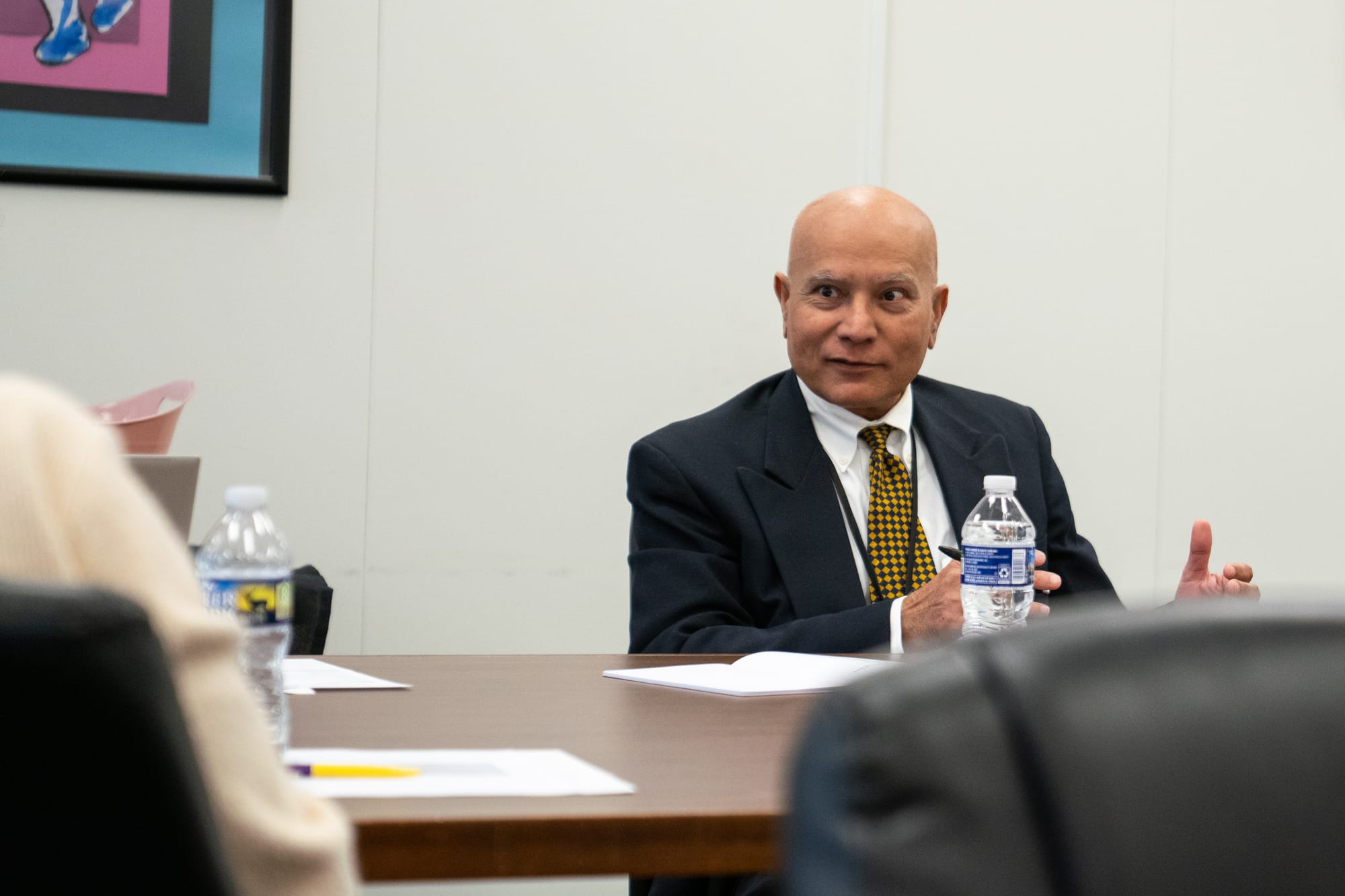
In a recent presentation to the RPS Finance and Audit Committee, recently hired Director of Internal Audit Ziauddin Ahmed told Board members that depending on the investigation’s scope, a forensic audit can last anywhere from 3 to 9 months, and costs can range between $100,000 to $300,000.
Ahmed presented four examples of forensic audits conducted in other school districts within the Eastern region of the country, two of which had audits in progress.
In Connecticut, the state commissioned a forensic audit on Bridgeport Public Schools’s budgets for fiscal years 2024 and 2025 after the division reported a roughly $39 million budget shortfall. Auditors found that the division simply manipulated the budget and misclassified funds by moving $16 million from the division’s retirement fund to pay salaries. That would’ve been deemed as fraud in Virginia, Ahmed noted, as it is illegal to do such in the state.
Another example in New York shows that the School Board for the Newburgh Enlarged City School District demanded the forensic audit into the district’s budget process and financial reporting for fiscal year 2023 and 2024. While the district reported a $16.4 million deficit, auditors found that the division actually had a surplus of that amount, concluding that the division had mismanaged and underutilized funds.
“Sometimes you’ll look at it and realize that nothing fraudulent has happened, we just had a misunderstanding or guidelines weren’t specific enough or outcomes weren’t defined the way they should’ve been,” said Michael Garber, another certified public auditor who co-leads the state and local government team at accounting firm PBMares.
A forensic audit into the school system’s full budget has never been done, but it was conducted on the division’s Career and Technical Center back in 2015. The city has also previously conducted audits on certain aspects of RPS, like payroll, transportation, training and workers’ compensation. The last time the city audited the division was in 2015.
Members of the School Board have previously signaled the need for an external set of eyes on the division’s operations and funding, especially once the calls for the forensic audit became louder.
“I do think going forward it would be helpful … to consider a comprehensive perhaps external analysis of our systems and our expenditures and get actually a really robust report on where perhaps we could find some efficiencies and even where we have gaps that could use more support,” said Stephanie Rizzi (5th District) in February. “I think it'll also help the public understand exactly how money is being spent and how they support our goals.”
Board Chair Shavonda Fernandez (9th District) at the time echoed Rizzi’s statement, saying that an external audit is something the division “should do.”
But since hiring Ahmed, the Board’s tone has shifted to putting the responsibility of finding areas to implement efficiencies onto the internal auditor.
In July, Rizzi said: “I do know that our auditor – Mr. Ahmed – has said that he will spend time combing through our budget and looking to see where some efficiencies can be made, so I look forward to that work, perhaps he will find something, perhaps there will be opportunities for us to trim in ways that don’t harm our students and their learning.”
Internal audits
Ahmed said in the meeting that the four example cases he presented were locations without an internal auditor, which he believes would help “root out the causes of the problem.”
The internal auditor, in the case of RPS, is hired by the School Board and reports directly to its members. As a result, the Board also dictates what areas the auditor should review. Garber said those reviews could vary, and include inspecting a certain type of transaction, department, or program to see if they’re functioning correctly.
Banta said that a good independent audit department operates outside of the departments they review, allowing them to remain independent.
In 2024, former RPS auditor Doug Graeff estimated that RPS paid bus drivers $1.8 million in overtime for after-school runs, including some payments that were more than time spent working. Graeff also found that some staff were not properly logging purchases made with the division’s procurement card, masking unauthorized expenses.
The new auditor is currently reviewing three areas as part of his audit plan for school years 2027 to 2029 – facilities maintenance, fleet maintenance, transportation logistics and schedule.
A review of the facilities department’s work order management has been completed and recommendations have been made, he told the Finance and Audit Committee. A report is expected to come out on that within the next month.
“The in-house (work order management) had a lot of gaps,” he said, adding that opportunities to address those gaps are being used to create a better system. The system that handles work orders that require outsourced maintenance, “in general, was good.”
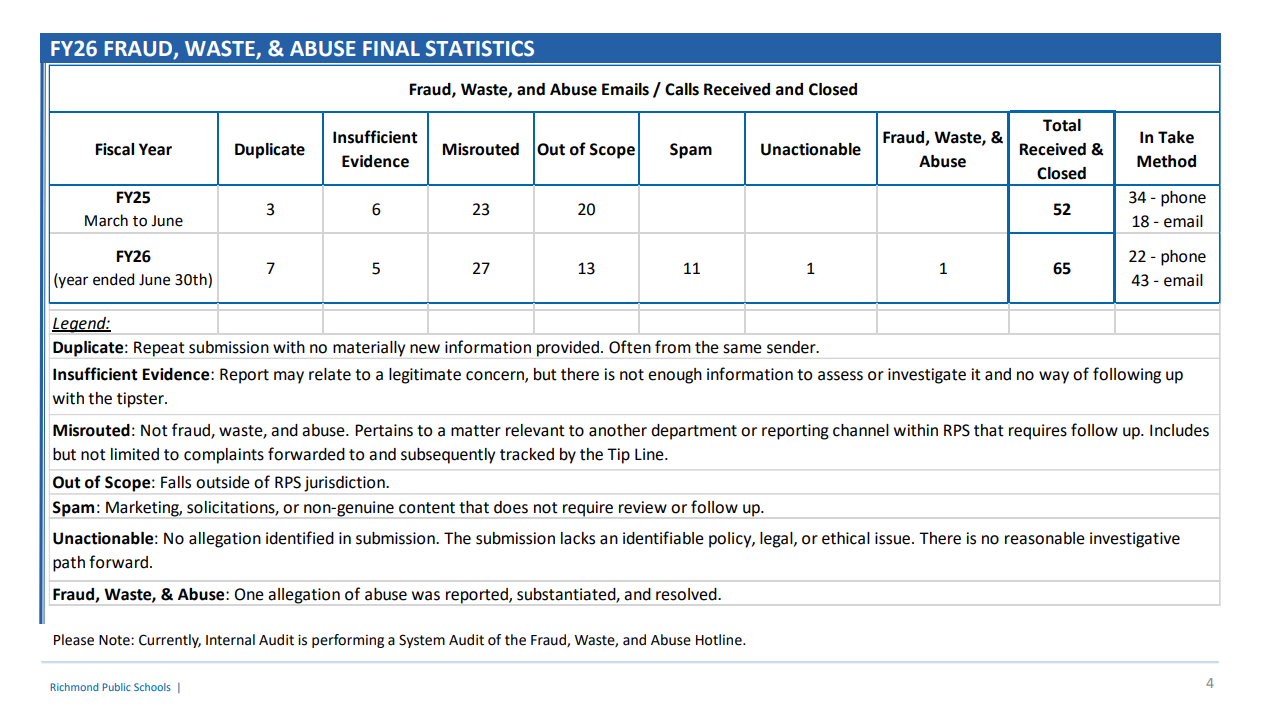
Ahmed is also in charge of the division’s fraud, waste and abuse hotline. It has received a total of 117 calls and emails as of June 30 between this and last school year. He told Board members that only one report was identified as fraud, waste and abuse, and it was resolved.
Ahmed said he has decided to conduct an audit of the system to see if there are ways to improve the medium. Part of improving the medium may include potential fraud awareness training for RPS staff, if approved by the School Board.
“It is to bring everyone at RPS in a comfort zone that they can come to a place that there’s no repercussion or there’s no fear,” he said.
At the Finance and Audit Committee meeting, Katie Ricard (2nd District) said she believes that when concerns about a forensic audit have been raised, “to me, they’re stemming from this inefficiency in our system.” Ricard also called for the administration to spend time reviewing operations and systems when the Board adopted the school’s budget recently. Ahmed agreed and insisted that the division needs to be more transparent about those systems and processes.
“I keep on asking myself why that type of call is coming in, and I understand because of the shortfall situation,” he told the committee. “But one thing I believe (is) you need to communicate how the budgeting system works.”
Contact Reporter Victoria A. Ifatusin at vifatusin@richmonder.org