For decades, Richmond mandated tidy lawns. A new proposal would give native plants more leeway.
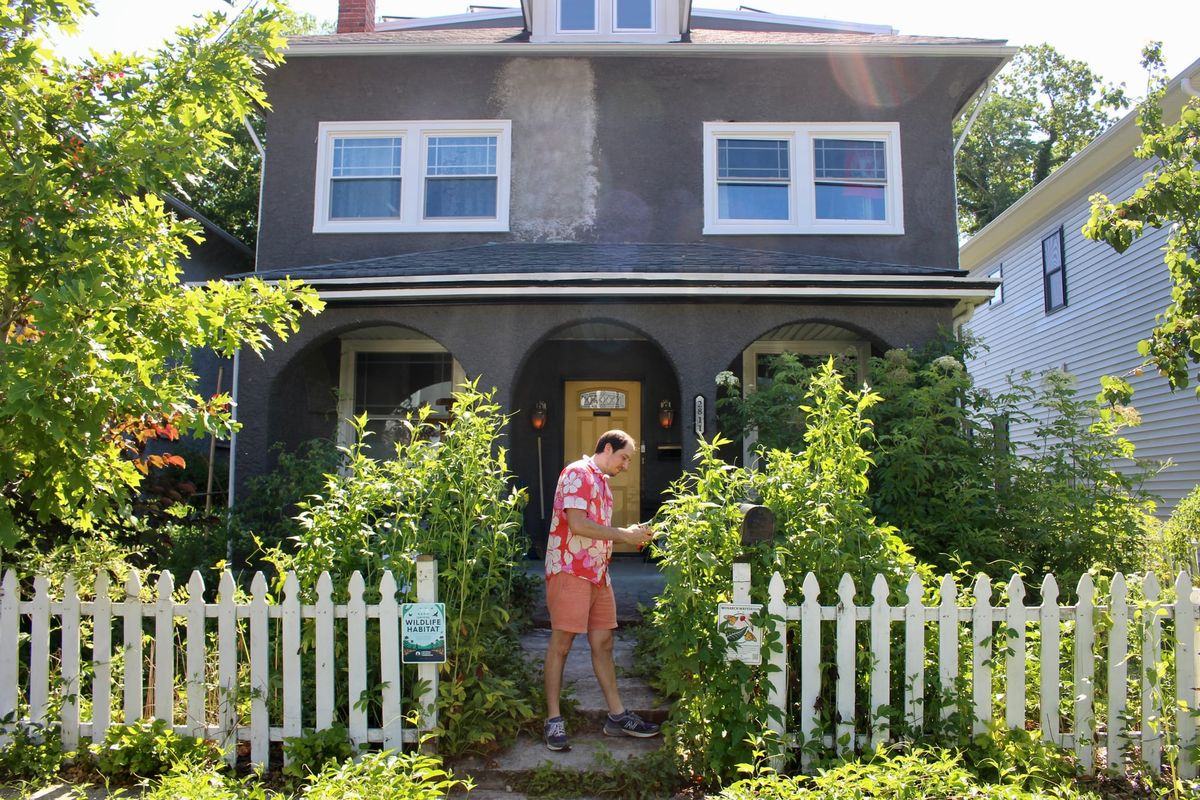
Steve Mothershead can pinpoint when one of the most recent warnings arrived from the city about his plants: It was the same week local public television station VPM came by to film his garden for an episode of “Virginia Home Grown.”
Mothershead’s yard in the Barton Heights neighborhood of Richmond’s Northside is a riot of native plants — mountain mint, passionflower vines, redbud, elderberries, river oats and more. They spill around the house and the fence and populate the adjacent “hell strip,” the narrow ribbon of land between sidewalk and curb. They are abundant and unruly, buzzing with life and bursting along the property lines.
“We’re talking landscaping that I paid for,” he said. “This isn’t even something where I’m putting plants in the ground and it’s looking kinda shabby.”
Some neighbors obviously don’t agree. After reports to the city, Mothershead received warnings and finally a citation this summer for violating Richmond’s ordinance on weeds and other vegetation.
Those rules, which date back in various forms to the 1950s, make it unlawful for grass and other non-ornamental or non-agricultural vegetation to exceed 12 inches, for any vegetation to encroach on the sidewalk or alley or for a resident to fail to remove any dead materials from their yard.
But as the years have passed, views on yards and gardens have changed across the U.S.
Although a drive down nearly any street in the Richmond region would make it clear that turf grass lawns are still thriving, mainstream views on them have been shifting. Besides requiring constant cutting during the warmer months (and, depending on the year, fertilizing and watering), grass lawns offer little ecological value, say opponents.
Instead, environmental groups have increasingly promoted native plantings as a way to not only reduce consumption of valuable resources like water — many natives can handle the vagaries of the local climate better than those that evolved in other conditions — but also support local insect, bird and animal populations.
Richmond has backed the push for natives. Among the many objectives the city included in its 2020 master plan is to “increase the prevalence of native plant species and plants for healthy pollinator communities at public facilities and promote such planting on private lands.”
Natives are “an easier way to maintain a yard with less mowing and less irrigation,” Daniel Klein of Richmond’s Office of Sustainability told a City Council committee last week.
But while the two approaches of lawn and natives can and do coexist, those residents who have fully embraced the conversion like Mothershead can find themselves caught between two competing city goals: go native but also keep your property tidy enough to keep accusations of neglect at bay.
This spring and summer, the Office of Sustainability has attempted to thread that needle by amending the weed ordinance to exempt native plantings from height rules as long as they meet certain criteria.
Revising the rules to encourage native plantings on private properties was also a goal of the master plan, office staff have pointed out. But setting the appropriate criteria has been a challenge.
Some pollinator or wildflower meadow-type gardens can look unkempt to neighbors, especially in communities with higher numbers of vacant properties that are already sensitive to charges of blight. For residents accustomed to seeing a well-trimmed lawn as a sign of responsible property ownership, more abundant and less contained vegetation can often be read as simple neglect.
That gives rise to complaints. In 2025, city inspectors issued 1,452 violations of the weed ordinance. (Not everyone is happy about that; Mothershead told The Richmonder that “I don’t think we should be siccing code enforcement on people for lawns.”)
Initially, the Office of Sustainability tried to set strict metrics to separate out “wildlife friendly” plantings from yards that a resident was just ignoring. Plantings would need to be at least 80% native, they suggested, and couldn’t be within five feet of a property line.
Gardeners kicked back, arguing the criteria were too strict and unrealistic for small city lots.
“I fully support this,” said Lee Burleson this May. “I just think we need to tweak the language a bit.”
This July, following meetings with environmental and gardening groups, a new version simplified the plan. Native plants would be added to the list of vegetation exempted from height limits, joining “trees, shrubbery, agricultural plants, garden vegetables, flowers or ornamental plants.” Woody debris would be allowed in yards as long as it was located away from structures and didn’t pose any safety risks. And inspectors would be directed to rely on indicators of intentional stewardship like defined borders, arrangement of plants and signage — known as cues-to-care — to determine cases of genuine neglect.
What will still remain: the prohibition on any plants extending into the sidewalk or street that could obstruct people passing by.
Taken together, said Klein, the new rules would ensure that “folks who are growing native plants and establishing native landscaping and incorporating cues-to-care are no longer getting accidentally fined or violations from code enforcement.”
Robin Allman, a resident of the City Stadium neighborhood and member of Wild Ones of Greater Richmond, said the changes were “a beautiful example of democracy in action.”
The program “will be a great tool to promote our beautiful Richmond native plants and pollinators,” she told the City Council’s Land Use, Housing and Transportation Committee.
On July 21, the committee endorsed the approach, although the ordinance will need the support of the full council to go into effect.
In the meantime, the Office of Sustainability has launched a webpage with information about native plantings and strategies residents should use to make it clear that their properties are the result of choices and not neglect.
“I don’t want to send the message that native plants don’t require maintenance,” said Councilor Ellen Robertson (6th District) at the July meeting.
Klein agreed. While natives require upkeep, “it happens to be more seasonal, so folks tend to do it every three months, four months,” he said.
Mothershead said that whatever approach Richmond takes, “I really hope that the city is going in a direction where they do care about the natural environment. We all know about the heat island effect and redlining and all that stuff.”
Contact Reporter Sarah Vogelsong at svogelsong@richmonder.org