Bob Burrus, a civic leader who led McGuire Woods to national prominence, dies at 91
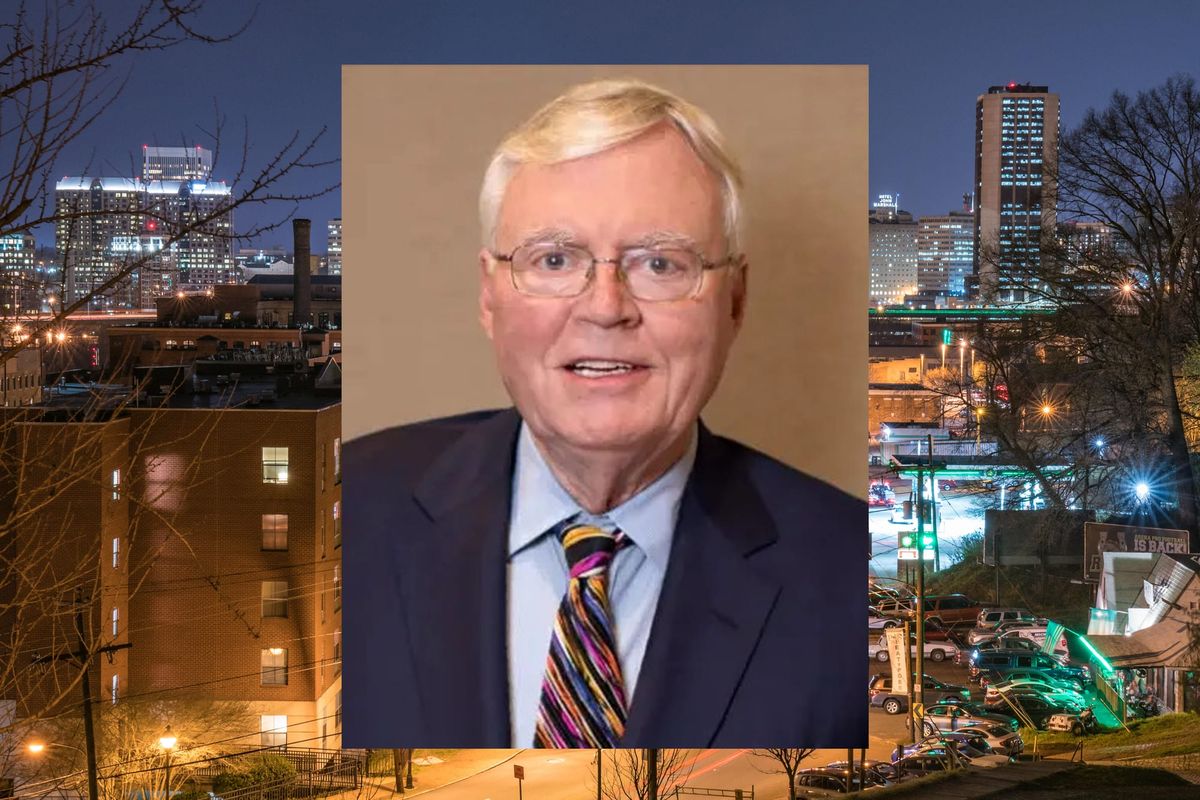
Robert Burrus, a longtime Richmonder who served in a wide variety of civic leadership roles for decades and who spearheaded a scholarship that has helped hundreds of students pursue professional opportunities, died this month at 91.
His obituary said he passed away on July 12 at his Richmond home.
Born September 16, 1934, to a farming family near Charlottesville, Burrus graduated high school at 16 and attended the University of Richmond, where he obtained a degree in political science, after which he obtained a law degree from Duke University School of Law.
He became a partner at McGuireWoods in 1963 after five and a half years in the U.S. Army Reserve. He would work at the firm for decades, eventually rising to the position of chairman in 1990; during his tenure at the head of the agency he “oversaw the firm’s growth from six to 18 offices in the United States and abroad,” his obituary said.
Throughout his legal career he was an advisor to numerous iconic business concerns in Richmond and Virginia, including Best Products, Dominion Energy, S&K Famous Brands, and Circuit City.
Among his civic roles, meanwhile, he served as the executive committee chair of the Richmond Renaissance, a local effort to help revitalize downtown Richmond. He also held leadership positions at the Virginia Museum of Fine Arts, the Virginia Historical Society, and numerous other local and regional organizations.
His obituary said he was “deeply devoted” to the University of Richmond. The school in 2002 developed the Robert L. Burrus, Jr., Scholarship for Developing Leaders in the university’s Jepson School of Leadership.
Kerstin Soderlund, the associate dean for student and external affairs at the Jepson School, told The Richmonder that Burrus was a “phenomenal person” and a “pivotal figure” at the university.
“We’ve been very fortunate to benefit from the Burrus Scholarship funds that have been developed for our students over the years,” she said.
The scholarship was launched in order to help students at the Jepson School defray costs when undertaking unpaid internships in the public sector or at nonprofits, Soderlund said.
“The idea is not that we were paying people for the internships they were doing,” she said. “Instead, we were helping offset the cost so that any student, despite their socio-economic situation, would be able to complete an unpaid internship.”
The program was a success upon its launch; in 2011 the school expanded the scholarship to include internships outside of public and nonprofit work. Burrus eagerly supported the expansion, Soderlund said, along with another expansion in 2023 that offered funds to students conducting summer research.
The Burrus scholarship has since come under the umbrella of the university’s Richmond Guarantee, which offers broad financial support for students undertaking summer research or internships. The Burrus funds are still managed by, and earmarked for, the Jepson School, Soderlund said.
Soderlund described Burrus as “deeply connected” to the university. He served as rector there from 1998 to 2002 and chaired several presidential search committees, among other service roles.
Burrus was also attached to his second alma mater: He served on the board of visitors of Duke University School of Law, which awarded him the Charles S. Rhyne award in 1998. The school says the award recognizes alumni who “exemplify the highest standards of professionalism, personal integrity, and commitment to education or community service.”
Geoff Krouse, the associate dean for alumni and development at the Duke Law School, told The Richmonder that Burrus was “a loyal and devoted alumnus” who was “deeply committed to Duke Law School.”
“He provided valuable counsel to the Law School as a member of the Law School Board of Visitors, generously supported the Law School Annual Fund and scholarships for law students, and promoted engagement among his classmates, Duke Law Journal colleagues and fellow volunteer leaders,” Krouse said.
He further praised Burrus for the “stellar contributions to the legal profession” that won him the Rhyne award.
“We are grateful for Bob’s enduring contributions to Duke and extend our deepest sympathies to his family and loved ones,” he said.
Soderlund, meanwhile, said Burrus took great pleasure in knowing his namesake scholarship was helping students pursue their education.
His obituary noted that he himself attended both the University of Richmond and Duke on scholarships. Soderlund said he “loved to hear about the student experiences” facilitated by the Burrus scholarship.
“He just so enjoyed that the students could go off and have these amazing experiences that they may not have been able to have without this financial support,” she said.
Burrus is survived by three sons and their families, along with a sister, Bessie Burrus Brooks.