Backers of Family Justice Center to seek $2 million from city for startup costs next year
A proposal to set up a “one-stop shop” for victims of domestic or sexual partner violence to get services without having to go to numerous different agencies will cost an estimated $2 million to get off the ground.
“We have got to start working together to be able to provide survivors one place they can come to not just address their needs, but their children’s needs,” said Rupa Murthy, CEO of the YWCA of Richmond.
The YWCA is working with the Richmond Commonwealth’s Attorney Office and Richmond Police Department to spearhead the push for the Richmond Family Justice Center, a centralized approach to providing services to people facing domestic abuse that is being used in roughly 150 other places around the United States including Norfolk.
Currently, victims in Richmond have to seek services from a multitude of places, requiring them to repeat an account of their experiences again and again as they seek medical care, get a protective order, talk with investigators, notify the public schools about their children’s changed circumstances, arrange new housing and transportation and seek counseling.
“Instead of the woman having to make all of those steps, she can come to a place that the city of Richmond has provided for her and her family, and that one-stop shop would provide all of those resources,” said Richmond Commonwealth’s Attorney Colette McEachin.
The YWCA, which provides extensive services to victims of domestic violence including a 24-hour regional hotline, has been working on plans for the center since 2020 and has received a federal grant for the effort. The group intends to continue seeking philanthropic and other support, Murthy told the City Council’s Public Safety Committee Tuesday.
But, she said, “the reality is we do need funding.”
While Mayor Danny Avula’s administration and the City Council won’t begin shaping next year’s budget for several months, supporters of the center are beginning their push for funding now. Besides the pitch to the Public Safety Committee Tuesday, a bus trip brought several city councilors to the Norfolk Family Justice Center Wednesday.
The $2 million the center’s backers intend to ask the city to fund next winter for start-up would cover an estimated $400,000 for a physical space, $300,000 for supplies and equipment, $1 million for personnel and $300,000 for operations. Additional support would be needed for operations in future years.
Murthy said they’ve eyed the West Franklin Street building formerly occupied by The Richmond Times-Dispatch as one possible site due to its proximity to the courts and downtown offices, but “there are some other locations that might work as well.”
Besides providing a needed lifeline to victims, the Family Justice Center could help reduce domestic assault, homicide and related crimes, supporters contend. Last year, about 20% of murders in Richmond were linked to domestic abuse, a greater share of cases than were attributed to drugs, and the YWCA has seen demand grow for its hotline and programs it offers to survivors like counseling and court advocacy.
Statistics from RPD indicate domestic violence is on the rise, with 577 cases of domestic assault this year to date compared to 545 at the same time last year — even as other categories of violent crime continue to see drops.
Aggravated domestic assaults — more serious cases that carry a felony charge — also appear to be rising, although the data are complicated by a change RPD made in the middle of 2025 that classified all domestic assaults involving strangulation as aggravated rather than simple. (Previously, those cases were only classed as aggravated if the victim lost consciousness.)
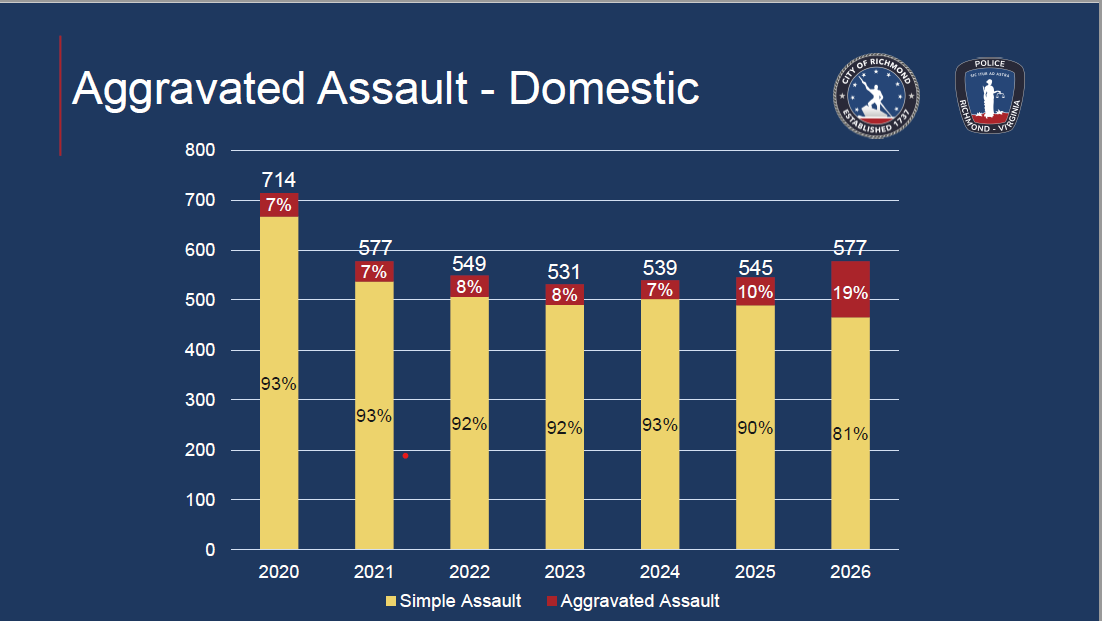
That reporting shift was the main driver of a doubling in Richmond’s aggravated assault numbers this year, said Richmond Police Chief Rick Edwards, although he reiterated that domestic cases are increasing. Strangulation, too, is considered by experts to be a particular cause for alarm in domestic violence because studies have linked it to a sharp rise in likelihood that a victim will be killed by their abuser.
Police aren’t sure why cases seem to be increasing right now.
“I think people are more apt to report it than ever before,” Edwards hazarded. “We’re getting better at taking those reports.”
Whatever the cause, McEachin is convinced that a Family Justice Center will bring the numbers down. Both she and Edwards point out that prosecutions for domestic violence can often be derailed when a victim, discouraged by the barriers they face, returns to an abuser or refuses to testify.
“The victim will finally call the police, the police will investigate, they will charge, and that charge will be brought to our office,” she said. “Now a month has passed maybe, (and) we finally can meet with the victim, start talking about trial. Well, in that month the victim has realized how difficult it’s going to be for her kids to not see their father, for her to survive financially without his income.”
By providing victims with an easier path to get critical services, backers say the Family Justice Center could help break that cycle. Prosecutions could move forward more smoothly. Victims and children could more easily find safe places to live. And, said Murthy, abusers could get resources like counseling themselves to stop those violent behaviors in the future.
“This looks like generational abuse in so many cases,” she said. “So if we can support the abuser as they are coming out of jail, as they are getting those charges, getting that indictment, being able to make sure that they then have support to not do this again, to end the cycle of violence, that’s part of the Family Justice Center too.”
Contact Reporter Sarah Vogelsong at svogelsong@richmonder.org