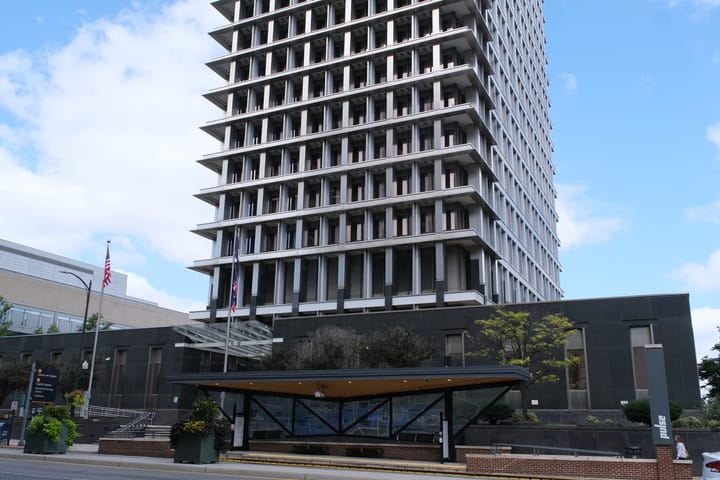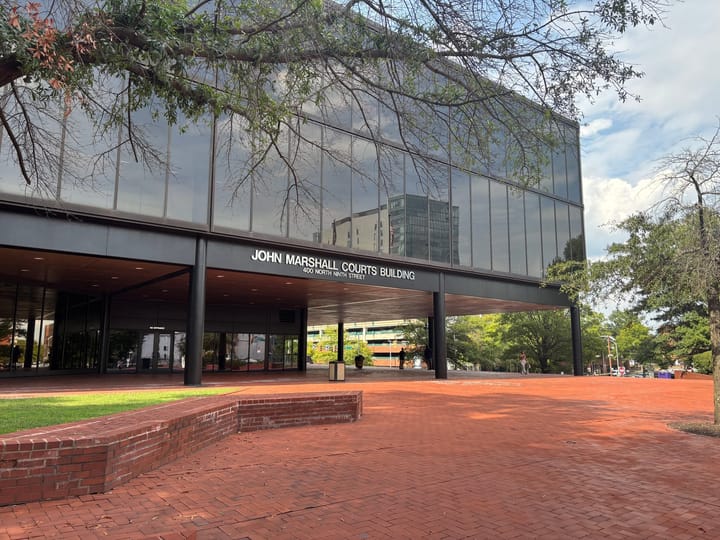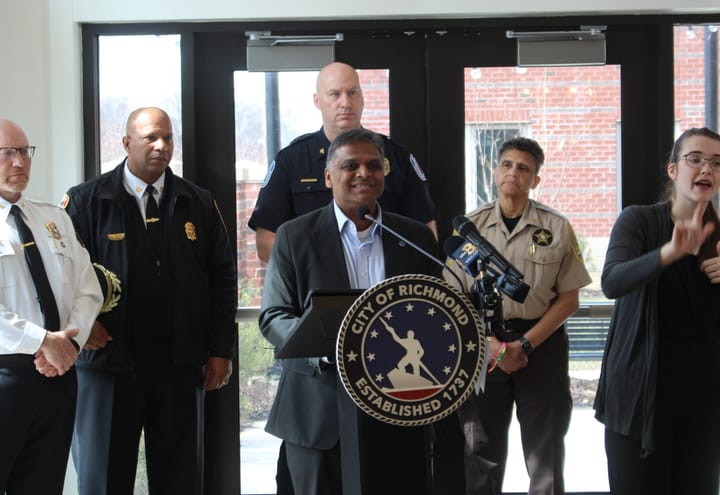
With new batch of invoices, city’s costs for FOIA officer lawsuit rise to $633K
The legal bills for Richmond’s efforts to fight a lawsuit filed by former city FOIA officer Connie Clay have risen to more than $633,000 after the private law firm handling the case filed seven months’ worth of invoices at the end of 2025.
The lawsuit is broadly about transparency at City Hall, but the legal expenses in the Clay case have become a mini-controversy in their own right.
Clay — who claims she was wrongfully fired in early 2024 in retaliation for speaking up about City Hall’s alleged failures to follow Virginia transparency laws — had been using the Freedom of Information Act to get copies of invoices filed by Ogletree Deakins, the outside law firm the city brought in to try to beat back her lawsuit.
Ogletree attorney Jimmy F. Robinson Jr. objected to Clay’s use of public-records laws to gain insight into the city’s side of the case, and his firm stopped filing invoices with the city after May 31 of last year.
 Graham Moomaw
In addition to preventing Clay and her attorneys from getting documents through FOIA, the invoice stoppage made it impossible for the press and the public to get real-time information on how much the litigation was costing taxpayers.
With the lawsuit dragging on for almost two years, the city has accused Clay’s team of wasting public dollars with a neverending search for evidence that doesn’t exist. Clay’s lawyers can’t find the proof they want, the city argues, because Clay was justifiably fired for clashing with co-workers.
 Graham Moomaw
Clay’s team contends the delays are the city’s fault, caused by stall tactics and evasive answers about its efforts to find documents relevant to the case. The pre-trial court battle has been unusually hostile, with Circuit Court Judge Claire G. Cardwell urging the two sets of lawyers to stop engaging in personal attacks and stick to the basics of professional decorum.
Though Clay and others following the case believe the disappearance of FOIA-able invoices was an intentional part of the city’s legal strategy, Robinson insisted there was no “conspiracy” to hide the documents. The invoices weren’t being filed, he told The Richmonder last year, because of an issue with his “billing apparatus.”
 Graham Moomaw
The missing bills came pouring in at the end of the year. The city received seven invoices from Ogletree, all dated Dec. 30 and adding up to $398,359 in costs. On top of the $234,711 the city had already spent before the invoices stopped, the new invoices pushed the total costs to $633,070.
The Richmonder and others had been filing periodic FOIA requests for invoices, prompting the city to release the new records on Thursday. The invoices contain several redactions covering up information the city deemed confidential under attorney-client privilege, but all total dollar amounts were made public.
At many law firms, compensation for attorneys is tied to their billable hours per year. The Richmonder previously asked the city attorney’s office it was expecting to receive invoices at the end of December to allow Ogletree to keep its billing sorted by calendar year. The city did not answer.
A city spokesperson declined to comment on why a large batch of invoices came in just as 2025 ended and would not say whether it’s expecting the Ogletree invoices to be filed on a monthly basis moving forward. Robinson and City Attorney Laura Drewry did not respond to an emailed request for comment.
“I’m just glad that the city’s international law firm with more than 1,000 lawyers was able to finally fix its billing apparatus,” said Tom Wolf, a local attorney who recently joined Clay’s legal team. “And it only took them seven months.”
Clay’s lawsuit initially sought $250,000 in damages. That doesn’t necessarily mean that’s what it might cost the city to settle the case now.
Clay’s own attorneys have been spending a large amount of time on the case, and she would likely be seeking money to cover her legal bills in any sort of settlement deal with the city. Because Clay is a private citizen, her legal bills aren’t subject to FOIA.
The costs to settle the case would have presumably been lower if the city had tried to resolve the matter sooner after Clay sued, before the legal bills started to accumulate.
City’s attorneys ask judge to stop Clay’s discovery ‘nonsense’
The case is not set to go to trial until June, but there have been few signs the two sides are cooling off or working toward more friendly relations.
Clay’s team has asked the judge to officially rule that the city has spoiled evidence by losing the work cell phone of former spokeswoman Petula Burks, who is named as a defendant in the suit because she was Clay’s boss. Burks reported losing her phone at an airport in the summer of 2024, after Clay had sued her and shortly before she too left City Hall. Text messages on the phone were not backed up digitally, according to the city.
In a recent court filing, the city’s team fired back, accusing Clay’s attorneys of filing such frivolous and unsupported motions that they should have to cover the city’s costs for responding to them.
“Defendants have gone to extreme efforts to address the Plaintiff’s various discovery motions, which have no merit and confirm one thing: Plaintiff is not using the discovery process to prove her claims, but to manufacture controversy by weaponizing discovery and motions practice,” the city’s lawyers wrote. “It is time for the Court to put an end to this nonsense so that this case can be resolved on the merits, as the law intends.”
The cell phone going missing along with its contents, the city’s team wrote, is a non-issue and Clay’s attorneys haven’t made a convincing argument it’s pivotal to the case.
“It is unfortunate that Ms. Burks lost her city-issued cell phone, but accidents happen and there is no evidence that Ms. Burks, and more importantly, the city, acted recklessly or intentionally by failing to have cloud-based backup in place,” the city’s representatives wrote in a Dec. 10 filing.
On Jan. 9, Clay’s team shot back.
“It is clear the Court and Clay will never receive a straight answer about the relevant data lost on Burks' city-issued cell phone,” Clay’s attorneys wrote.
Clay’s motion referenced a Richmonder article from December about a city IT report that suggested the missing phone may have been found. That report said the phone was being kept in a “secure location” as Burks and the city awaited instructions on how to get it back.
Because that information was never disclosed in the legal proceedings and only surfaced through the media, Clay’s lawyers argued, the city “has not been transparent” in its statements to the court.
“Not retrieving the lost phone was not an accident,” Clay’s lawyers wrote.
Last month, the city filed a sworn statement from Burks that said she left the phone in an airplane seat pocket on June 20 and was unable to get it back before she resigned from the city on July 1 of 2024. She also swore she didn’t send text messages to other city employees about her decision to fire Clay.
The city has not said whether it made any efforts to retrieve the lost phone after Burks resigned.
The judge has not yet ruled on the phone dispute.
Contact Reporter Graham Moomaw at gmoomaw@richmonder.org