New murder-mystery graphic novel explores Richmond’s art world
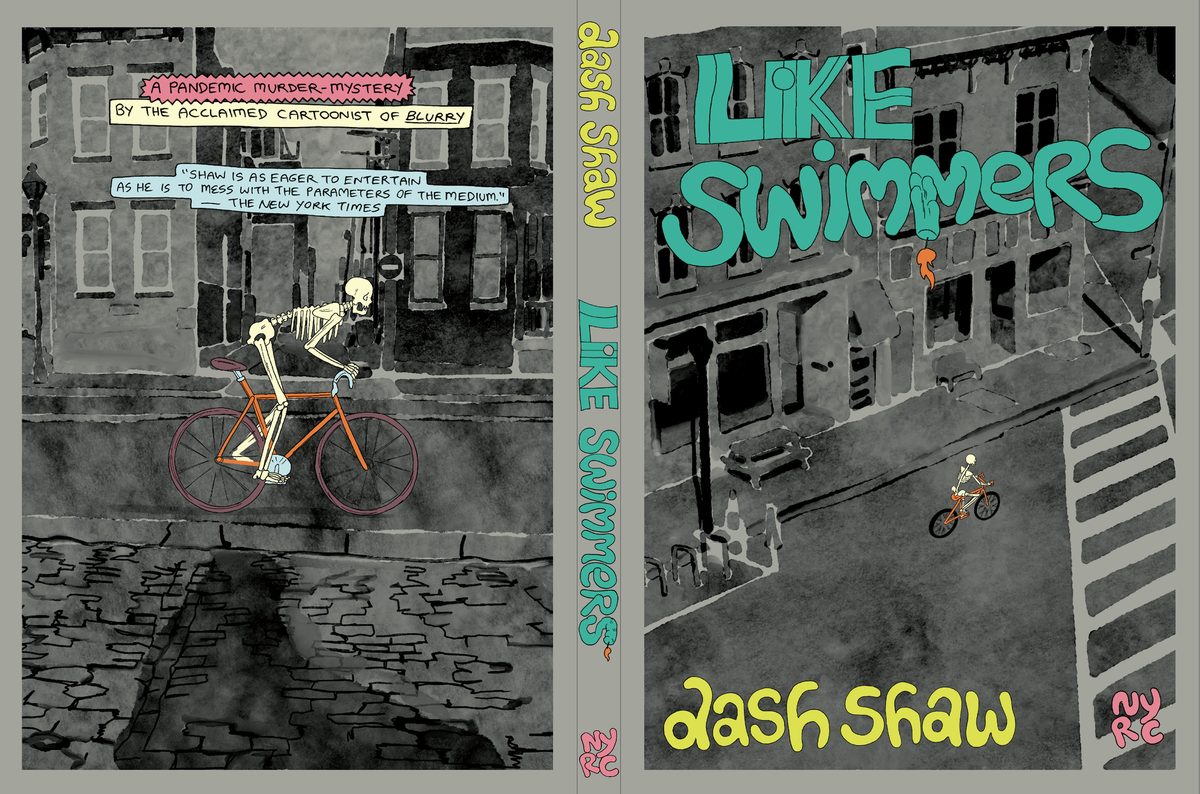
The idea for Dash Shaw’s latest graphic novel, the COVID-era murder mystery “Like Swimmers,” began at the Lombardy Street Kroger.
During the height of the pandemic, the store’s pharmacy offered tests and vaccinations, all while a large, $2 million structural renovation was underway.
“It was a fraught place,” Shaw said of the store, which has a complicated reputation among locals. “I often thought that if someone had made a documentary about that space during COVID, it would have somehow summarized all of COVID and all of the chaos.”
“Like Swimmers” follows a young woman, Kenzie, in the aftermath of her younger brother Howie’s mysterious death. With the police overwhelmed by the chaos of the pandemic, Kenzie puts it on herself to learn the truth about what happened to her brother.
“I lost a lot of people during COVID,” Shaw said. “When you lose someone, it feels a bit like a murder mystery, even if they weren’t murdered. Especially if you lose someone who wasn’t that old, you’re like, there’s got to be a reason for this. I’ve got to puzzle out the reason. Even when there’s not a real reason.”
Kenzie’s search for resolution takes readers to several iconic Richmond locations, including Monroe Park, the ICA, and the Jefferson Hotel.
Despite the difficult subject matter of “Like Swimmers,” the book is not without funny moments, and its color palette is full of bright pastels.
“You’re doing a book about COVID, someone dying. I thought making it really dark or even black and white would be too on the nose,” Shaw said.
He described the color palette as “a little swimmy, a little watery, a little dreamy. I always think of the color as the score of the movie.”
Shaw, who is also a filmmaker, often thinks about his comics in cinematic terms.
“So if this is an indie movie, it’s shot in Richmond. So that means, I’ll use the ICA, or the Jefferson Hotel. I don’t really know anything about what’s going on at these places, but it’s like it’s shot there. I can walk around, and I can think about the locations I’m shooting at,” Shaw said. “And then what’s the score? I think it’s a synth score. It’s going to be a swimmy, synthy score. Sad synth.”
Shaw didn’t originally plan on “Like Swimmers” becoming a graphic novel. He originally wanted to make story into a pamphlet comic series. After he made the first issue, he sent it to a few mainstream comic publishers, but there were no takers.
“Technically they didn’t reject me,” he said. “They just never responded.”
Over the next several years, between other projects, Shaw made more issues of “Like Swimmers,” and eventually he plotted it out into a graphic novel.
Now, the book is set to release this week in Richmond. The launch party for “Like Swimmers” will be held at 7:30 PM on Wednesday at Studio Two Three, and the book will be stocked at Velocity.
Everyone who attends the launch party on Wednesday will also be treated to a film screening of Claude Chabrol’s 1992 thriller, Betty.
“I’m a big French New Wave Guy,” Shaw said. “And Claude Chabrol made a whole bunch of—they’re called thrillers, but they are about as thriller-y as my book is murder mystery-y. The tone of them is what I hope 'Like Swimmers' is like, in that it’s not mocking these messed up people or being judgy towards them, but it’s also not affectionate. It has a very even tone. And this to me is the best.”
While “Like Swimmers” also operates in some ways as a thriller, it’s also a character-driven and study of Richmond’s strangeness. For instance, there is a moment in “Like Swimmers” when the character Howie insists that Richmond is haunted.
“Not everything the character says is the author,” Shaw said. But, he admitted, “I do think Richmond is kind of haunted.”
Shaw says he has a “fraught relationship” with the town because it’s where he grew up.
“I used to feel like it was in the humidity of the air. The fallout of the Civil War. The ghost dog in Hollywood Cemetery. Edgar Allen Poe. Those kind of vibes were present as a high schooler,” Shaw said. “The Jefferson Hotel is obviously haunted. I think that’s pretty obvious to anyone walking in there.”
Shaw first started drawing comics as a kid with his dad. His dad would write them, and Shaw would add the illustrations. As a teenager, Shaw became an illustrator for the Richmond Times-Dispatch.
After Shaw grew older and went to art school, some of his artist friends moved to L.A. to work in the animation industry. But Shaw stayed in Richmond.
“Because of life reasons I didn’t move to LA. I did different things,” Shaw said. “And maybe someone could’ve done the exact same things as me and become more famous somehow. There’s certainly been little moments when like, okay, this might be it.”
Shaw’s first film, My Entire High School Sinking into the Sea, premiered at the Toronto International Film Festival.
“It starred a bunch of famous people, and there was a line around the block for the premier. And only in that moment, seeing the line, I thought, I might make a lot of money. This might be a real change,” Shaw said. “And it had a good rollout. But it didn’t radically change anything. I had enough of those come and go where I gave up.”
Shaw credits Richmond’s relative affordability for giving him the financial freedom to make all the books and movies he’s made over the years.
“Maybe if I had suddenly come into a lot of money I’d be like, I’m moving to Paris,” Shaw said. “But I think that version of me would be a more obnoxious presence.”
Shaw has seen Richmond’s culture around comic arts change radically in recent years.
“In my little world, Brian Baynes and what he’s done at Bubbles Con—that is huge for me,” Dash said.
Bubbles Con, a “symposium of interviews and talks on comics and manga,” takes place annually in Richmond.
“I know that I’m in my niche universe, but it really goes to show you that it doesn’t take a whole lot of people to really change something in a city,” Shaw said. “It only takes a couple, sometimes just one really excited person who can get other people excited.”
The pop artist Roy Lichtenstein’s work is mentioned several times in “Like Swimmers,” and the title of the book comes from a Lichtenstein.
For a time, Shaw was nervous that making a book about COVID-era events wasn’t going to age well.
“There was a stretch there where I thought, is this book dated in a bad way? Are there going to be a hundred books about this same thing, right now?” Shaw said. “And then, by the time it came out, I feel like it’s just a period piece. And I’m grateful that I documented it. Because I wouldn’t remember a lot of this stuff.”
Shaw hopes Richmonders will come to “Like Swimmers” for the murder mystery but stay for the family drama, the Lichtenstein debates, and the pastels.
“Get them in and disappoint them,” Shaw joked. “That’s my motto.”
This article has been updated to note Shaw’s role at the Times-Dispatch.