It’s only 41 feet long, but replacing this Manchester bridge is key to future projects
Another bridge that’s been carrying Richmonders for more than a century is up for replacement.
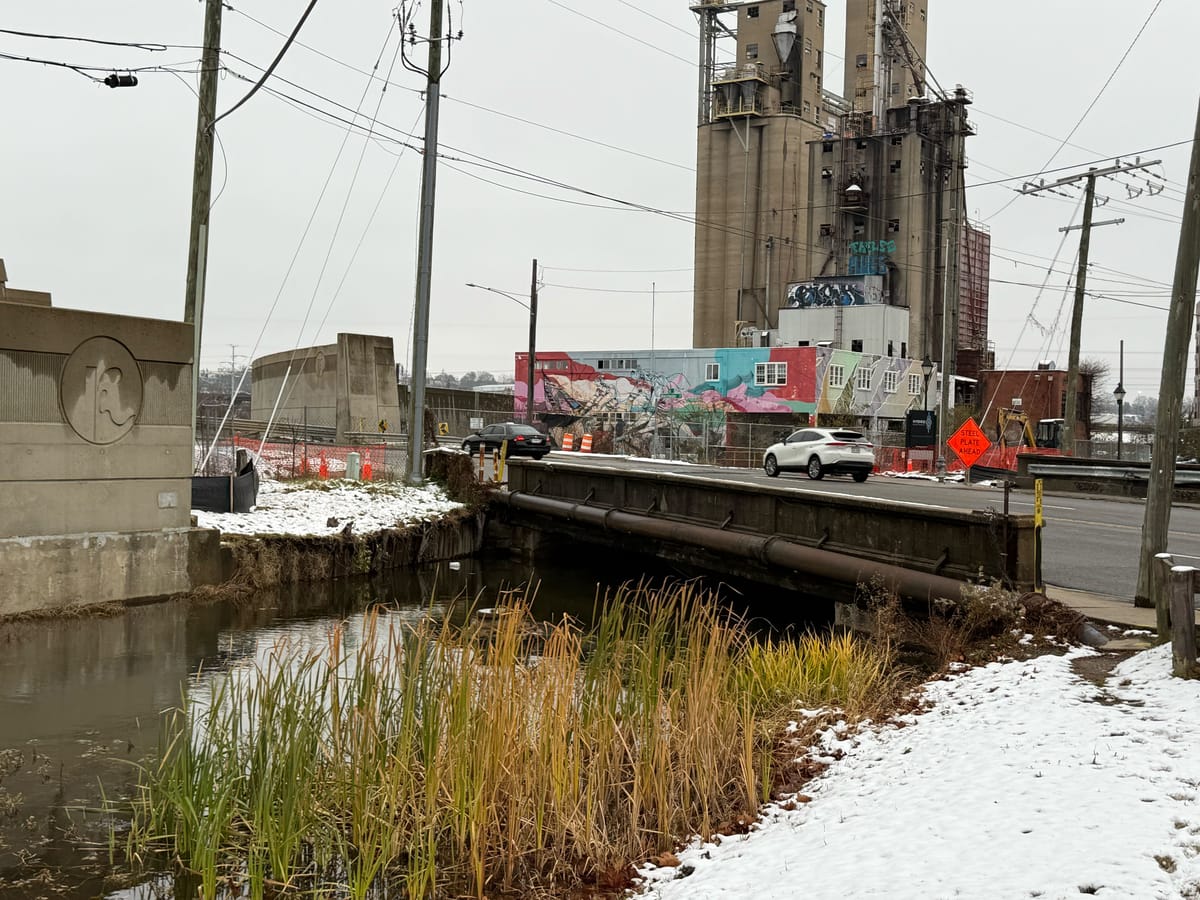
Between the aging Mayo Bridge across the James River and the Hull Street corridor of downtown Manchester lies the 104-year-old Manchester Canal Bridge.
Like Mayo, the canal bridge has suffered significant deterioration. Federal regulators rate the bridge as being in poor condition, it underwent emergency repairs in 2005, and a recent safety inspection found what engineer Jeremy Schlussel called “significant concrete deterioration and cracking.”
Replacing the bridge, which is about 66 feet wide and 41 feet long, is expected to cost $10.8 million. Officials say they’ve secured full funding for the project using a combination of federal and state money and a city general obligation bond.
More complicated has been the task of designing the new structure thanks to major projects in the pipeline at either end of its span.
To the north, the 112-year-old Mayo Bridge is slated to be replaced beginning in 2028, and the city is transforming the once-industrial Mayo Island — which it purchased several years ago — into a 15-acre public park. To the south, Richmond’s Hull Street Streetscape project aims to make a densely populated and trafficked corridor through Manchester more pedestrian friendly and green.
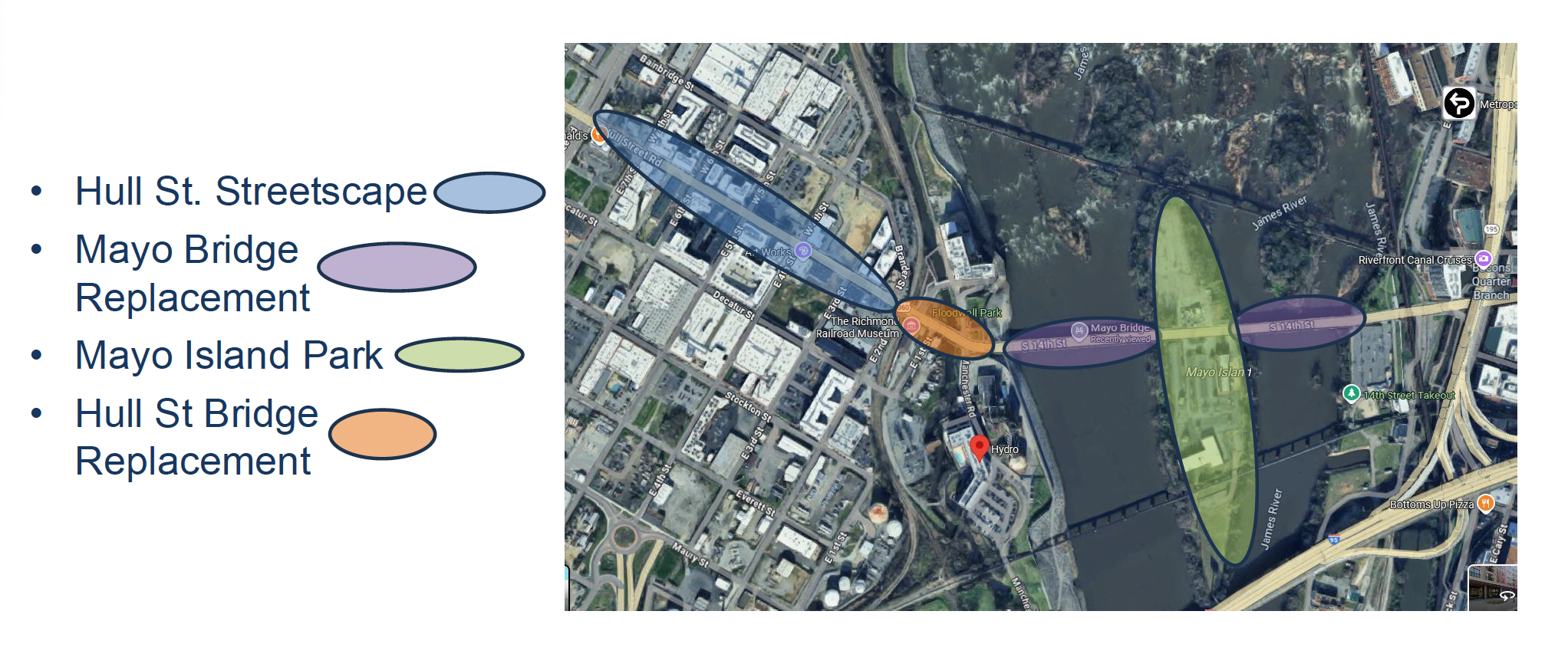
Officials with Richmond’s Department of Public Works say the canal bridge has to be replaced before construction on Mayo Bridge starts. But because the Mayo plans call for the current four-lane bridge to be redesigned as two lanes with more expansive bike and pedestrian infrastructure, the city is moving forward with a two-phase overhaul of the canal bridge that DPW says will be able to match both configurations.
“Right now, the plans that we have for the Hull Street bridge over the canal will be matching the existing four lanes,” DPW Capital Projects Administrator Lamont Benjamin told Richmond’s Planning Commission this November. “But once the construction of Mayo Bridge is in place, it will be restriped to match the existing Mayo Bridge.”
The Planning Commission signed off on that approach, but not everyone endorsed it. Both the Manchester Alliance and the Shockoe Partnership, which represent communities north and south of the corridor, have questioned why the city doesn’t instead design the canal bridge to match the future two-lane configuration now.
“The two-phase approach doesn’t really make sense,” said Janet Woodka, president of the Manchester Alliance. “It just seems to me you should be planning for the future and not the present, especially if the future is not that far.”
Richmond, said Spencer Grice of the Shockoe Partnership, has “committed to a two-lane Mayo Bridge. That’s coming.”
The question of whether the replacement should occur in one or two phases also sparked discussion earlier this fall among the city’s Urban Design Commission, which ultimately backed the two-stage DPW plan but included a condition that the project “match future travel lane configuration” of Mayo Bridge and the Hull Street Streetscape improvements.
Asked why DPW considers the two-phase plan the better option, department spokesperson Paige Hairston said the project “is to replace the structurally deficient bridge” and “DPW is providing a canvas for any future lane configurations.”
“Currently, the lane configuration is four travel lanes from the north bank of the James River to Commerce Road with off-peak hour parking from 1st Street to Commerce Road. After the bridge over Manchester Canal is replaced, the Mayo Bridges are to be replaced,” she wrote in an email. “The four travel lanes will be used for access to the developments between the river and canal. While the Mayo Bridges are closed for replacement, the current configuration of Hull Street will remain. Due to the limited project limit on the Manchester Canal bridge replacement and with no bike lanes currently configured on either end of this project, the reconfiguration would occur after the Mayo Bridge Replacement project is complete with one travel lane and bike lane in each direction.”
The Manchester Canal and Mayo bridges aren’t Richmond’s only major bridge projects underway. Replacement of the more than 75-year-old Arthur Ashe Bridge is supposed to start in fall 2026, while the 122-year-old Lombardy Street bridge that connects the city’s Northside with the Broad Street corridor is expected to close for two years beginning in 2027 to be redone.
Contact Reporter Sarah Vogelsong at svogelsong@richmonder.org