Interview: Jason Kamras shares next steps as RPS prepares for $850 million sales tax infusion

Last week, Richmonders voted to approve an additional 1% sales tax that would be used solely for school facility modernization. That means Richmond Public Schools is looking at $850 million over the next 20 years, acquired through bonds, it can use on some of its aging buildings.
“It is truly a once-in-a-generation opportunity for our kids and our teachers, and I’m also just really, really grateful to the voters of Richmond,” Superintendent Jason Kamras said in an interview with The Richmonder.
The Richmonder spoke with Kamras to better understand how that money will be used within the division’s schools. Specific details of the plan still remain undisclosed, but it is certain that the plan will contain a mixture of rebuilding schools and making major upgrades to others over the next 10 years.
What will be done to the chosen schools is dependent on the school – some schools have historic buildings where “the bones are strong” but need better “wiring and plumbing,” while others need “to be torn down and rebuilt.” Ultimately, the Richmond School Board will vote to approve any plan.
Kamras believes residents understand that RPS really “needs the money for our schools,” and that residents trust the division to “use the money well and to be efficient and transparent.”
“That is my solemn commitment to the voters of the city,” he said.
Final plan coming this spring as listening tour concludes
Rather than presenting a plan before November’s vote, Kamras told reporters at a July press conference that the division would work with the public to develop the facilities modernization plan, which will come about as a result of two phases.
Phase 1 will articulate which schools are of the highest priority, which is determined by stakeholder meetings and an assessment report of the division’s facilities conducted in 2024.
 Sarah Vogelsong

RPS hosted those meetings over the last few months in each of the nine districts, informing attendees about the division’s difficulty of funding school facilities and letting them decide which of the schools the division should prioritize if the vote passed. Kamras said over 400 residents attended the meetings, and more participated in a survey the administration conducted.
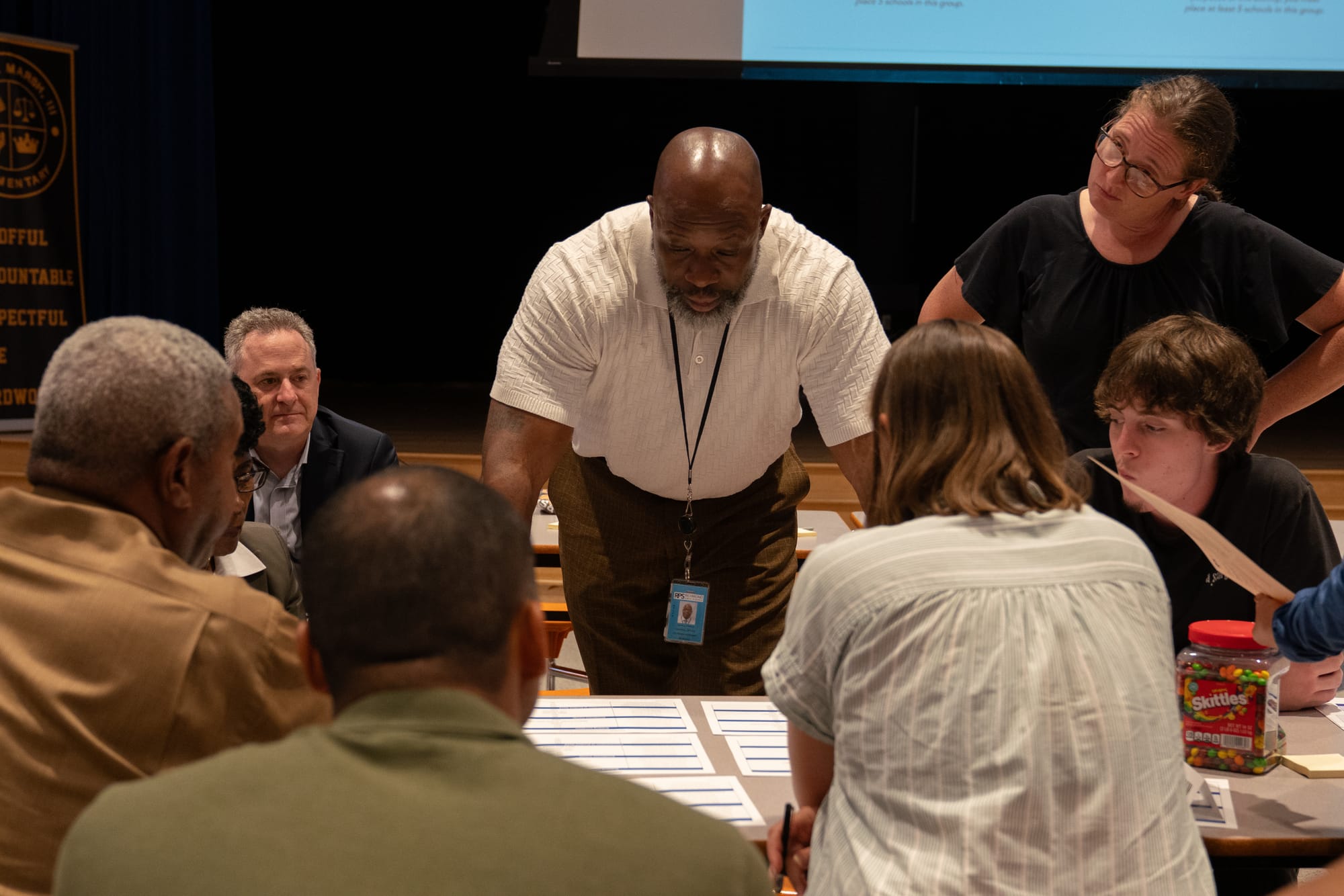
At the 7th District facilities modernization meeting held in September, Kamras gave a presentation to attendees displaying the division’s situation with funding, the city’s population, enrollment and state of buildings.
He emphasized that the division being a school system containing old buildings with significant needs “is inextricably linked to our very painful history with race,” and displayed a history of inequity within Richmond schools.
In the “early 1900s, Black schools were routinely built to lower construction standards,” he said.
Urban-renewal projects, like the demolishing of entire blocks in Jackson Ward and Navy Hill, displaced families and institutions like schools in the 1950s. Desegregation in public schools later came in the 1960s, but fueled relocation and support for private, segregated schools.
That – coupled with Virginia’s funding formula not accounting for student poverty, he said – were all factors that members took into consideration when choosing schools for modernization.
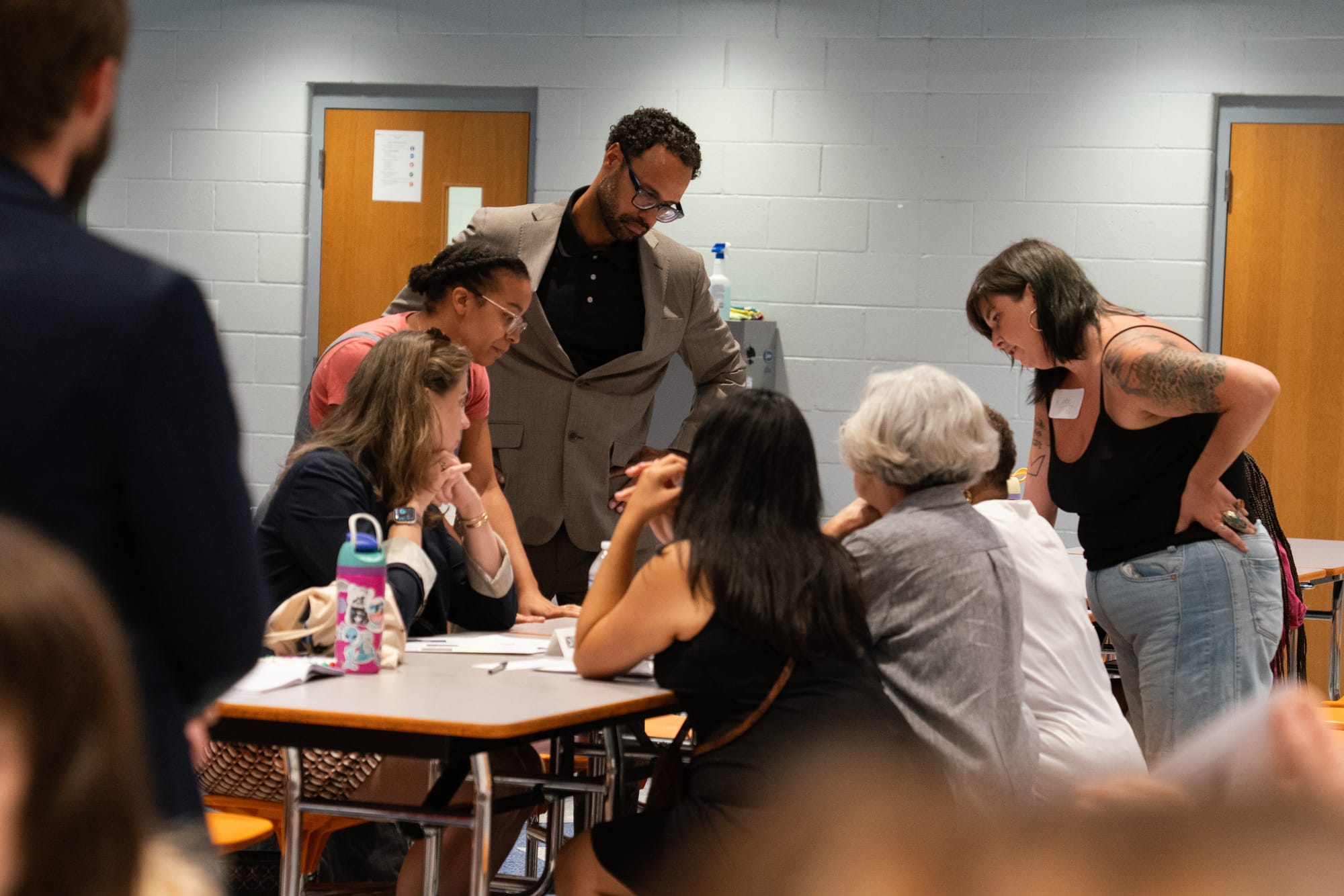
Members were then divided into about three groups, each consisting of parents, students, school employees and city leaders within the 7th. Each group was handed placards containing information about 23 of 24 schools, with data like enrollment, subgroup populations, and when the school was created. Aspects of schools, like HVAC systems and building structures, were categorized into good, fair, poor or critical conditions, as determined by the 2024 facilities assessment report.
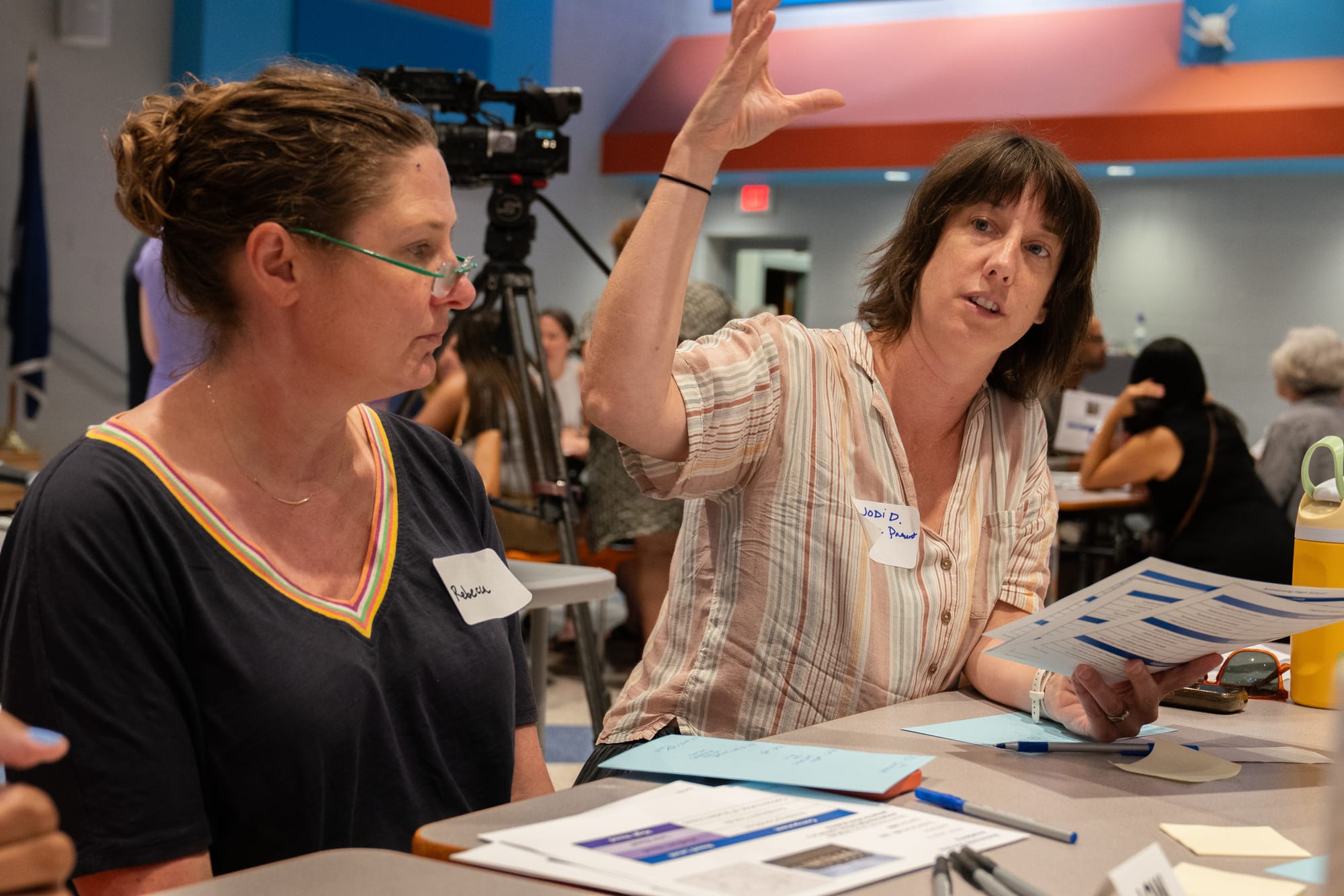
One group particularly looked at the population of economically disadvantaged students within the division. Jodi Dubyoski, a parent of a student in Bellevue Elementary, chose Armstrong High as one of the schools she’d put on a high priority, because of the student population and poor condition of the building.
“As a parent in the district, I would love to see efforts towards the whole spectrum of elementary and middle and high schools,” she said. “So for me, investing in the high school I think is a high priority.”
Havis Wright, a resident of the 7th District, pointed to George Carver Elementary as his school of high priority, despite it being underenrolled in recent years.
“It is well positioned to attract a lot of folks who might be approaching child-bearing age over the next 20 years,” he said. “Folks that stay in Scotts Addition want to have kids, folks that live in parts of Jackson Ward want to have kids. It's the only great school that's nearby. So it currently has low utilization, but for a number of reasons it shouldn't.”
Another parent chose Southside’s Miles Jones Elementary, due to the high enrollment at the school causing students to learn out of trailers.
“We’re in the process now of looking at all that feedback and using it to inform some recommendations to the Board that they will take up in December,” Kamras said. “In the spring we’ll discuss and ultimately decide how we’ll modernize the schools. Will we rebuild them? Will we renovate them? Would we consider potentially a consolidation? Whatever the case may be, that would be Phase 2.”
By then, the Board would vote on the finalized plan.
The process was helpful to Dubyoski, who was curious to understand what the division will do with the information.
Kamras said that the administration has so far identified five schools for potential rebuilding or renovation that residents frequently identified for prioritization during the meetings.
“That has been incredibly helpful to us,” he said. “It has been helpful, I think, for the community to learn about the extent of the facilities challenges outside of their own particular school or particular neighborhood.” He believes residents’ “empathy for the challenges” Richmond schools are facing likely helped with the 1% vote.
He declined to share which schools they were, adding that it is not yet public and will first go to the School Board for their consideration in the coming weeks.
What is currently in the plan?
Constructing a new Woodville Elementary school building and Southside technical center are the remaining parts of the division’s existing facilities plan. But they are also set to be partially funded by the 1% sales tax.
The Southside technical center is funded in two phases. The first, costing $79 million, is currently being covered by the roughly $200 million lump sum given to RPS in 2024 under a plan created by former Mayor Levar Stoney, as well as a grant from the state’s school construction assistance program. That money, along with previous lump sums, was used to build River City Middle, Cardinal Elementary, Henry L. Marsh Elementary and Richmond High School for the Arts.
 Victoria A. Ifatusin
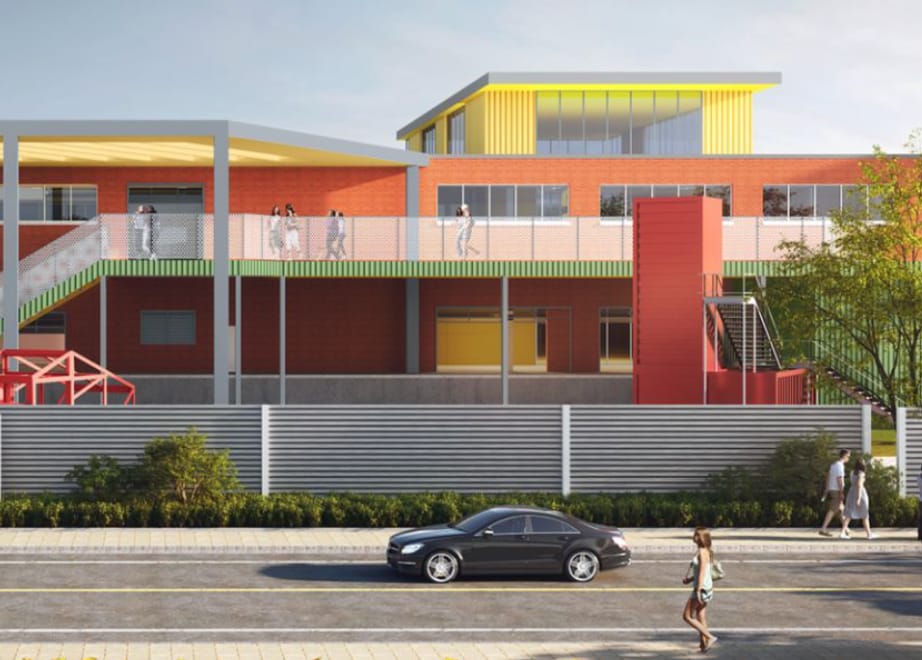
Part of Woodville would also be covered by a $12 million grant from the state’s school construction plan.
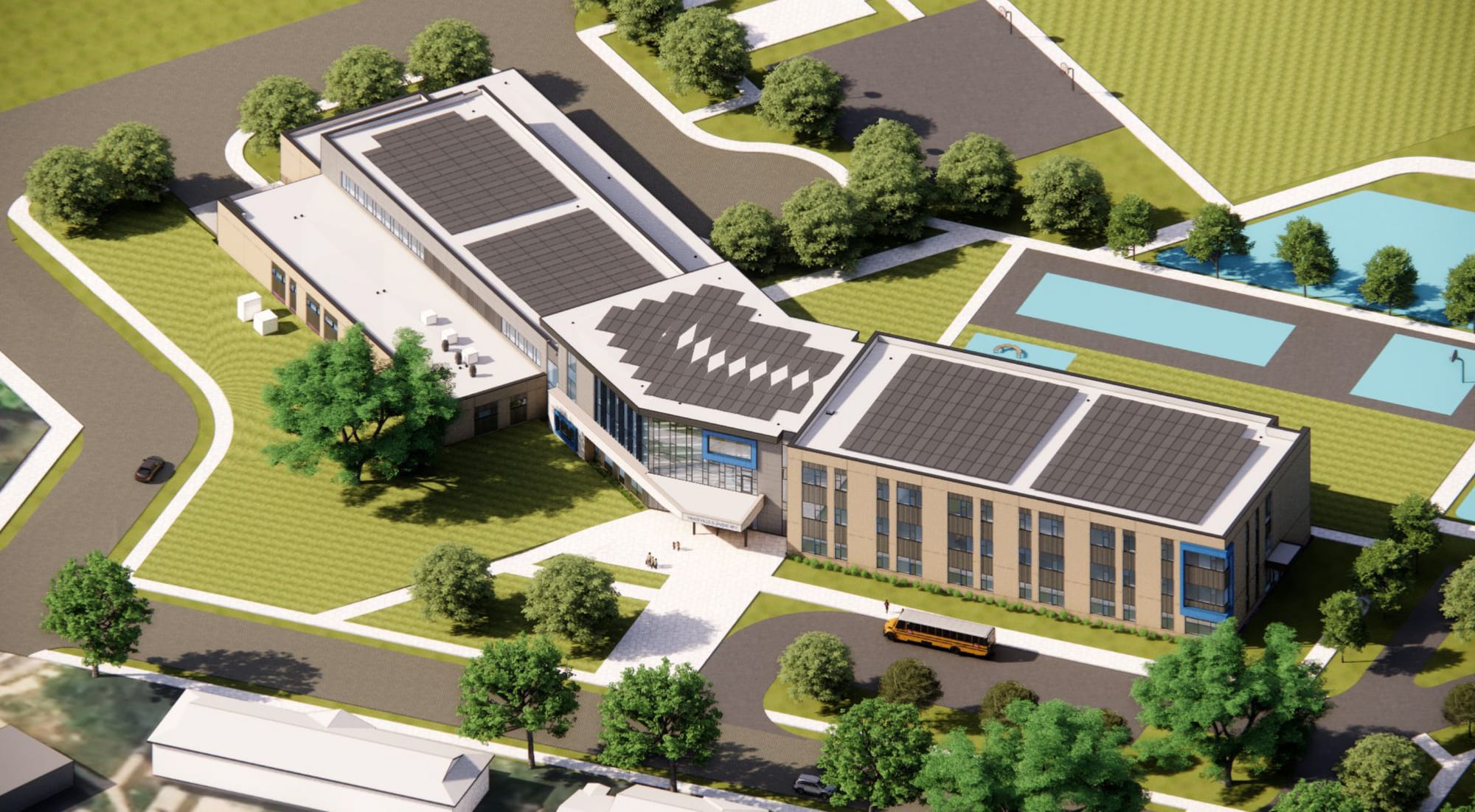
So the remaining $118 million for the technical center’s phase two, and $41 million for Woodville will be funded by the 1% sales tax, and will likely be the first projects the division embarks on.
Using the funds to pay for Woodville, the technical center and the $680 million school maintenance needs for the next 20 years identified in the assessment report alone, would put the division very close to using up the $850 million, not including any other new schools.
When asked about it, Kamras said building the new schools would eliminate having to spend money to fix some things pointed out in the 2024 assessment report.
“There’s a give and take here. As we build and renovate new schools, the basic maintenance needs for those schools go away,” he said.
For example, a new Woodville Elementary would cost the division $41 million. Providing the basic maintenance for the next 20 years at the school would cost nearly $18 million.
“If your question is, does the 1% solve everything, the answer is no,” he said. “Does it get us a lot farther a lot more quickly, the answer is yes.”
Redistricting and consolidation of schools
While Kamras did not discuss redistricting and consolidation at the 7th District facilities modernization meeting, they are topics for discussion when it comes to RPS’s 10-year facilities plan. And the most prominent example is likely going to be Woodville Elementary.
With Woodville being first in line for the new funding, administrators are eyeing the neighboring Fairfield Court Elementary for potential closure and rezoning.
This idea is not new, as it has been a part of the division’s facilities conversation for years as seen at School Board meetings. It was part of why Woodville was listed as a priority for the current facilities plan that the division is slowly completing.
 Victoria A. Ifatusin
Enrollment at both schools has been declining over the last decade. In 2016, the two East End schools reported nearly 500 students at each school. Last school year, each had less than 220.
The schools are also very close to each other, just a 10-minute walk away.
“I do think given the relatively low enrollments at those two schools, given their geographic proximity, and given that we’d be able to get all the kids into a new school pretty quickly, I do think that makes sense and I do think it’s something that people [would] look at pretty seriously,” Kamras told The Richmonder.
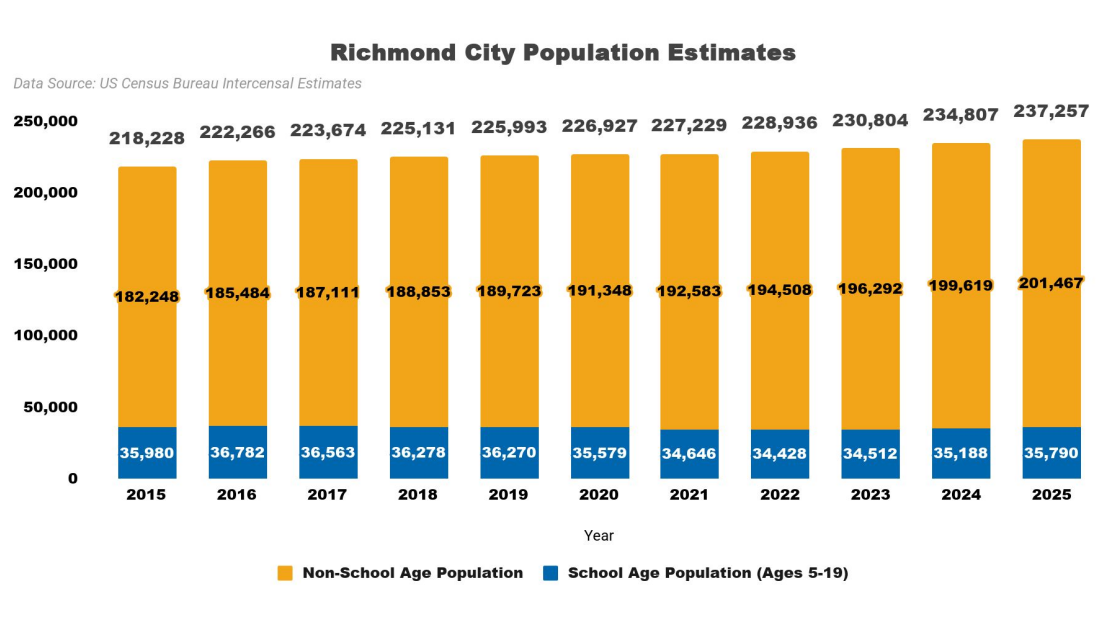
During the meeting, Kamras presented data showing the city’s population increasing over time, while the population of school aged children remains roughly the same, even though RPS’ enrollment has slightly increased from last year – 21,427 to 21,554.
When asked if the administration identifies other schools within the district that could be eligible for redistricting or consolidation, Kamras said “not currently at the moment.”
“But I do think that’s going to be part of the discussion as we go through Phase 2 – is there anywhere else where it might make sense? I don’t know that there is, but there might be.”
Contact Reporter Victoria A. Ifatusin at vifatusin@richmonder.org