Catching up: Toxic wastewater is leaking out of a bankrupt Chesterfield landfill
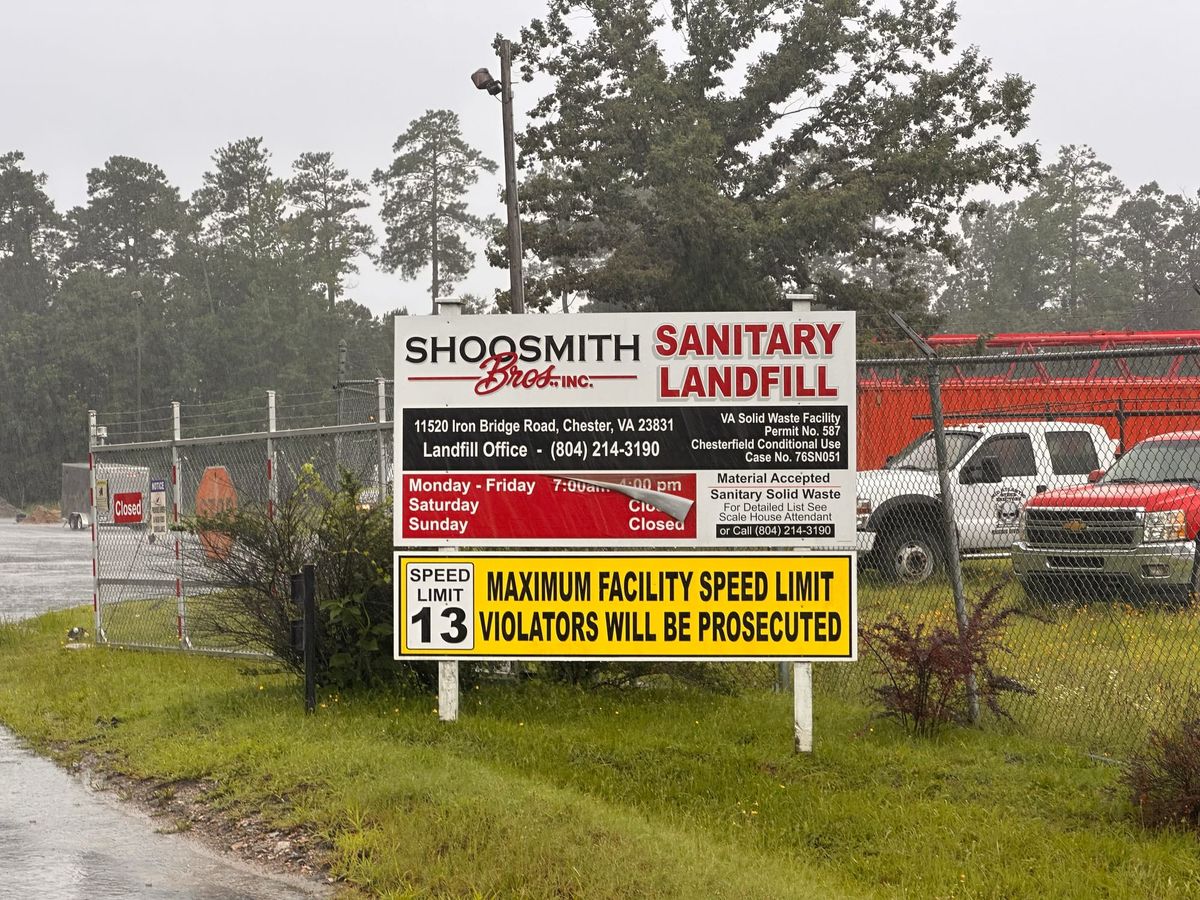
A bankrupt Chesterfield landfill is leaking contaminated wastewater, and officials are still working to determine the damage’s full extent — and who will foot the estimated $173 million cleanup bill.
The liquid in question is called leachate, and it forms when rainwater passes through waste. It’s usually caught by collection systems below ground and then disposed of. But this wasn’t the case at Shoosmith Landfill. Shortly after its owners declared bankruptcy in 2025 (nearly three years after it stopped accepting most waste), state inspectors discovered leachate was seeping into nearby stormwater channels that connect to Swift Creek.
While the landfill is located in the county, the state gives sole authority over privately owned landfills to the Virginia Department of Environmental Quality, meaning Chesterfield officials are limited in what they can do.
During its Wednesday meeting, the county’s Board of Supervisors is scheduled to hear an update on the landfill, during which it’ll review the proposed budget for Shoosmith’s closure and post-closure care.
Here’s what you need to know before then.
What is leachate?
Because its wastewater and drinking water systems are separate, Chesterfield residents don’t have to currently worry about what they’re ingesting.
So what’s all the fuss about?
As water seeps through layers of garbage at a landfill, it picks up different chemicals and compounds — some of which may be hazardous. This could include microplastics and metals, though specifics depend on exactly what was dumped into a given landfill and when.
In Shoosmith’s case, a February inspection found its leachate contained higher-than-legal levels of zinc and ammonia. Each day, the landfill produces about 65,000 gallons of this toxic wastewater.
If prevention efforts aren’t maintained, leachate could continue leaking into Swift Creek. Other creeks could be impacted, so a worst-case-scenario could lead to leakages into the James River — a primary water source for both the county and Richmond.
Drinking impacted water can result in neurological, respiratory and gastrointestinal disorders. The most at-risk groups include infants, children, pregnant women and the elderly. The geographical reach can be magnified once contaminated water impacts crops or livestock.
How did we get here?
The leachate was one of many problems these inspectors uncovered at Shoosmith. Turns out, there hadn’t been a licensed operator on record since December 2024.
But the county had been aware of leachate leakages before then. Earlier in 2024, Chesterfield responded by revoking the landfill’s license to use the county sanitary sewer and wastewater treatment system to dispose of leachate. Since then, Shoosmith had been trucking leachate for treatment off-site, which the landfill’s owners have said contributed to their eventual bankruptcy filing.
Shoosmith Bros., Inc. owns the landfill. The site’s namesake, Shoosmith Construction, owned and operated the company up until 2008, when it sold Shoosmith Bros. to now-bankrupt VWS Holdco. Virginia’s Department of Environmental Quality is the primary regulator of privately owned landfills.
Currently, court-appointed trustee Lynn Tavenner is looking after the landfill and working with a combination of county and state officials to manage the mess. The Richmonder reached out to Tavenner for comment, but didn’t receive a response by deadline.
According to the Board of Supervisors’ meeting notes, in April 2020, the landfill “contracted with Morrow Energy (via Swift Creek Renewables, LLC) to capture and process methane for sale via natural gas pipelines.” Once construction of the gas treatment addition began in 2022, Shoosmith stopped accepting waste.
In late 2022 and early 2023, the county notified the landfill’s owners that it needed to upgrade and maintain the pretreatment system and other infrastructure needed to safely manage leachate. Chesterfield has alleged that the landfill failed to do so. Around this time, the county said it asked the state to share its authority over Shoosmith in 2023, but the Virginia Attorney General’s office rejected the request.
Over the next 30 years, cleanup is predicted to cost $173 million. The Spanberger administration requested that $50 million of the Virginia General Assembly’s budget go towards Shoosmith. The landfill ended up with an immediate $10.6 million to ensure leachate monitoring and disposal can continue through May 2027.
Up until recently, two waste management companies had been disposing of the leachate: Atlantic Waste Disposal and Shamrock Environmental Corps.
Shamrock has since been told by Richmond city officials to stop, because it is not allowed to dump wastewater derived from the treatment of leachate into Richmond’s wastewater system.
Contact Eleanor Shaw at eshaw@richmonder.org. She is a Report for America corps member.