As Richmond estimates $28.6M budget surplus, Avula admin asks City Hall to prep for budget crunch
Richmond officials say they have a math problem.
Even with a growing population and a real estate market that’s been running hot, City Hall’s spending is rising faster than its tax collections.
Mayor Danny Avula’s administration now says it’s putting measures in place to restrict spending growth, while warning the City Council against pursuing tax relief beyond the one-cent reduction the mayor has proposed for the real estate tax rate.
A recent financial analysis the city commissioned from the PFM consulting firm said the city’s yearly budget surpluses are projected to shrink and — in future years — turn into deficits.
On Sunday, officials reported the city’s latest budget surplus is estimated to be $28.6 million, higher than the $22 million estimate listed in the same report last year (the final number last year was lowered to $12.6 million). Administration officials have played down the significance of the surplus projected for fiscal year 2026, which ended June 30. Like last year, they’ve stressed the number is unaudited and subject to change.
City Hall is legally required to report an “unaudited calculated general fund surplus” number to the Council every year by Nov. 15. In its latest report — delivered over the weekend because Nov. 15 fell on a Sunday — Avula’s team stopped using the word surplus. The report instead uses the more technical term “unassigned fund balance estimate.”
In the past, administration officials have bristled at the idea that budget surpluses are a sign City Hall is overtaxing residents to collect more money than it needs.
The surplus report written by Chief Administrative Officer Odie Donald II doesn’t go into detail about why the surplus occurred. The report mostly reiterates that the city expects to be lower on funds going forward. It suggests using the expected surplus to balance the upcoming fiscal 2028 budget and continue building the city’s reserves.
Last week, Donald said he’s asking departments to “be prepared” to find 10% in cuts that could potentially be made to their budgets. He clarified there’s no strict mandate to cut, saying essential services like police and fire would likely be spared.
The CAO also said the city will implement a hiring freeze for “non-priority” positions starting Monday.
The theme for the fiscal year 2028 budget Avula will present next spring, the CAO said in an internal memo, is “Making Every Dollar Count.” The goal is to prioritize essentials, Donald wrote, not things that are “simply a good idea.”
“A fiscal challenge of this magnitude is easier to resolve if every part of city government is moving in the same direction,” Donald wrote.
Assessment uncertainty looms over negotiations
The projections showing a budget crunch have taken some Council members by surprise.
The city is taking a year off from reassessing property values to allow officials to align schedules and give policymakers more leeway to build a budget based on more precise tax revenue forecasts.
The one-year assessment freeze put the city in a temporary lean period without much revenue growth. But revenue was expected to bounce back next year as tax assessments catch up.
Based on the city’s projections, that’s not panning out. Officials had initially expected the taxable real estate base to grow by 10% for the upcoming year, a number that would add around $500 to the tax bill for a typical Richmond home. The city is now working off a lower projection of 4.5%, but expects to get a new assessment forecast next month that could change the calculus again.
Several Council members have been pressing for deeper tax relief for homeowners. Hitting residents with higher and higher tax bills, they’ve argued, is at odds with Richmond’s professed commitment to housing affordability and contributes to displacement of lower-income homeowners.
Since fiscal year 2021, the city’s general fund budget has grown from about $780 million to roughly $1.1 billion. In that same time period, city funding for Richmond Public Schools has grown from roughly $182 million to $257 million. Higher tax bills from higher property values have fueled much of that growth, without city leaders having to vote to raise the tax rate.
“I don’t see that we can tax our people any more than we’re currently taxing them,” said Councilor Ellen Robertson (6th District), who recently called for the city to have a more cohesive economic development strategy in order to ease the tax burden on existing residents.
The forecast for skimpier future growth has bolstered the mayor’s argument City Hall can’t afford a bigger reduction in the real estate tax rate.
Avula’s plan to reduce the tax rate by one cent — taking it from $1.20 per $100 of assessed value to $1.19 — could leave the city facing a $21 million gap between projected spending and projected revenues. If the Council were to adopt the $1.16 tax rate some of its members prefer, the predicted gap would grow to $35.6 million.
Dropping the rate by one cent would take a little under $40 off the yearly tax bill for a median Richmond home valued at $377,900. A four-cent reduction works out to about $150. In both scenarios, the tax bill could still go up if a home’s value rises enough to offset the savings.
Would more tax relief require cutting jobs?
Donald indicated the shortfall would be manageable under the mayor’s plan through measures like the hiring freeze, spending reductions and the use of one-time money to plug budget holes.
The Council’s proposal, he said last Monday, could require cutting jobs.
“We also have to ask our partners on Council: Are we interested in making a significant reduction in our workforce?” Donald said.
The CAO said he was only speaking for himself, not the mayor.
“That's a tough one for me to swallow,” Donald said of the possible downsizing if the city had to reduce spending by an additional $14.6 million beyond what Avula’s plan would require. “I think that our workforce is operating in an extraordinary fashion.”
According to the city’s latest job vacancy data, money was budgeted for 4,328 full-time positions. As of late September, 460 of those jobs were unfilled, resulting in a vacancy rate of 10.6%. The potential savings from the vacant jobs amount to about $45 million, according to the report, but departments routinely spend their vacancy savings on other needs.
In an internal memo, the Avula administration said its hiring freeze won’t apply to “mission-critical” roles involving public safety, revenue generation and legally mandated government functions. The memo also says the freeze won’t apply if leaving a role vacant “would cause a core service to fail,” or if leaving a job empty would be more expensive than filling it by adding to overtime or outsourcing costs. Any vacant roles that don’t meet that criteria could still be filled through exceptions that would need several layers of approval.
The hiring freeze memo didn’t outline specific cost saving targets, saying only that the initiative would be “monitored on an ongoing basis.”
Eliminating vacant positions is a common cost-saving measure. When Council members have asked the administration to help identify unfilled jobs that could be cut without layoffs or frontline service cuts, they’ve run into resistance.
That trend appears to be continuing into the next budget cycle.
CAO shrugs at Council’s request to see lower-tax budget option
Back in February, the Council took a formal vote to ask the administration to prepare side-by-side budget scenarios to show what it would take to build a budget with a $1.16 tax rate.
That information, the body said, could help the Council and the public better understand the tradeoffs and be more informed about budget and tax options.
Nine months later, the Avula administration said it doesn’t know if it will honor the Council’s request or not.
“I’m not sure. That’s a question I think we can ask the mayor,” Donald said after Councilor Stephanie Lynch (5th District) asked if the Council should expect to get what it requested.
Donald didn’t rule it out. But he said it could be a question of “capacity” as the administration faces a “very short timeline to be able to deliver a balanced budget.”
Councilor Kenya Gibson (3rd District) pushed back. She said that, from her perspective, the CAO is “the most powerful person in Richmond” and it would be well within his authority to prepare multiple budget scenarios.
“I would appreciate an understanding of what that could look like and if there are reasons why it can't be done, why that would be,” Gibson said.
At several points during last week’s meeting, Council President Cynthia Newbille (7th District) moved the discussion along by saying the administration could follow up later on points Council members were raising.
In an interview, Lynch said she feels the Council needs to have a serious tax relief option on the table to avoid Richmonders seeing tax bills spike again if property values rise more than expected.
“If we want to take a meaningful crack at reducing the tax rate and giving people relief in their cost of living and household budgets, we have to have two budgets presented to us,” Lynch said. The size of the latest surplus estimate, Lynch said, shows the city is getting more tax money than it needs.
If a $1.19 tax rate is the only one up for consideration, Lynch said, it will lead to a familiar “quagmire” next year where higher tax revenues are already baked into the city’s spending plans and can’t easily be taken out.
“A penny, I don’t know that that really helps anybody to be honest,” Lynch said. “Four cents is really going to barely offer the type of relief that people need to see.”
What are other jurisdictions doing?
During his presentation last week on the city’s fiscal health, Donald suggested it’s uncommon for local governments to lower their property tax rate.
“I think the counties have done it, but most folks are not reducing the tax rate,” the CAO said. “I've actually never been in a jurisdiction where that's happened.”
That drew an interjection from Councilor Sarah Abubaker (4th District).
“Quite a few localities have reduced the tax rate,” she said. “They have.”
The city’s hired financial consultants compared Richmond’s tax rate history with five “peer jurisdictions” in Virginia. The other localities were the cities of Newport News and Norfolk, as well as Henrico, Chesterfield and Hanover counties.
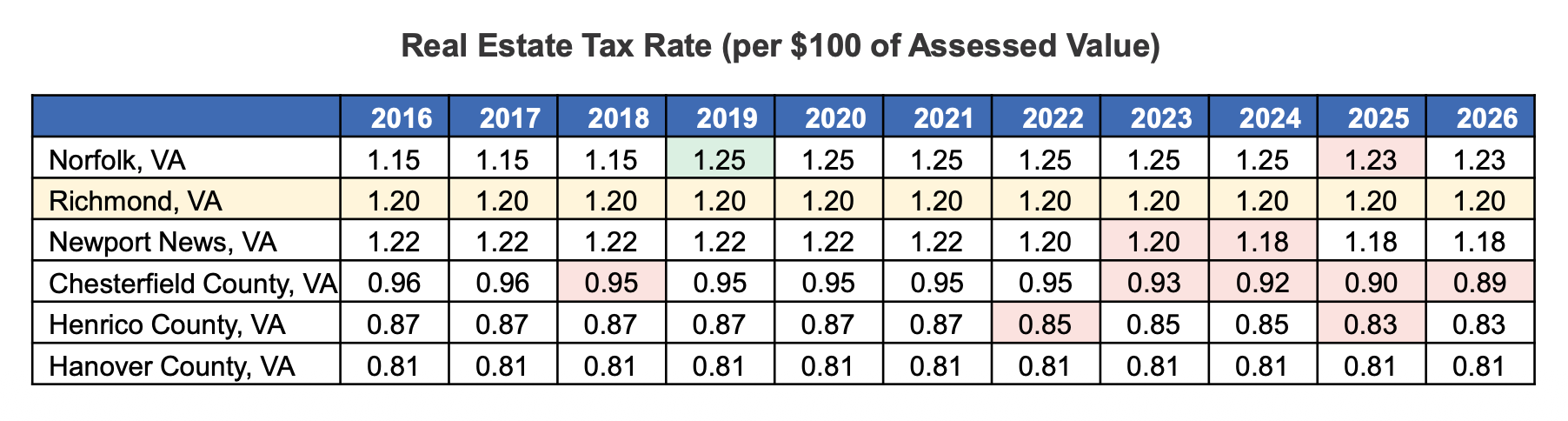
All except Richmond and Hanover have lowered their tax rate at least once in the last decade, the PFM firm’s report says. At 81 cents per $100 of assessed value, Hanover has the lowest tax rate in the group. Norfolk’s tax rate is higher than Richmond’s after rising to $1.25 in 2019 and dropping to $1.23 in 2025.
Chesterfield has lowered its rate four times in the last five years. Henrico has lowered its rate twice.
The consultants concluded that “peer localities are actively managing their rates in response to fiscal conditions and assessment growth, while Richmond has held flat.”
The firm’s report noted that comparable Southern cities like Durham, Winston-Salem, Savannah and Chattanooga have all lowered their tax rates in 2026.
Richmond has constraints other jurisdictions might not face, the report says, such as a high poverty rate, a high volume of state-owned property exempt from local taxes and a collective bargaining agreement allowing a unionized public workforce.
Because collective bargaining can increase personnel costs, the report says, Richmond “likely must maintain a higher tax rate to account for these locked-in expenses.” Richmond is currently doing a round of collective bargaining negotiations, and officials have stressed that’s an unknown cost factor.
Avula will formally introduce his next budget in March.
Contact Reporter Graham Moomaw at gmoomaw@richmonder.org