RPS Roundup: School Board asks Mayor to add funding for virtual academy as budget decisions loom
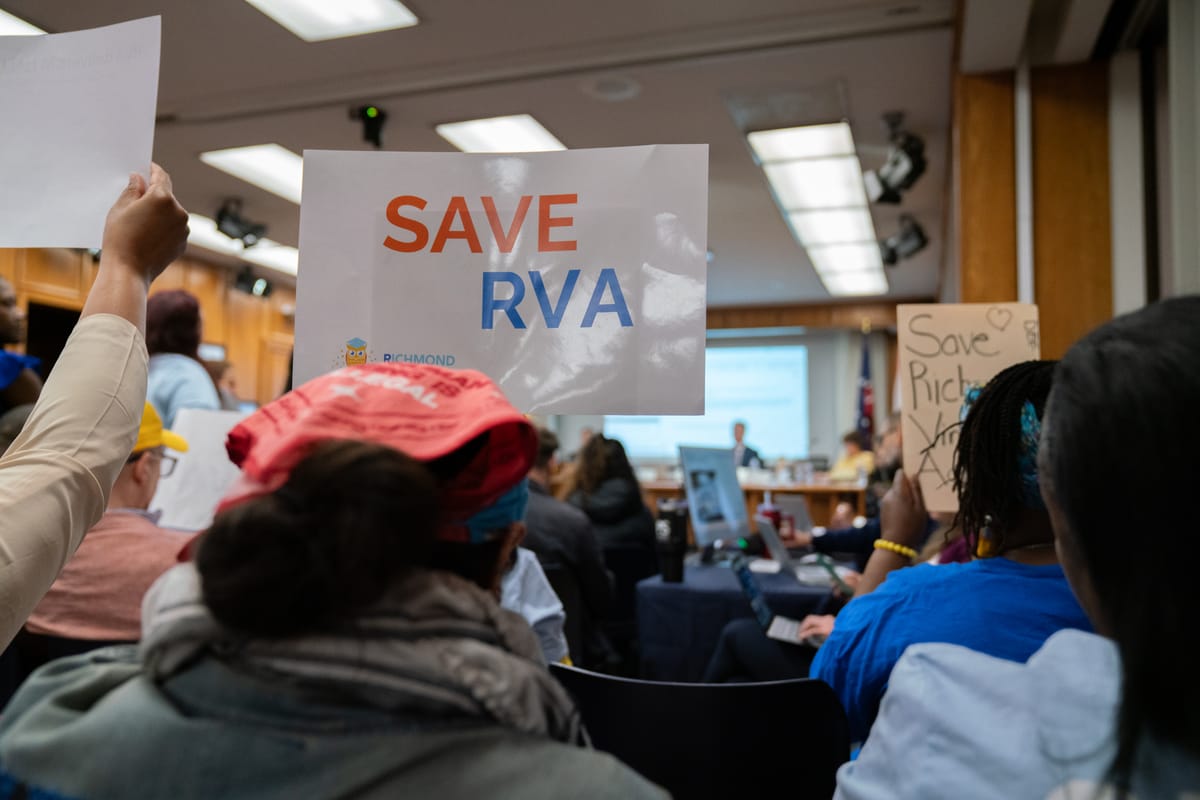
The Richmond School Board voted 6-2 to submit a revised budget for school year 2026-2027 that will ask the city to pay for Richmond Virtual Academy Tuesday night, putting pressure on Mayor Danny Avula one week before he unveils what he has said will be a tight budget.
The initial budget asked for the city to add $5 million to its funding commitments from last year. The new budget asks for $19.8 million extra, with $7.8 million earmarked for capital improvement projects.
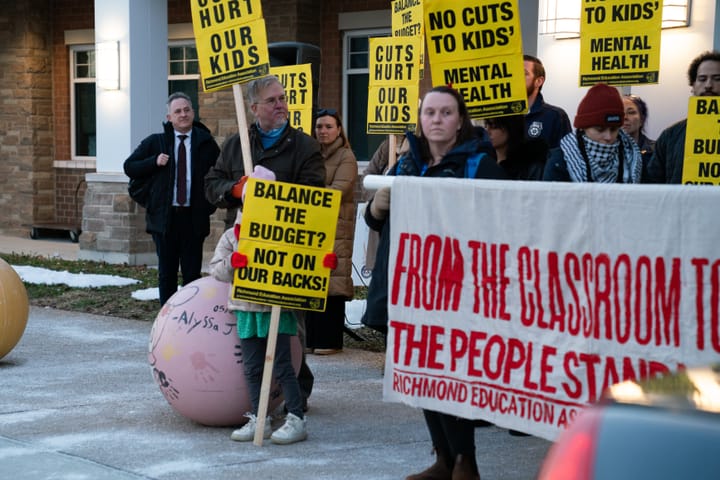
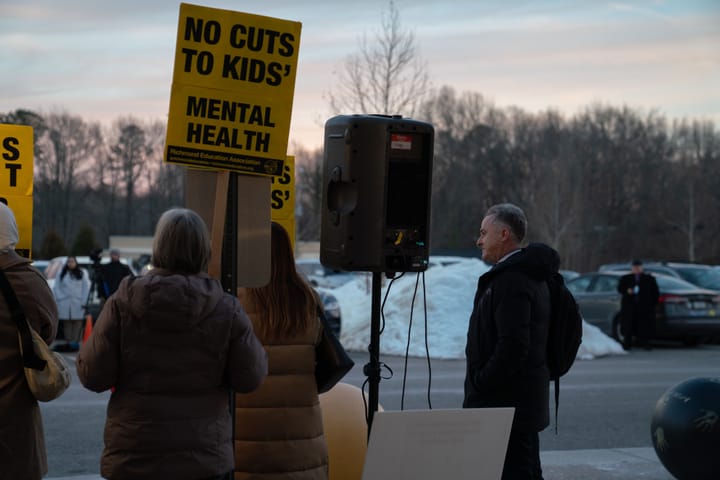
The vote followed a rally hosted by the division’s teachers’ union, the Richmond Education Association, outside of City Hall before the meeting began, a nearly hour-long public comment almost solely dedicated to preserving the academy, and nearly two hours combined of deliberation from the Board on the matter at both of its March meetings.
“Learning from home gave me peace. It gave me focus. It gave me room to breathe without fear of bullying. My confidence grew, my anxiety faded and my academic performance soared,” said an 11th grade student of Richmond Virtual Academy, speaking to Board members Tuesday night.
While admitting that adding the academy back into the budget does not guarantee it will be funded for next year, supporting members said that they recognize how important the virtual academy has been to families and students. The school serves about 150 students at a cost of $3.2 million annually. The federal government initially funded the program through COVID relief funds, but those funds have expired.
“The equity policy on student achievement … commits us to eliminating disparities and ensuring equitable access to learning environments for all students,” said Wesley Hedgepeth (4th District), who somewhat championed the school’s reinstatement. “The policy specifically acknowledges that students with different needs require different supports in order to reach their full potential, and for many students that’s Richmond Virtual Academy.”
Public comment may have swayed Stephanie Rizzi (5th District) and Katie Ricard (2nd District), as they previously expressed wanting to wait until the division surely received the extra funds before adding the academy back in.
Dissenters Matthew Percival (1st District) and Anne Holton (6th District) argued that it is unrealistic to add the academy to the budget when it’s highly unlikely that the city will meet RPS’ request for more money. Percival said that while he also wants to fund the academy, the division has other priorities to meet, like providing teacher raises.
“There were teachers here, but I never heard teachers say ‘I’d be willing to give up my raise for Richmond Virtual Academy to be funded,’” he said, referring to teachers who spoke during public comment. “And I wouldn’t expect them to, but that wasn’t on the table.”
Kamras warned that if the division does not receive the $3 million needed to keep the academy in May, he could not guarantee that currently vacant positions within Richmond schools for the academy’s teachers would still be available, as the general hiring season begins around that time.
“I do worry we would potentially be in a position of no longer being able to slot all teachers and certainly not having them go into positions that would be their first choice,” Kamras said.
As for students, he said the administration has been in touch with families and has extended open enrollment into the traditional schools for them.
Rizzi, along with Board Chair Shavonda Fernandez (9th District) asked Superintendent Jason Kamras to consider “reimagining” the academy, that could possibly support students transition back into brick and mortar schools. Kamras said he’d consider it, but it would still require funding.
The division’s total proposed budget is now $549.8 million for operating expenses – which includes school employee raises, mental health contracts, full funding of summer school and health insurance costs – and $10.3 million for capital improvements. The elimination of the 46 central office full time positions will remain.
The budget will now be sent to Mayor Danny Avula, who will introduce his proposed budget for the city on March 11. City Council will then approve the city’s contribution to the schools, at which point RPS will reconvene to set its final budget.
Cheryl Burke (7th District) was absent from the meeting, Fernandez noted, because her husband, Emmett “Spike” Burke, passed away early last month.
Facilities and vacant property committee recommends application process for property use
Chief Operating Officer Patrick Herrel presented a newly streamlined process that would allow nonprofits, private partners and government entities to apply to use RPS’ facilities.
Different organizations have requested to reuse some of the division’s vacant properties for services like affordable housing, community hub or early childhood center, Herrel and committee members noted, causing the creation of the process. The division is finalizing a transfer of the Moore Street School property to a nonprofit, and historic preservation groups have asked the Board to save the disintegrating 13 Acres building.
Interested stakeholders usually presented their request as items during board meetings or in public comment.
The application requires prospects to detail how the building will be used, who it will target, how it plans to fund the use and whether it will offer opportunities for RPS students.
After an individual applies, administrators will review applications and bring forward all, but also highlight fully vetted proposals to the Facilities and Vacant Property Committee. The committee will then review those applications once every four months, before making recommendations to the Board on specific proposals.
Increase in vapes despite clear book bag policy
Chief Wellness Officer Renesha Parks recommended that the Board continue maintaining the division’s clear backpack policy, despite a recorded uptick in vapes confiscated from February 2025 to February 2026.
Students were mandated to wear clear backpacks beginning July 2024 to make it easier for school officials to visually inspect contents of bookbags. The policy was also intended to make the search process of students during morning arrival to school more efficient, while aiming to deter and identify prohibited items like weapons, vape pens, and narcotics.
But the clear bags didn’t really stop the vapes.
School officials discovered 73 vapes from students this year, up from 47 last year. Faruk questioned whether the clear bags were the most effective way to catch, reduce and prevent vapes from entering the school.
“I just really have a problem with a policy that was designed to prevent one thing and now it mostly does another thing,” he told Parks, adding that there are many positives to the policy.
Parks said vapes and the clear backpack policy are two separate issues, and instead sees the uptick as evidence of the policy working, since more vapes are being seen and confiscated.
Fernandez also brought up the durability of the bags and concerns from constituents where bags have broken and are not replaced. The bags have been provided by the division to every student through its annual ultimate backpack drive.
Parks responded that such concerns have not been raised to her, but administrators have previously purchased drawstring bags that students can use for a day if their backpack fails on them. She added that some bags, specifically for elementary school students, are available.
“We want to make sure that we are reserving that for families who have the greatest need and there is no way they could absolutely replenish that backpack,” she said.
Rizzi brought up concerns about a culture of “surveillance” that students are frequently under, saying that she hopes administrators are talking with students to explain why the policy is in place while emphasizing that students do have “a right to privacy.”
Lisa “L.J.” Delao, an English teacher at Huguenot High School, exemplified what Board members were talking about, saying during public comment that their students have asked for the clear backpack policy to be removed because “they are constantly tearing, they are an invasion of privacy and they do not actually create a safer environment.”
Parks told Rizzi that students who have special circumstances can let school leaders know to receive better accommodations.
Contact Reporter Victoria A. Ifatusin at vifatusin@richmonder.org