RPS roundup: New system will manage 'difficult choices' on maintenance
Richmond Public Schools’ Chief Operating Officer Patrick Herrel introduced a priority system when school employees identify maintenance issues, ranking issues from high to low priority.
Issues identified as “high priority” include problems like chemical leaks, power outages or water leaks, and can be expected to be fixed within 48 hours. Medium priority problems pertain to items like a single room experiencing HVAC difficulties or broken ceiling tiles with no safety hazards, expected to be fixed within two months.
Issues involving aesthetics, like peeling paint or stained ceiling tiles with no active leak, are considered low priority and will be addressed in six months.
The division has financial limitations when addressing facility problems, Herrel said, resulting in “an enormous amount of deferred maintenance on our buildings.”
After spending funds on preventative maintenance and budgeted capital improvement projects for this school year, Herrel said the facilities team only has $170,000 for unexpected maintenance needs. That in turn requires the division to prioritize and make “difficult choices of what we can and cannot do.”
Superintendent Jason Kamras said it may be difficult for constituents and staff members to adapt to the new system, but it is necessary “to begin to manage expectations.” Administrators have already identified school leaders, Herrel said, and the public can expect to see more online very soon.
The School Board also voted last week to adopt a set of recommendations presented by the facilities committee last month, including sunsetting the 13 Acres property for a year before demolishing the building and retaining green space if community members are unable to provide solutions on what to do with it.
RPS enrollment numbers show slight changes
The district has witnessed a nearly 350-student increase in its enrollment numbers this school year, bringing the division’s enrollment to 21,775 students, an increase from 21,427 for the 2024-2025 school year.
The district is still behind pre-pandemic levels, as enrollment numbers reached a high of 28,225 and 25,212 in the 2020-2021 and 2019-2020 school years, respectively. There are about 35,000 school-age students living in the city, said Luke Hostetter, RPS director of enrollment, adding that the remaining students are likely attending private schools.
In an effort to recruit more students to RPS, Hostetter said that his department has been in frequent contact with families who have rising kindergarteners to help with applying for schools. The department also uses birth rate data from the State Department of Health along with historical data for rising sixth and ninth graders to predict enrollment.
Kamras added that the division has reached out to multiple developers of affordable housing projects to ask for details about units they plan to build, to better predict enrollment numbers for the future and whether or not the schools can handle the capacity.
This year brought slight gains in Hispanic and white students, while the number of Black students decreased.
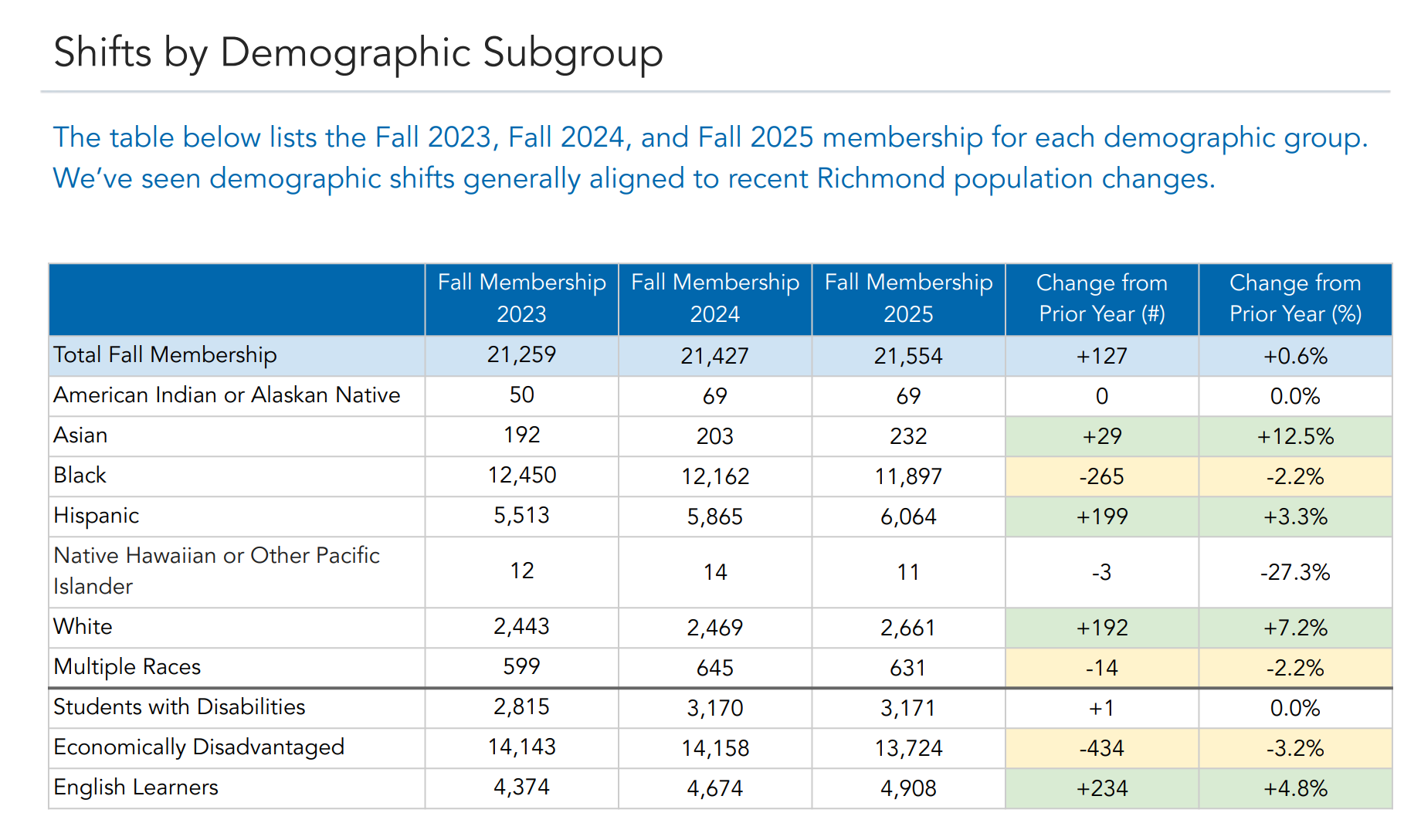
The trends follow the population coming in and out of the city as seen in U.S. Census data, Hostetter said. Although population numbers for 2024 and 2025 are not available, the decline among Black residents and rise in white residents in Richmond is evident, beginning shortly after the COVID-19 pandemic.
As of 2023, more white residents (98,401) live in the city than Black residents (95,612). Hispanic residents have also risen in population, to 23,439 in 2023, up from 16,220 in 2020.
Along with the presentation were statistics about middle schoolers applying to the area’s selective admissions schools – Appomattox Regional Governor’s School, Franklin Military Academy, Maggie L. Walker Governor’s School, Open High School and Richmond Community High.

Board members noted low acceptance from Martin Luther King Jr. Middle School specifically, where 65 students applied to the schools, and only 23% of students were eligible to be accepted.
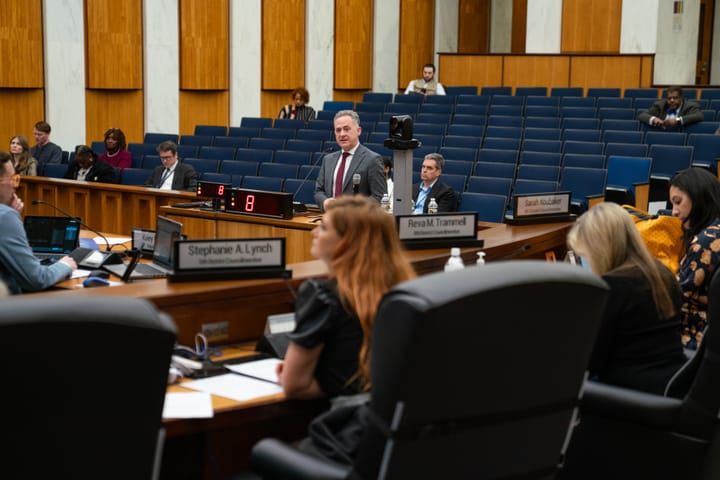
“A lot of students are applying, very few are getting in,” Stephanie Rizzi (5th District) said. “Non-RPS students are doing better getting into these schools than MLK students, and not to say that’s something we need to address, but I do think we need to pay attention to it.”
RPS hires new chief talent officer
Elizabeth Veliz joins RPS as its new Chief Talent Officer, beginning her position in mid-November. Her position oversees human relations and hiring in the district.
Originally from New Jersey, Veliz is bringing over two decades of experience in human resources, the division announced, with the majority of it being in health organizations.
She comes in after the departure of former Chief Talent Officer Maggie Clemmons in May, after employees alleged she created a toxic work environment. Clemmons filed a lawsuit in September, alleging the superintendent and School Board allowed employees to defame her during public comment at a Board meeting.
Contact Reporter Victoria A. Ifatusin at vifatusin@richmonder.org