RPS offers new budget asking for additional city funding to reinstate raises, other programs
Richmond Public Schools Superintendent Jason Kamras is walking back some budget items he previously proposed cutting for fiscal year 2027, but in order for those programs to return, Mayor Danny Avula will have to provide additional funding in his upcoming budget, which is expected to be tight.
In a workshop meeting, Kamras proposed a budget that would include additional funding for:
- a 2% raise for all union units currently in negotiations, like teachers, school nutrition services, care and safety associates and instructional assistants ($7,000,000),
- existing collective bargaining agreements like raises for central office staff, custodians, office associates, transportation, and principals ($5,428,938),
- a 75/25 split between RPS and employees on increases in health insurance costs, rather than a 50/50 split ($4,265,278),
- mental health support contracts ($576,737), and
- summer school for elementary and middle school students ($2,100,000).
The new proposed budget puts more pressure on the division to find an additional $40 million in new revenues on top of last year’s $526 million budget.
As a result, the division will now ask the city for about $21 million in additional funding, up from an initial request of $6 million.
Kamras said that while the proposed budget safeguards the most critical functions of Richmond schools, he reiterated that cuts will still impact the division in case all funding needs aren’t met, which he suspects is likely due to the city’s pause on property taxes.
“I think it is extremely unlikely that the city of Richmond … (is) going to come up with $21 million and I'm being very transparent about that with everybody here tonight,” he said.
 Michael Phillips
The updates come after a nearly month of calls for a “needs-based budget” from the division’s teachers’ union and other public comments of frustration with Kamras’ proposal.
Adding the items back into the proposed budget does not guarantee they will be in the final and approved budget, as funding is still needed to pay for them.
RPS said it is now expecting to receive $8 million from the state, up from an initial projection of $7 million, thanks to a budget bill that includes a 2% salary increase for funded instructional and support positions under the state’s Standards of Quality. However, that will not cover all RPS employees.
“We have more positions than the SOQ requires us to have,” said Vice Chair Matthew Percival (1st District). “So when the state says here’s money for a 2% raise, what they’re really saying is here is a fraction of a fraction of the money for a 2% raise.”
A proposal to eliminate 46 central office positions remains, but was concerning to Board members during the meeting.
Newly appointed Anne Holton (6th District) called the potential 46 layoffs “hard,” adding that “a well operating central atmosphere is crucial” for student outcomes.
“That’s a lot of FTEs to be cutting out of central office if we’re already lean,” she said, using the acronym for full time employees. “Are they ones we can afford to make? Are we cutting into fat or are we cutting into bone?”
“Bone,” Kamras responded.
Board Chair Shavonda Fernandez (9th District) agreed with Holton and proposed revealing the 46 positions, to provide transparency and an understanding of how cuts may impact student achievement.
“We can say to [the public] ‘just trust us that these are not impacting the inside of the classroom.’ But by us not allowing for that layer of transparency, it is not clear to the public which roles are being eliminated,” she said.
She added that the division’s lawyers said there are no legal ramifications for disclosing the positions and some employees have shared that they are open to their situation being public. Members agreed to notify and ask the 46 employees ahead of the March Board meeting, when the positions may be announced.
The somewhat lone voice on the matter, Wesley Hedgepeth (4th District) said he would continue to advocate for funding to reinstate Richmond Virtual Academy.
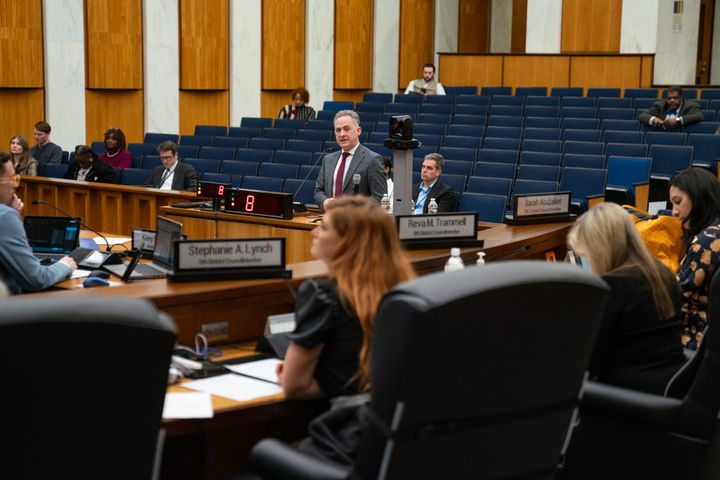
Kamras spoke at City Council’s Education and Human Services Committee meeting last week, where questions surrounding collective bargaining agreements, teacher pay and other budget items were raised.
“The reason why I’m asking those questions is to really break it down in dollars and cents so that we know what is potentially before us and what is before you all,” said Committee Chair Stephanie Lynch (5th District), who added that more discussion on the division’s budget items will occur.
Specific requests
If additional funding is obtained, Rizzi asked Kamras if the administration can “streamline” aspects of budget items like summer school for elementary and middle school students. She shared that administrators told her that there are 5.7 students for every one adult in summer school, adding that she has seen “very tiny classroom sizes.”
She added that the division should better track the impact of summer school for elementary and middle schoolers to ensure that RPS is getting “a return on those investments.”
The administration can look into making summer school more cost effective, Kamras responded, meaning that the program can be half a day rather than full, or targeted towards a specific number of students.
As part of calls for transparency from the public, Rizzi also referred to the Richmond Education Association’s demand for an audit of RPS’ budget, and said that the Board should consider an external analysis of the division’s systems and expenditures, which Fernandez backed.
“I would really like to see that. I think it would also help the public understand exactly how money is being spent and how they support our goals,” Rizzi said, adding that the report could reduce the uncertainty the public feels about how RPS is allocating funds.
Although funding for mental health services returns in the latest proposal, Hedgepeth asked for more funding towards mental health, and for Richmond Virtual Academy to be fully reinstated if money becomes available.
Ali Faruk (3rd District) also asked what options are available for students, as he said he has heard from parents that Virtual Virginia – a virtual schooling program from the state – does not meet all of their students’ needs.
In response to concerns previously raised about whether students leaving the division would impact RPS’ average daily membership, which is tied to how much money Richmond schools get from the state, Kamras said it will have some impact, but likely not a lot.
Hedgepeth also asked the Board to consider adding a parking lot, drop-off and pick-up loop project for Westover Hills Elementary School to the division’s capital improvement plan for fiscal year 2027, a request specific to his district.
The project is urgent due to the city’s upcoming reconstruction of Jahnke Road – which is next to the school – and the need for safety improvements, he said. The request is not currently among the identified $9.3 million needed in facility projects, although it is likely that only $2.5 million will be provided for such projects in the end.
“We can proactively mitigate this now or deal with the daily congestion, safety risks and higher costs later,” he said, adding that Councilor Sarah Abubaker (4th District) expressed her support for the project.
Board members agreed, as long as the project doesn’t deprioritize other construction plans, which Hedgepeth agreed to. Percival (1st District) shared his support for the project if the city can agree to at least pay half of the construction’s costs.
Kamras will present his budget to a meeting of City Council on March 2, and on March 11 Avula will present his proposed budget, which will indicate how much additional money he intends to provide for schools. RPS will finalize its budget on June 2, after final funding amounts are known.
Contact Reporter Victoria A. Ifatusin at vifatusin@richmonder.org This story has been updated to correct the number of students to adults in summer school.