RPD has spent $1 million on Flock license-plate readers. With those contracts up for renewal, anti-surveillance activists call for cancellation while Mayor, Council demur
Since 2024, the Richmond Police Department has spent over a million dollars on a controversial, artificial-intelligence-powered surveillance system, a Richmonder analysis of public records revealed.
Now, as the city’s contracts with Flock Safety are approaching renewal deadlines, activists are calling on Mayor Danny Avula and City Council to terminate the department’s use of its cameras and audio sensors, citing high-profile examples of racialized policing, false positives, and federal abuse.
At a mid-February protest, Victoria McCullough, a member of Richmond’s chapter of the Democratic Socialists of America (RDSA), joined speakers from Virginia’s Americans for Civil Liberties Union and Christopher Newport University’s Center for Crime, Equity and Justice Research and Policy in objecting to the contract.
“These cameras have already been used repeatedly to target protected political activity and marginalized communities,” she said, detailing how RPD tracks cars by model, color, and license plate number on approximately 100 always-on cameras around the city, without a warrant. The Avula administration, McCullough added, must “block Flock.”
So far the mayor has done the opposite, repeatedly coming down in Flock’s favor. Avula’s press secretary, Mira Signer, declined to make him available for an interview, citing scheduling conflicts and complications from the winter storm in late January, but wrote in an emailed statement that he “continues to be both supportive of RPD's use of Flock as a tool to solve crimes and also continues to take the privacy and auditing seriously.” City Council spokesman Steven Skinner told The Richmonder in an emailed statement that Council President and 7th District representative Cynthia Newbille “wholeheartedly support[s]” RPD’s use of the Flock system.
Police Chief Rick Edwards hopes to renew the contracts this year. “We're very pleased with the results,” he said in a phone interview in mid-February. “From our standpoint, there's example after example after example after example, of this technology being used to catch criminals ... not only quicker, but leaving the innocent witnesses out of it.” He believes Flock’s benefits outweigh its harms.
With both its Flock contracts up for renewal this year, RPD has begun promoting its use of the surveillance system to the public. It was “good police work” combined with “the narrow, sharp focus of Flock technology” that helped officers quickly arrest a driver suspected in a deadly hit-and-run on South 2nd St. on Feb. 17, Edwards said in an official press release announcing the collar.
A day later, RPD spokesperson James Mercante issued another press release touting the use of information from Flock's automated license plate readers (ALPRs) in the arrest and indictment of the alleged driver in the hit-and-run on Semmes Ave. in Dec. 2025. Edwards also said Flock’s ALPRs “were used very effectively” in the investigation that led to the arrest of suspects related to the fatal shootings in Shockoe Bottom in late February.
RPD uses two types of devices manufactured by Flock: gunshot detectors (effectively microphones designed to alert police to noises that fit that audio profile) and ALPRs, which stream footage from around the city to the Capital City Intelligence Center, which Edwards and then-mayor Levar Stoney opened in 2023 with a $750,000 grant from the commonwealth.
A Richmonder review of public records indicates RPD’s contracts for the use of Flock's microphones and cameras expire on March 18th and June 30th, respectively. The city’s payment register shows at least $1,003,674.81 in Flock-related remittances made between October 2024 and November 2025 to Insight Public Sector, Inc., the procurement vendor through which RPD and other city departments purchase technology systems.
In addition to its own public-records requests, The Richmonder also used documents previously obtained by RDSA and The Church Hill Lookout to reach this total.
The Richmonder requested payments by the city to the company providing Flock services to RPD. That request dovetailed with another controversy right now at City Hall, as the requested documents would be part of a payment register that it is required to be provided by city code, but hasn’t been updated since 2019.
In early March, City Councilmember Kenya Gibson (3rd District) threatened to subpoena Avula over what she said was the administration’s ongoing disregard for the ordinance and good-government advocates’ concerns about a lack of transparency; in a statement to the Richmond Times-Dispatch, Signer claimed cost and staffing limitations were to blame and pointed instead to a “monthly financial synopsis,” a noncompliant document.
Federal abuse, statewide noncompliance spark concern
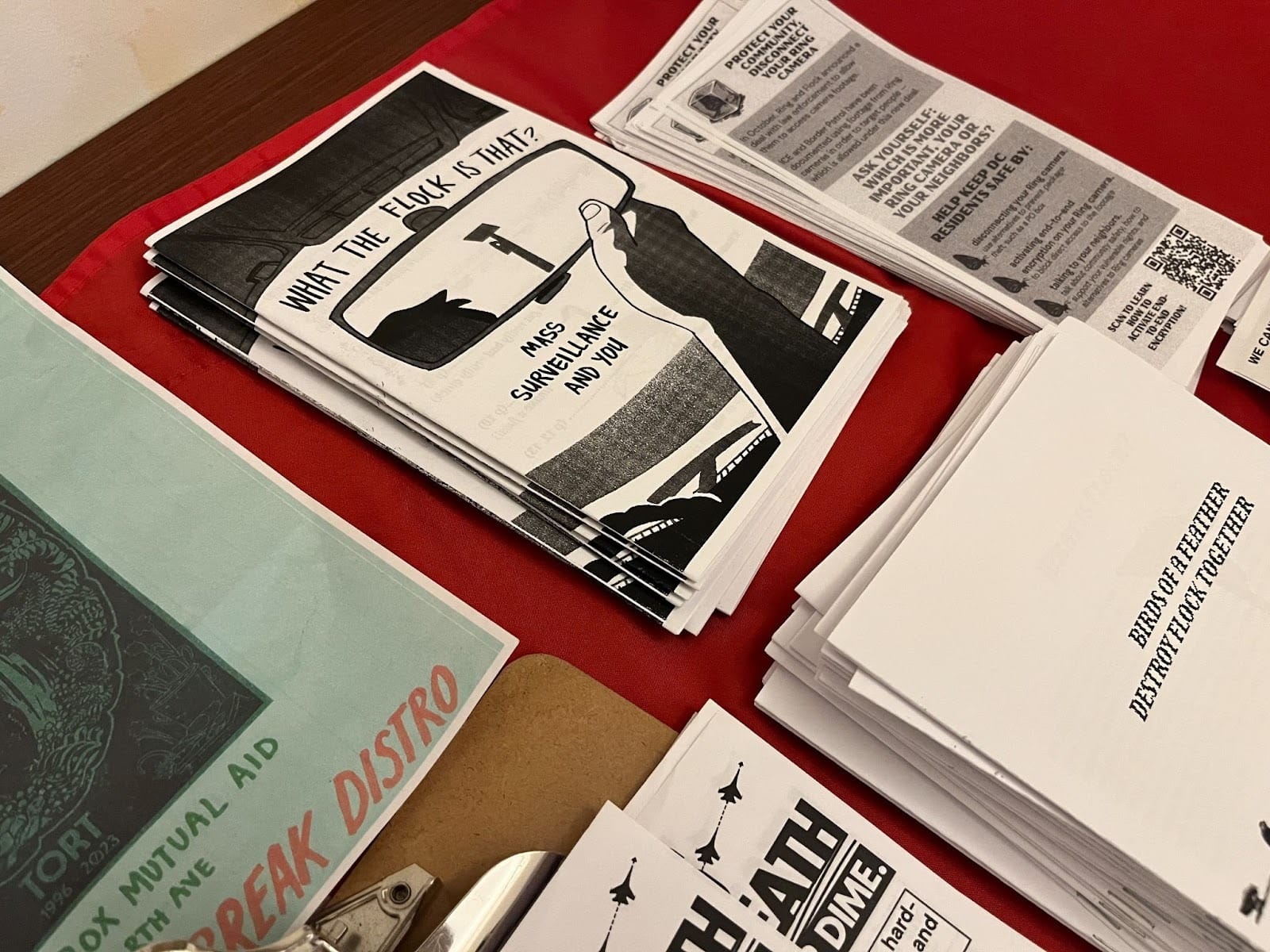
Richmond DSA’s protest plan, first outlined at a standing-room only meeting at Richmond Public Library’s main branch in January, includes raising awareness among city residents for what Flock is, how much it costs, and the ways in which its physical cameras, online software, and caches of footage have been exploited across the country by federal immigration officials, sheriffs' offices, and rank-and-file police.
“Flock has a fast-and-loose relationship with privacy,” said Rob Poggenklass, the executive director of Justice Forward Virginia, a non-partisan criminal justice nonprofit that has lobbied against ALPRs at the General Assembly. “I strain to use the words ‘Flock’ and ‘privacy’ in the same sentence.”
A representative for Flock Safety acknowledged The Richmonder’s request for comment but did not respond further.
The company has come under increased scrutiny since the beginning of the second Trump administration as researchers and journalists discovered evidence that federal immigration enforcers were tapping into the cloud-based footage database fed by locally operated license-plate readers to track the locations of people targeted for deportation.
In July 2025, after inquiries from the press, RPD acknowledged that its Flock system had been used to conduct immigration-related searches by a Bureau of Alcohol, Tobacco, Firearms and Explosives (ATF) agent who had previously been granted access for an unrelated reason.
“If ATF had formally requested access for that purpose, I would have denied it,” Edwards said at the time.
At least five counties in Virginia, as well as municipalities across the country from Syracuse, New York, to the Chicago suburbs, to the Bay Area of California, have had their footage improperly accessed for similar queries.
Flock’s critics contend this sort of federal abuse—not to mention other sorts, like cops stalking their ex-wives, or sheriffs searching license plates across the country to find a Texas woman who had an abortion—is the unavoidable result of building such syndicated surveillance systems. National detractors include Democratic members of Congress like Senator Ron Wyden and Illinois Representative Raja Krishnamoorthi, who in November 2025 called on the Federal Trade Commission to investigate Flock over its data-collection and cybersecurity practices.
Edwards told The Richmonder that he believes a Virginia law signed in early May 2025 will stanch this potential for abuse, thanks to provisions that prohibit out-of-state footage sharing and make use of ALPRs for unsanctioned purposes a Class 1 misdemeanor, similar to reckless driving or trespassing.
A report published in January 2026 by the Virginia State Crime Commission suggests some Virginia law-enforcement agencies that use ALPRs are not complying with the law, which took effect on July 1 last year. More than one in five law-enforcement agencies that responded to the survey volunteered that they are retaining the data gathered from their surveillance networks longer than the legal limit of 21 days; 21 allowed continuous footage-sharing across state lines; nine admitted to sharing ALPR data with federal agencies. All these practices are illegal under Virginia’s statute.
“In addition, almost one-third of law enforcement agencies did not respond to the survey; therefore, their ALPR use is unknown,” the commission wrote. RPD is one of approximately 160 Virginia agencies that use Flock-branded tech, according to the company’s “transparency portal;” some 70% of respondents to VSCC’s survey use ALPRs overall.
Perhaps unsurprisingly, opponents to RPD’s use of this technology are not comforted by the new rules.
Alyssa Todaro, an East Henrico resident and RDSA member, told The Richmonder that “lack of accountability and lack of transparency about the use of it” are her biggest objections to Flock. (Henrico and Chesterfield Counties both maintain their own contracts with the company.) “Anybody who has access to it can just share that access or abuse their access to it… it’s too gratuitous.”
Even when Flock’s system is not deliberately manipulated, it has suffered several prominent security scandals in which watchdogs have found ways to access its sensitive footage without credentials. Late last year, technologists and security researchers were able to easily access the company’s Condor facial-recognition cameras filming pedestrians in Georgia and California due to what the company would later describe to 404 Media as “a limited misconfiguration on a very small number of devices.” (RPD does not currently operate the Condor model.)
Jack Soulen, a Richmonder who attended the RDSA meeting in January, is worried about the potential harm from such mistakes and mismanagement.
“These tech companies are filled with idiots, they don’t know how to secure” the systems, he said.
Other activists concede Flock has flaws, but back RPD’s use of the system. “No system is perfect, including Flock,” said Juan Braxton, the criminal justice chair for the Richmond NAACP at the RPD’s presentation to City Council about ALPRs last month. “But when it’s your family that’s looking for something, you’re going to want those Flock cameras.”
In January, some police departments across the country accidentally released the license plate numbers of millions of surveillance targets across the country by improperly redacting Flock audit logs in response to public-records requests. A privacy activist in Iowa set up HaveIBeenFlocked.com as a searchable repository of the 2.3 million plate numbers “to show how pervasive and prevalent this monitoring,” as he told 404 Media. (Flock blamed this failure on “increased public records act/FOIA activity seeking by the public” and tried to get the site taken offline.)
Soulen said he is creeped out by the fact that Flock cameras, unlike the more heavily regulated speed cameras that operate around some Richmond schools, feed an always-on network on which law-enforcement users can conduct warrantless searches statewide. (“It gives me the willies,” he said.) This advanced, interconnected function has inflamed debates about the appropriate balance of public safety and individual liberty, both nationally and here in Virginia.
In Norfolk and Richmond, plaintiffs filed separate suits in 2024 alleging that those police departments’ use of the system — which, according to the law passed by the General Assembly in 2025, can retain the footage it gathers for 21 days — violated their privacy and Fourth Amendment rights barring warrantless search and seizure. Judges in those cases have allowed that Flock’s ALPRs could present constitutional problems in higher numbers, but ruled for the police in both instances for the time being.
“ALPR surveillance could become too intrusive and run afoul of [constitutional privacy standards] at some point,” wrote federal judge Mark Davis of the Eastern District of Virginia in a 51-page ruling released late last month. “While a definitive answer to that question is elusive, what is readily apparent to this Court is that, at least in Norfolk, Virginia, the answer is: not today.”
The plaintiffs in that case, represented by the Arlington-based libertarian organization Institute for Justice, told WHRO they plan to appeal.
Those rulings have affirmed Edwards’ belief that Flock’s benefits outweigh its harms.
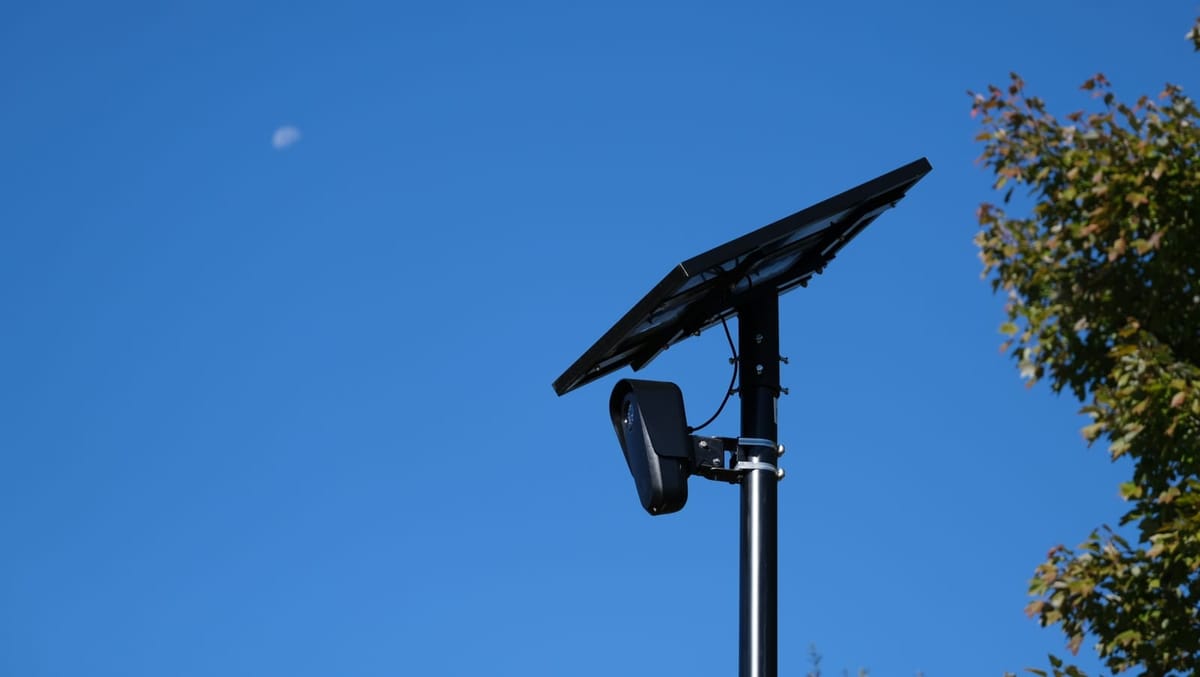
“We don't have them on every corner,” he said. There are around 100 Flock LPRs fixed to traffic-light poles or standalone black streetposts throughout the city; in an October 2024 ruling upholding RPD’s use of the cameras within the city, U.S. District Judge Robert Payne deemed that to be enough of a “limited number” as to not violate the plaintiff’s privacy, though he noted he couldn’t predict “whatever might happen in the future” regarding the technology.
Edwards considers Richmond’s fleet of Flock cameras to be a compromise position, pointing to Hampton Roads, where Suffolk and Norfolk lead the commonwealth with the highest number of the devices—196 and 176, respectively.
“Certainly, there are those in my office who said let’s triple” Richmond’s count, he said. Richmond’s rate of public devices per resident comes in around one ALPR per 235 people, which Edwards said puts RPD in the “middle of the pack” compared to other cities in Virginia with contracts for the technology. (The metric does not include Flock devices on private property, like those monitoring the Lowe’s parking lot on West Broad St.; these also feed searchable footage into the Flock database.) He defended RPD’s record of providing elected officials, and the public, information about its use of the system.
“There are many places that just don't acknowledge [their use of Flock] but I’ve been transparent from the beginning,” Edwards said. He declined multiple requests to disclose the locations of the city’s Flock cameras, citing concerns about vandalism.
Nonwhite neighborhoods more heavily surveilled
The layout of Richmond’s surveillance network is of particular interest to activists and scholars trying to understand how the cameras may reinforce racial discrimination or encourage pseudo-scientific “predictive policing” in the city.
“The brunt of the surveillance state, as ALPRs expand it, is going to fall on communities of color,” said Steven Keener, an assistant professor and the director of the Center for Crime, Equity and Justice Research and Policy at Christopher Newport University.
He is the Richmond-based co-author on a first-of-its-kind independent study, the preprint of which was published in mid-January, that used the location data for 614 Flock ALPRs across Hampton Roads unsealed in the Norfolk suit to analyze how law-enforcement agencies place these devices. By overlaying the Flock map on census tracts, the researchers were able to quantify just how much more Black residents of Hampton Roads were surveilled than white residents.
“When you get into highly segregated census tracts, so census tracts that are 70% Black compared to 70% white, they have almost eight times their camera share compared to population share,” one of Keener’s co-authors, Johnny Finn, a CNU geography professor, told WHRO last month.
(Neither Signer nor Skinner, spokespeople for Avula and Newbille respectively, responded to The Richmonder’s inquiry as to whether the officials had read the CNU study, which has garnered statewide media coverage.)
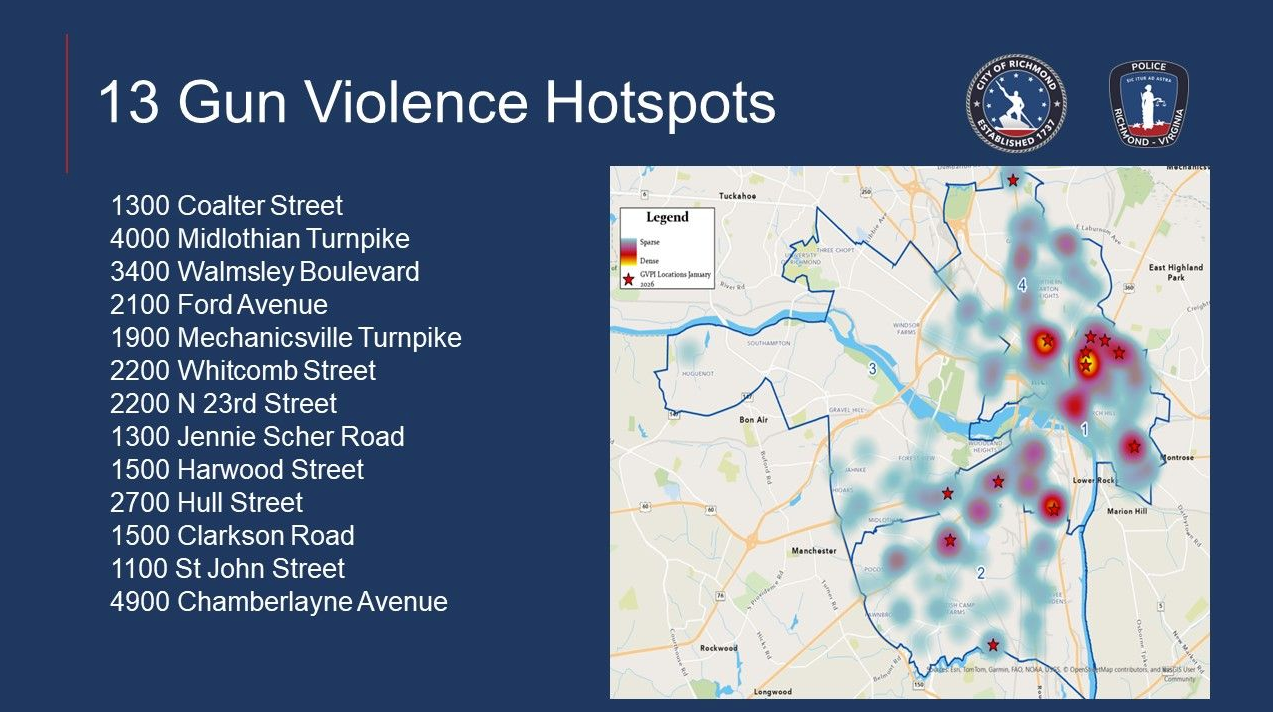
While there are “some [cameras] in the West End,” Edwards told The Richmonder that “we do generally put them where our gun-violence hot spots are.”
Those 13 locations are clustered in the Blacker and poorer East End and Southside; there are none west of the Nickel Bridge. (The use of the cameras is not restricted to solving only gun-related crimes.)
Without real transparency on where RPD’s surveillance devices are located, Keener sees no way to rule out a racialized layout like the one his research team found in Hampton Roads. “If you are this confident, and [Flock] is this amazing technology despite the myriad of security and privacy risks, then give us a peek behind the curtain,” he said.
Absent that, Richmond residents, privacy advocates, and social- and racial-justice advocates are left with what McCullough jokingly referred to as a “just trust me, bro” promise from RPD and city officials that Flock is not being used to perpetuate Richmond’s long history of overpolicing nonwhite communities.
Edwards takes umbrage with the critique that RPD’s decision to focus the surveillance technology on poorer and Blacker parts of Richmond is discriminatory. Not putting them there would be discriminatory, in his view—a form of racist disinterest for nonwhite neighborhoods that he said is “much more prevalent” in some local media coverage than in RPD’s enforcement patterns.
“There are people being murdered in these areas and shot and wounded,” Edwards said, dismissing predictive-policing concerns as a “false equivalency” because the shootings are already happening in these neighborhoods. “They are the victims of crime and deserve our protection.”
Efficacy in crime-solving contested
Edwards is quick with examples of how RPD has used Flock’s cameras to make arrests more quickly and efficiently, including the Broad Rock killing, shooters apprehended on Redd Street and a recent arrest in Mosby Court.
He has also said that the cameras also allow RPD to gather evidence without exposing would-be witnesses to retaliation and more tightly focus pursuit of suspects based on their “vehicle fingerprint[s]” to avoid inconveniencing or endangering innocent bystanders, claims that appeared to resonate with some members of City Council during a public-safety presentation last month.
Thanks to Flock, “we're not stopping soccer moms who are driving through at gunpoint,” he told The Richmonder.
Reporting shows that Flock’s software has occasionally precipitated that exact scenario. In June 2025, police in Morristown, Tennessee drew their weapons on grandparents traveling with their 3-year-old granddaughter after stopping them due to an alert from the system triggered by a misread license plate. Other innocent drivers have been less lucky. The Toledo Police Department sent a citizen to the hospital with brutal K-9 wounds after Flock misread his plate there in April 2024. Due to issues stemming from the trauma and injuries sustained in that incident, the man lost his job, dogs, and home, eventually settling a lawsuit with TPD for $35,000 in October 2025.
In response to these situations, Flock has insisted its software is highly accurate and improving all the time. “A human should always manually verify any ALPR hit,” it recently told Business Insider.
A similar misread error has not been reported in Richmond.
“What it’s done for our clearance rates,” or the number of cases solved per year compared to the total number of cases, “cannot be understated,” said Edwards.
In 2024, when RPD’s Flock system was installed, the department had a uniform crime reporting (UCR) clearance rate of 53.7% and an incident-based reporting (IBR) homicide clearance rate of 85.2%. (IBR is preferred by the FBI because it is considered more comprehensive than UCR.) Last year, the first full year with the system, RPD’s UCR and IBR homicide clearance rates were 64.8% and 79.5% respectively. Both years saw 54 murders, roughly 10% fewer than the city’s 10-year average.
Flock’s actual effect on these rates is notoriously difficult to quantify.
“Crime rates are coming down across the country regardless of whether jurisdictions have cameras or not,” said Poggenklass. “You can't pin falling crime rates on ALPRs.” Federal crime data shows 2024 was the safest year on record since 1969. (The FBI has not yet released its annual comprehensive report for 2025.)
Available independent scholarship and reporting on the matter suggests Flock ALPRs’ impact on crime-solving is limited. (Data on gunshot detectors are even less encouraging.) But legitimate research is itself limited, in part due to the difficulty of obtaining credible data on the systems’ operation. In fact, despite its seven-figure price tag, RPD does not collect data related to its use of ALPRs that independent experts could analyze.
“There are no easy-to-access metrics on Flock use / Flock success,” RPD spokesperson James Mercante wrote in an emailed statement. “When used, it is a component of many different parts of a criminal investigation.”
The absence of such data doesn’t just make it difficult to evaluate whether Flock and systems like it are effective at reducing crime. As CNU’s Keener points out, it also makes it virtually impossible to say whether they are cost-effective. “How much are we actually spending, not just on contracts, but on the fact that the vast majority of uses of this database are turning up nothing of significance?” he said. “How much taxpayer money are we wasting on that?”
Three Virginia jurisdictions block Flock
Not every Virginia city has Flock cameras. Two that did — Charlottesville, and Staunton — have since canceled their contracts, citing concerns over cost, privacy, potential for abuse. (The city of Warrenton abandoned discussions to purchase Flock devices in October 2025 for similar reasons.) In Staunton’s case, an unsolicited email from Flock’s CEO to its chief of police helped to turn the tide against the tech by baselessly casting residents’ objections to the technology as a “coordinated attack” by “activist groups who want to defund the police, weaken public safety, and normalize lawlessness.”
Edwards echoed this framing, saying that “there [are] a lot of powerful entities that want to see this technology go away.”
When asked to clarify, he alluded to “certain lobbyists that go to the General Assembly trying to tear this down,” but did not identify any critics by name.
Flock, for its part, has powerful entities behind it as it pushes to expand in Virginia and across the country. It has raised hundreds of millions of dollars of funding from investors that include funds affiliated with prominent right-wing billionaires like Peter Thiel and Marc Andreessen. In announcing its most recent $275 million fundraise, Flock touted its value at $7.5 billion. By contrast, Justice Forward Virginia, which has emerged as a key opponent of Flock’s lobbyists at the General Assembly, reported revenues of just $126,200 on its most recent filing with the IRS.
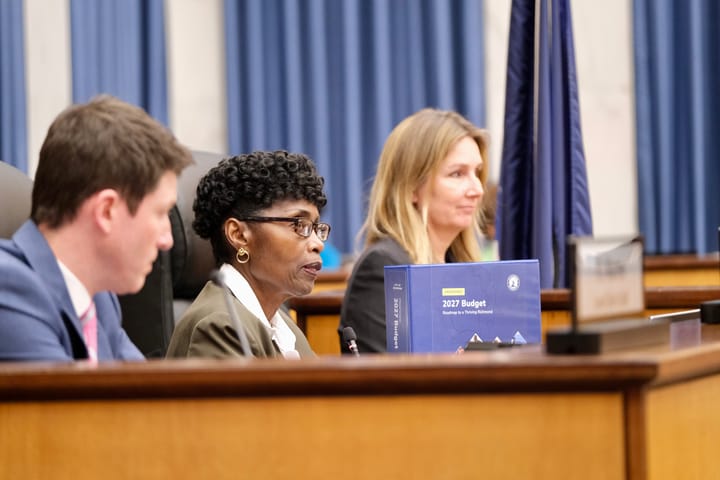
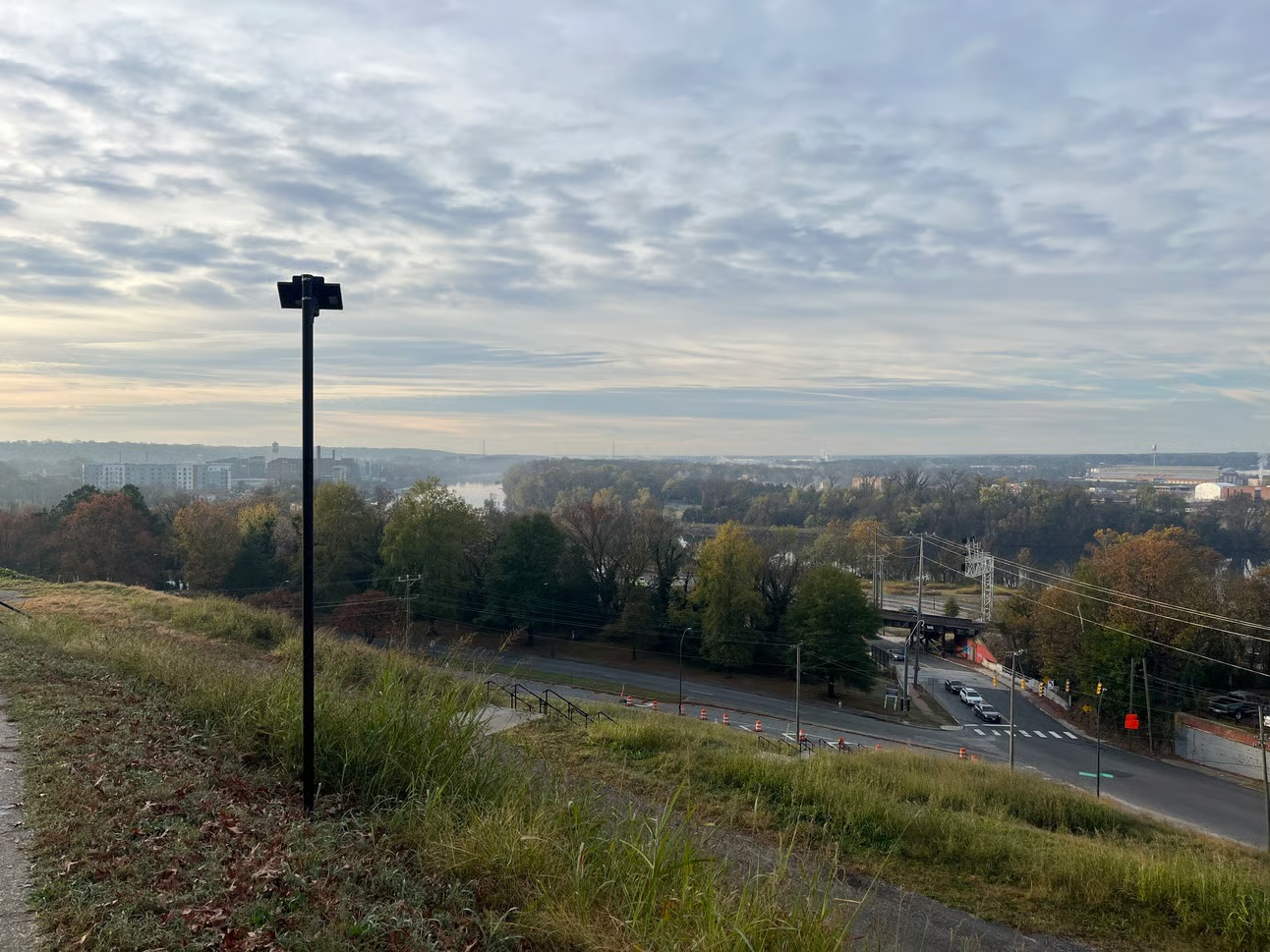
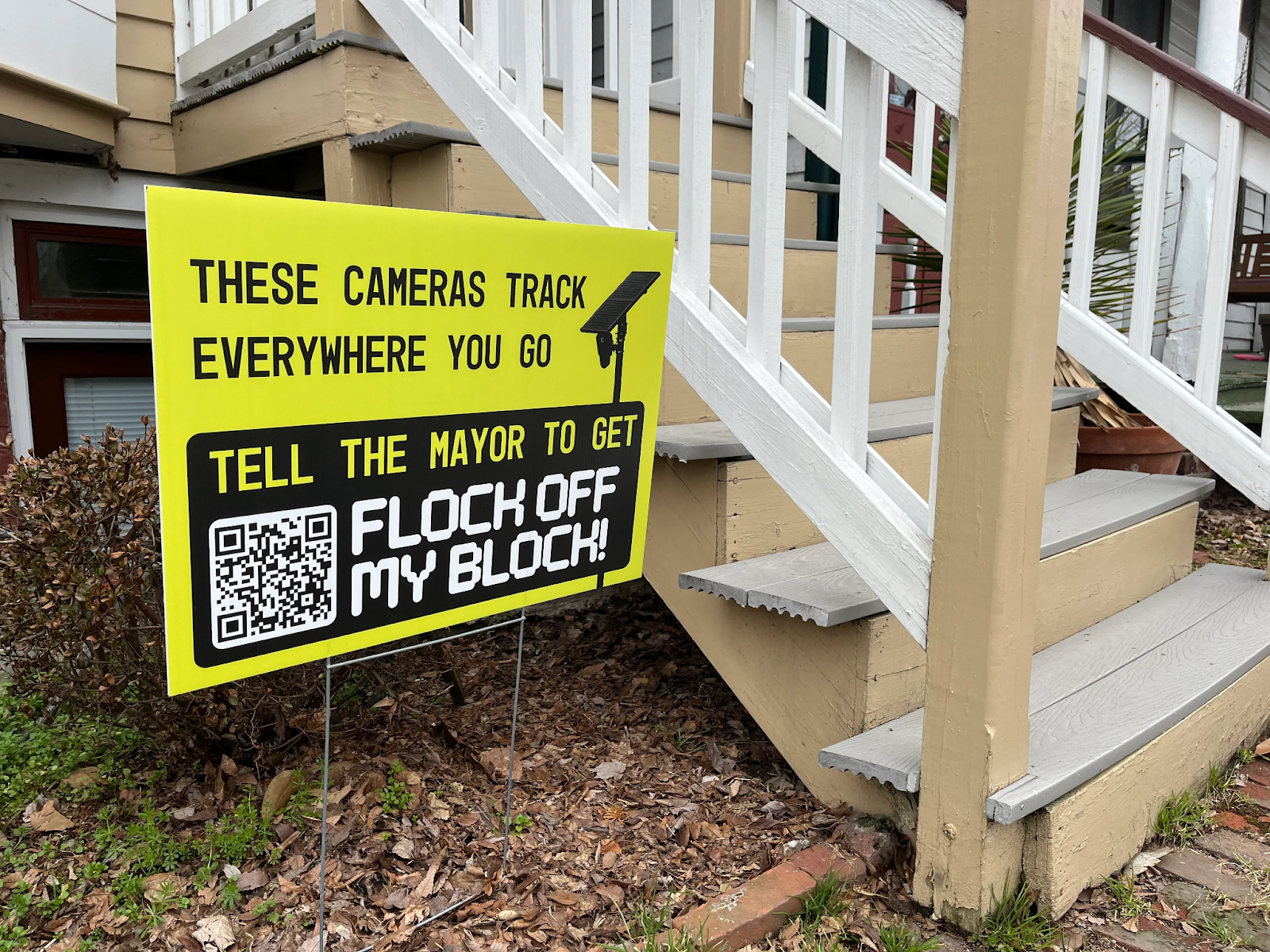
The RDSA has not explicitly focused on that partisan power dynamic as it pushes the Avula administration to cut ties with Flock. Instead, McCullough and other organizers of the “Flock Off” campaign hope to convince City Council members and private citizens that the for-profit system’s potential for abuse and mismanagement are contrary to the mayor’s stated support for the city’s immigrant communities and his vision of “a thriving Richmond.” In February, it held a benefit concert at Gallery5 to raise awareness for the campaign, and protested at a City Council meeting, calling on councilmembers to demand the contracts be canceled. Campaigners have been speaking at neighborhood association meetings and canvassing in public spaces across the city to tell residents about what those new-fangled black posts with the solar panels that sprouted up in their neighborhoods last year are used for.
“This campaign is to make sure that community voices are a part of these decisions,” McCullough said.
At publication, Avula had agreed to meet with RDSA activists about their “Block Flock” campaign on the condition that RPD’s Edwards also be allowed to attend, said McCullough. Despite following up, activists had yet to actually get on the mayor’s calendar.