Richmond’s lawyers told a judge a phone was lost in an airport. City documents show it might have been found
To explain why a city-issued cell phone relevant to a pending lawsuit had virtually no text messages on it, attorneys for the city of Richmond said in court that the original phone had been lost in an airport.
The phone shown to the judge was mostly blank, the lawyers explained, because it was a replacement for the one that went missing.
However, city records obtained by The Richmonder show that, at one point, officials believed the original phone issued to former city spokeswoman Petula Burks had been found.
Burks reported the phone lost in late June of 2024, shortly before she resigned from City Hall on July 1.
A June 20 incident report about the lost phone said it was being kept in a “secure location” at the unidentified airport. And officials seemed to be trying to figure out how to get it back.
“DIT was able to lock the device and forward all calls while waiting for further instructions from airport staff to deliver the phone back to Ms. Burks,” the report from the city’s Department of Information Technology says. “The phone is in a secure location with airport security/customs.”
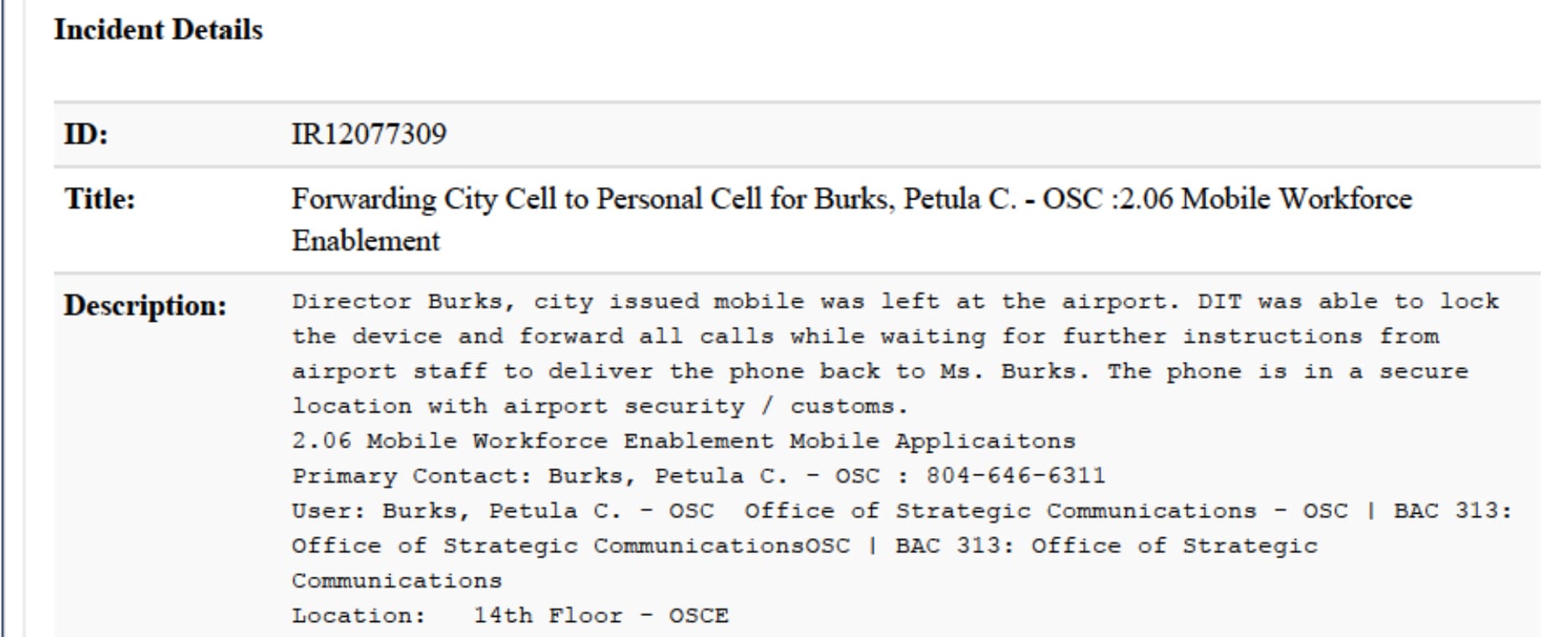
The help desk documents — which the city released to The Richmonder in response to a Freedom of Information Act request — raise new questions about what happened to a missing cell phone that’s become a major sticking point in a lawsuit about an alleged lack of transparency at City Hall.
Data on the phone is being sought by lawyers for former city FOIA officer Connie Clay, who claims the city improperly fired her after she raised concerns the city was mishandling requests for government documents. Burks was Clay’s boss, which means the missing phone could potentially contain evidence about what motivated Burks to fire Clay in early 2024.
The city has portrayed the phone as gone for good once it was left at the airport. The newly released records show other officials asked multiple times if Burks had gotten the phone back.
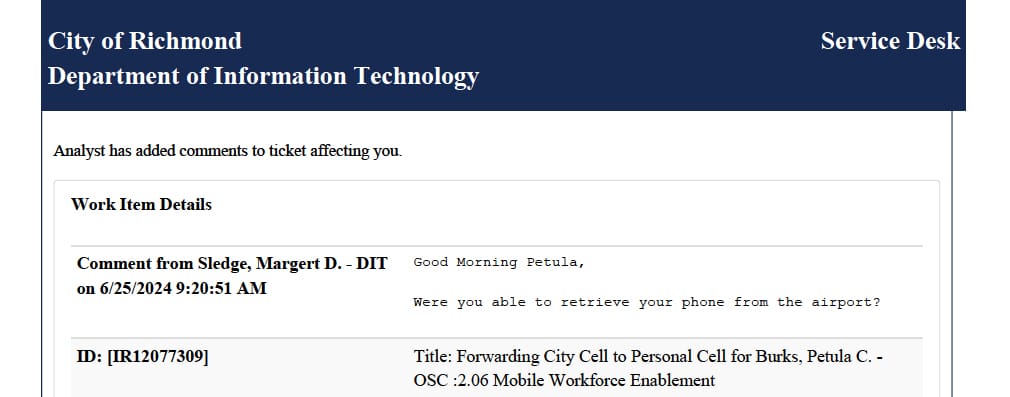
The records from 2024 don’t say if the phone was ever recovered, and the city refused to answer that question last week.
“Unfortunately, we can’t comment on active litigation,” said city spokesperson Ross Catrow.
 Graham Moomaw
Legal implications
The city’s lawyers — a team of outside attorneys from the Ogletree Deakins law firm led by Jimmy F. Robinson Jr. — have disputed Clay’s narrative about why she lost her job, saying she was let go because she wasn’t a good fit and routinely clashed with co-workers over FOIA responses. The city’s team has downplayed the significance of the missing phone, saying any text messages that were lost with it would also exist on the phones of other city officials.
Regardless of what was on the phone, the judge handling the case has said she has “great concern” about the issue.
To try to settle the dispute over evidence, Circuit Court Judge Claire G. Cardwell ordered the city to give her the phone issued to Burks so she could personally review it for any text messages relevant to the case.
 Graham Moomaw
Cardwell said in court that the city gave her the mostly blank replacement phone without telling her it wasn’t the phone she thought she was getting. At the time, the city’s lawyers indicated they too were just learning the original phone had been lost.
Clay’s attorney — employment lawyer Sarah Robb — has already filed a motion asking the court to officially rule the case has been irreversibly tainted by the city’s failure to preserve the phone. The future jurors scheduled to hear the case next summer, Clay’s team is arguing, should be told to take that into consideration.
Cardwell has not yet ruled on that request, but the city IT documents could become a factor if and when that question is taken up.
Clay’s attorneys have argued the city had an obligation to try to get the phone back because it was lost months after the IT department had initiated a “litigation audit” to find and preserve all records relevant to the case.
“The city and Burks should have undertaken efforts to find the old phone, which likely contained city of Richmond records beyond the texts,” Clay’s attorneys wrote in the motion alleging spoiled evidence. “No efforts have been described.”
If the phone had been found at the airport and the city didn’t try to get it back, that could bolster Robb’s argument that the city recklessly allowed evidence to disappear that it knew it should keep. If the phone was not actually secured at the airport, that would mean the city’s own documentation of what happened to it is partly inaccurate.
Clay’s attorneys have questioned whether they and the court are getting the full story about the missing phone. Earlier in the case, they floated the possibility that the device may have been “wiped” as Burks was preparing to leave City Hall.
The IT documents show the replacement phone was issued to Burks less than a week before she resigned from the city’s top communications role. At the time, Burks was facing questions about her use of a city purchasing card, but an internal review later cleared her of wrongdoing.
On June 25, a city IT staffer said the replacement phone was ready to be delivered to Burks.
That same day, the IT staff asked Burks if she had gotten the original phone back yet.
“Not yet,” Burks replied. “I had to file a lost and found claim with American Airlines. At this point, can we issue a new phone and transfer the number to it and then shut off the old phone?”
The contents of the lost phone were not backed up digitally, according to the city’s lawyers.
Contact Reporter Graham Moomaw at gmoomaw@richmonder.org