Richmond Police Chief: Increasing demands are putting strain on shorthanded force
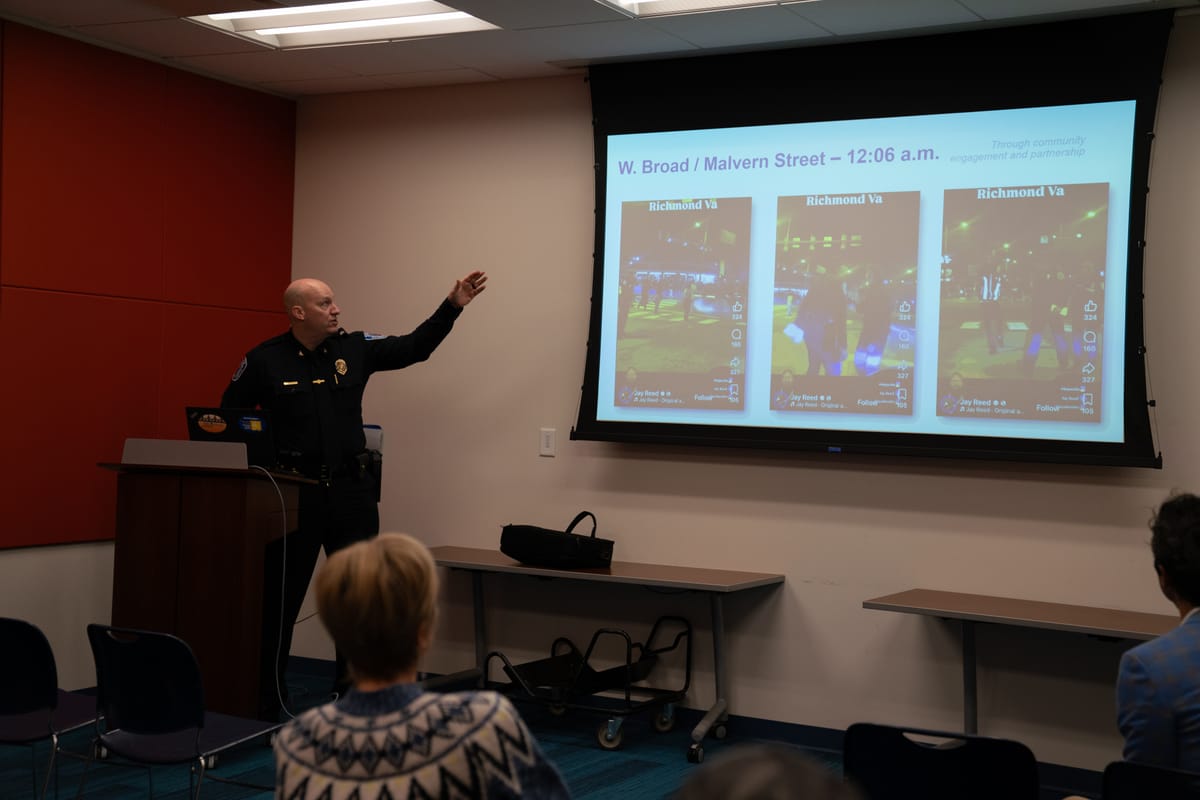
In a meeting last week organized by City Councilor Andrew Breton (1st District), Richmond Police Chief Rick Edwards explained to impacted residents why officers had a difficult time effectively addressing a “street takeover” that took place overnight on March 7.
That night, the police department received numerous 911 calls reporting reckless driving and sounds of gunfire from six different locations, as a group of “mostly 20 somethings” travelled together, stretching from the city’s Southside to the West End and into Chesterfield County. Edwards said police did not find any evidence of gun shots – instead the similar sounds came from fireworks and cars that “backfire” to get attention.
An officer was able to initially ward off takeover participants at the group’s first location on Cowardin and Semmes because members had not yet set up a blockade to do donuts. But at the next stop at West Broad and Malvern, members had already blocked off the intersection.
In an online video, an officer is seen attempting to issue tickets before the crowd surrounds him and another officer takes him away.
“What was getting ready to happen was going to be a use of force with probably 100 people there and [for] these two first officers — it would have ended poorly,” Edwards said.
The situation can escalate quickly, as individuals will stand in front of police cars “almost daring us to hit them” in order to stop officers from making arrests, he added.
Other demands on police
Outside of the event, the department was already at capacity during that weekend, he said.
Officers were deployed to patrol Shockoe Bottom on Friday and Saturday nights following a mass shooting that occurred there in late February. Officers were also monitoring an anti-Iran war protest that occurred the same day as the half marathon, where 87 officers had to block off roads and control traffic.
Later on that Saturday night, two shootings broke out on Brown’s Island and in Hillside Court. To respond to those events, police used an airplane that allows officers to see in the dark.
Edwards said the plane had to come down by the time the takeover began, meaning that there was no air support to help find takeover participants.
“I mean, we have never been asked to do more as a police department with less officers than what’s happening right now,” he said.
The department has 754 positions funded in the city budget, but in recent years has only been able to hire about 600 of those roles. Edwards has made a recruitment push, and City Council has worked to raise salaries for sworn officers in recent years to help the division be more competitive.
Preventing future takeovers
Regarding the street takeover, Edwards said the lack of prior knowledge played a role.
“We couldn’t address it because we didn’t know they were coming. So what it takes for the future for us to be successful is intel,” Edwards said.
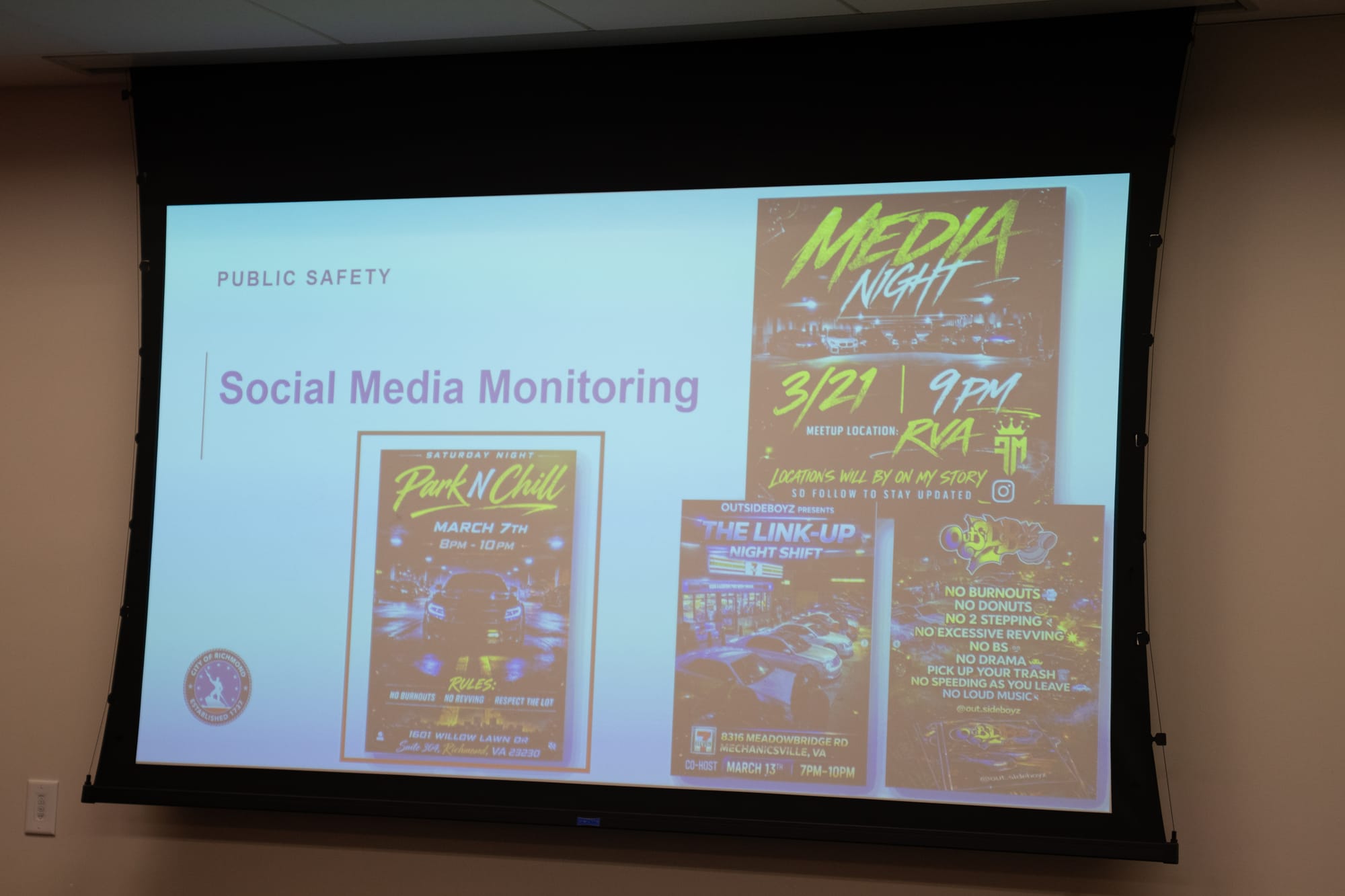
In addition to sharing flyers about the takeover on social media, the groups are able to coordinate their gathering in group chats. For example, while the majority of the crowd is at one location, other members can scout locations and begin to block it off for fellow drivers before officers arrive. Having access to these chats would have helped officers this time around.
Officers also could not use a pepper spray fogger to disperse the crowd, as the spray could blind drivers and cause crashes.
“If it’s not handled properly by the policy department, a negative response is going to be even worse,” he said.
Street takeovers are also happening all over the country, Edwards said, including in states like Maryland and New York. In New York, he shared, a person recording a car doing a donut was killed by that car.
When attendees at the meeting asked why participants do this, Edwards said that it’s about social media “clout.”
“You saw some people sitting on the hoods of the car and the people that are just filming it. The whole point of this is social media,” he said.
Making the takeovers costly to offenders is a way to reduce them from happening, Edwards said.
The department is also looking to use a “20 day hold” on cars involved in takeovers by seizing and towing cars and making offenders pay to get them back.
Edwards said he spoke at the State General Assembly about the problem last year because “the law wasn’t designed to address this specific issue.” The state legislature later passed a law prohibiting racing or exhibition driving, in which doing so could result in the confiscation of an individual’s license for at least six months.
As the group moved from one location to the next, the communication about their whereabouts went to three different radio channels, likely making it difficult for officers to know when and where exactly the group was going. To avoid this, Edwards said a police captain will designate one of the four lieutenants in charge of each precinct to take command, allowing for one single point of contact and better coordination.
The conversation also steered towards automated license plate readers, also known as ALPR or Flock cameras. At the time of the takeover, officers did charge Tre’Vell Taylor, 20, of Hampton Roads with reckless driving and a window tint violation – one of the about 100 individuals involved. But Edwards said the department is looking to charge other participants using the Flock cameras, as RPD gathered about 20 license plates from that night with the help of traffic cameras.
“If they run by one of those ALPRs, it’s going to trigger it for us,” he said.
He reiterated his support for the cameras, saying that he understands the concerns on the matter, but the technology “makes our officers more effective after something happens.” He shared that he was sensitive to repeated stopping of individuals who do not commit the crime, which he said Flock prevents.
“This enables us to go after the people that are committing the crime and ignore the people that are just going about their daily lives,” he said.
The department also plans to use “stop sticks,” a device officers can toss in front of cars to slowly deflate tires.
Edwards said he believes that officers “did the best they could that day,” but moving forward the department has to better monitor the situation and stay on top of it.
He noted at the meeting last week that the department was already tracking another group, which was distributing a social media flyover for a planned takeover on Saturday.
Contact Reporter Victoria A. Ifatusin at vifatusin@richmonder.org