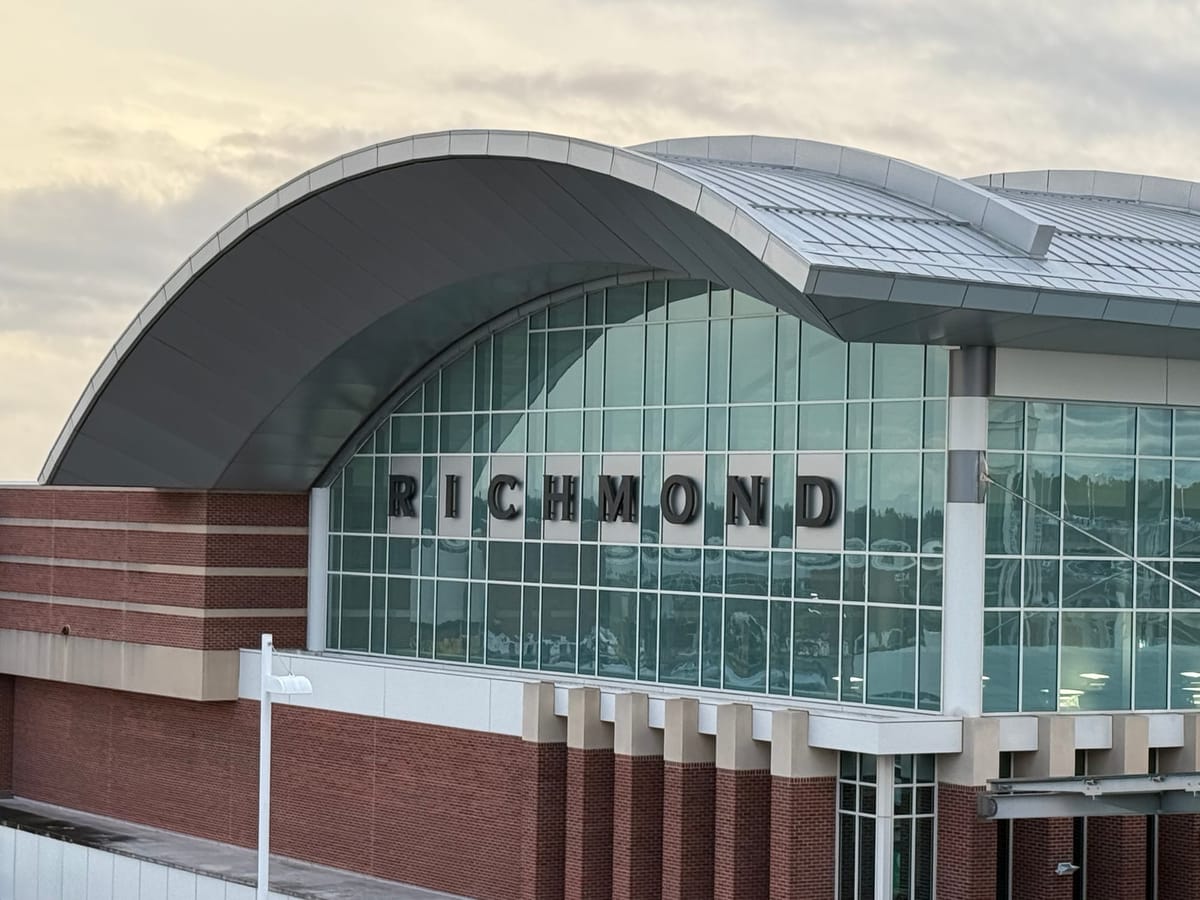
Richmond officials are courting a nonstop flight to Europe. It won’t be cheap.
A nonstop flight to Europe has long been on the wish list for both local companies and Richmond International Airport executives, but competition is red-hot for a limited number of flights across the ocean each day.
In the past few months, a group has been working to lure one of those flights to Richmond. They point to statistics that show more than 300 passengers leave RIC each day with Europe as their final destination, while many others make the drive to Dulles.
But for major international airlines, which are famously risk-averse, statistics alone aren’t enough to gamble on a new route.
Those carriers often ask for a “minimum revenue guarantee” when they enter a new market. If the route is profitable, no money is exchanged. But if the airline loses money, those losses are subsidized.
Markets similar to Richmond, which is considered “mid-sized,” have laid out big guarantees in recent years to land European flights.
- Indianapolis offered nearly $20 million in potential guarantees to Aer Lingus for four-days-a-week service to Dublin.
- Cincinnati offered a three-year guarantee which officials would only describe as “millions” to land a British Airways flight in 2023.
- Hartford, Connecticut made a four-year, $13.3 million guarantee for its Dublin flight.
Troy Bell, the airport’s spokesperson, said offering incentives has helped the airport grow from 21 nonstop destinations in 2019 to 38 today.
The airport offered nearly $1 million in incentives to United Airlines in 2016 to get the airline to fly nonstop to Denver, but that route now stands on its own, and Southwest has also added a Richmond-to-Denver route.
The airport itself can’t offer revenue guarantees, so the funding, and fundraising, for a European route is currently being done by the Greater Richmond Partnership.
Andy Kerr, who serves as Richmond Market President at Atlantic Union Bank, and Jeff Wright, the CEO of Allianz Partners USA, are co-chairing the task force.
“There’s been some strong support for what we’re trying to do,” Kerr said of the local business community. “It’ll take a little bit of time, but it’s been fun.”
While Allianz would benefit from a more direct path to Europe, Kerr said his involvement is about being a booster for the region.
“We want to be a part of this, and help it in any way we can,” he said.
An international flight would be a game-changer for the region’s ability to land new businesses, according to GPR President Jennifer Wakefield.
In the past five years, she said, Richmond has made significant progress in getting businesses to consider relocating to the area.
But a survey commissioned annually by the Greater Richmond Partnership continually shows one thing working against the Richmond region: A lack of nonstop air destinations, particularly internationally.
“We are losing projects because of a lack of direct flights,” she said.
Irish eyes
The task force has reached out to airlines across the continent, including British Airways and Air France, but even with subsidies, those major carriers are often constrained by equipment and capacity, and are generally risk-averse when it comes to new routes.
However, Ireland’s Aer Lingus has been building up its status as a European hub out of Dublin, and has been receptive to initial inquiries from Richmond officials.
“Obviously Heathrow (in London) is a gigantic hub, but so is Dublin, which I didn’t know prior to getting involved with this,” Kerr said.
The task force would view a flight to Dublin, or any destination which signs on, as a first step on the way to even more European flights. If carriers like British Airways and Air France see international service thriving in Richmond, they would be more open to entering the market themselves.
In a best-case scenario, the first route would succeed on its own without subsidies, allowing the guarantee funds to either be returned to businesses or used to lure additional international service. In Cincinnati, British Airways added an extra day to its service each week after initial success.
At a recent meeting of the Capital Region Airport Commission, the board floated the possibility of a $20 million subsidy fund in total, though one person familiar with the negotiations said the final number was unlikely to be that high, and emphasized that the funds would be part of a multi-year commitment.
The group asked for state support in this year’s budget, but it appears unlikely that it will be granted.
The airport is also expected to contribute in ways that it is legally able to, including marketing assistance and waiving some fees for the participating airline.
Ready for takeoff
Richmond’s airport would not need any major modifications to host a European flight.
Funding from the Bipartisan Infrastructure Law in 2022 was used to renovate the airport’s customs facility, which is now ready to handle international traffic.
In addition, the runways are long enough and the gates would be able to handle international aircraft.
Ironically, if Richmond is able to land a flight to Dublin, it is the only city in Europe with a “preclearance” facility, which means passengers clear customs in Dublin, then land in the United States like they would on any domestic flight.
RIC’s Bell said he believes the numbers show strong demand for international travel out of Richmond.
“The total volume of passengers from RIC’s catchment area traveling between the Richmond region and Europe is more than sufficient to support transatlantic service,” he wrote. “Some travelers already make the trip from RIC, while others will be recaptured once a nonstop becomes available.”
The airport has never had transatlantic service. For the business community, offering it would be another way to distinguish Richmond in a competitive marketplace.
“Clearly, there’s the demand for it right now,” Kerr said. “If it’s successful, we would hope to have more flights, and that would only make Richmond a more attractive place for businesses to relocate and expand.”
Contact Michael Phillips at mphillips@richmonder.org.