Richmond Council asks state for law allowing city to prevent ‘rent gouging’
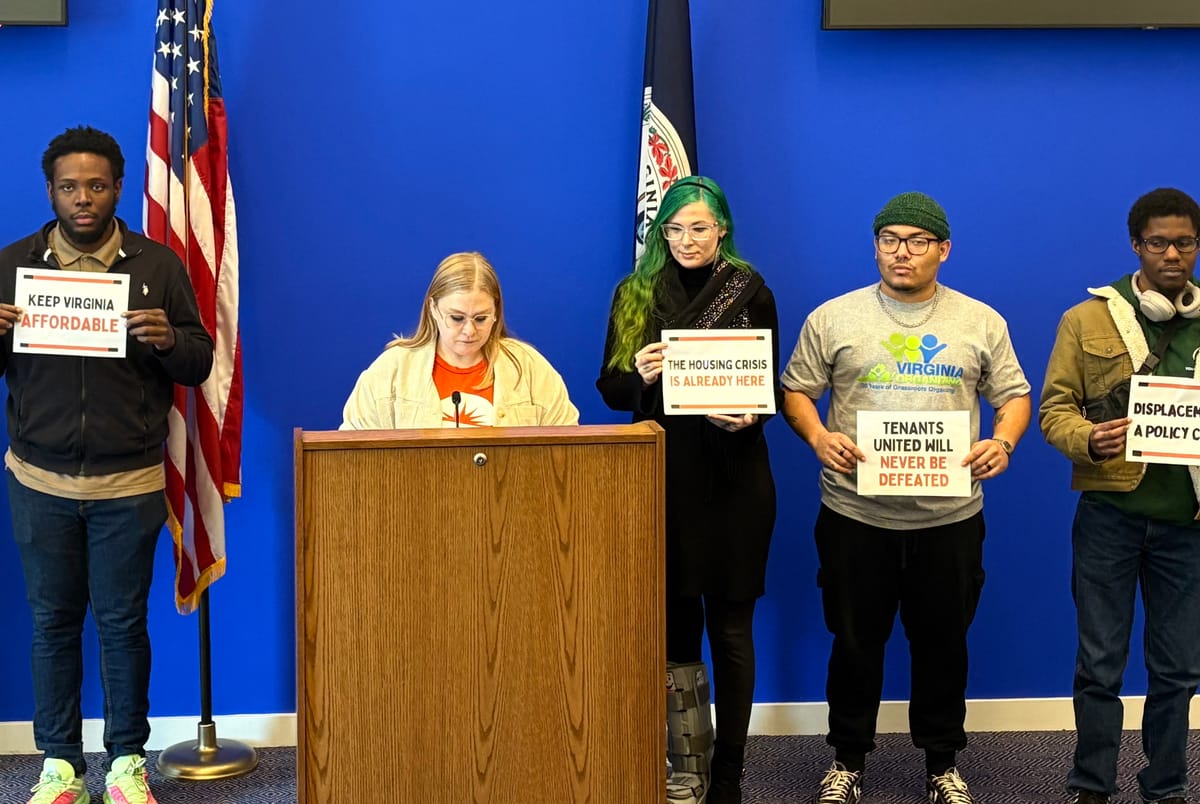
With the General Assembly gearing up to reconvene this January, the Richmond City Council is asking for legislation that would let local governments institute anti-rent gouging rules.
The request is among the city’s top three legislative priorities for the 2026 session, along with completion of a state study on a program to keep long-term residents in their homes despite rising real estate taxes and permission to institute mandatory inclusionary zoning programs. The Arlington County Board has also cited anti-rent gouging powers as a priority.
Because Virginia is what’s known as a “Dillon Rule” state, local governments can only wield the powers specifically granted to them by the state and must ask the General Assembly for the right to exercise any new ones.
The ability to impose rules to prevent sharp increases in rental prices will “add to our toolbox,” City Council Vice President Katherine Jordan (2nd District) said at a press conference Tuesday held by progressive advocacy groups New Virginia Majority and the Richmond chapter of Virginia Organizing. “The city of Richmond is a majority-renter city.”
About 57% of Richmond’s population are renters, according to figures cited by Mayor Danny Avula’s administration.
Proposals to let localities set anti-rent gouging rules came before the General Assembly in 2024 and 2025 but failed in committee votes.
Sen. Jennifer Boysko (D-Fairfax) and Del. Nadarius Clark (D-Suffolk) put forward two possible frameworks for the program in bills last year.
While both would have let local governments pass ordinances setting a ceiling on how much rent could rise annually, they initially differed in what that limit would be. Boysko’s bill proposed capping annual increases at 3%. Clark’s initial bill, in contrast, would have set it at the lesser of either 7% or the percentage increase in the consumer price index from March of the previous year to the next, although he later amended his proposal to match Boysko's limit.
Both proposals would also have required localities instituting such rules to set up an anti-rent gouging board that would be able to grant exemptions from the rule if “deemed appropriate and necessary.”
Any new legislation is likely to spark fierce debate. Opponents in prior years have argued that anti-rent gouging provisions will discourage the construction of critically needed rentals and keep landlords from making repairs because of uncertainty about their ability to recoup their costs. Supporters say a lack of such protections for renters has led to widespread displacement of both individuals and families.
“No family in our community can remain housed when rent grows faster than their wages,” Virginia Organizing member Kindy Anderson said on Tuesday. “Affordability is not abstract. It determines whether children stay within the community, within our schools, whether parents can survive even a minor crisis … and whether families can remain in the communities that they serve.”
Richmond rents have risen precipitately over the past decade and continue to increase.
Contact Reporter Sarah Vogelsong at svogelsong@richmonder.org
This story has been updated to note that Clark amended his legislation last year to match Boysko's 3% proposal.