Pilot to examine energy costs at aging public housing complex
Sometimes a little fix can go a long way.
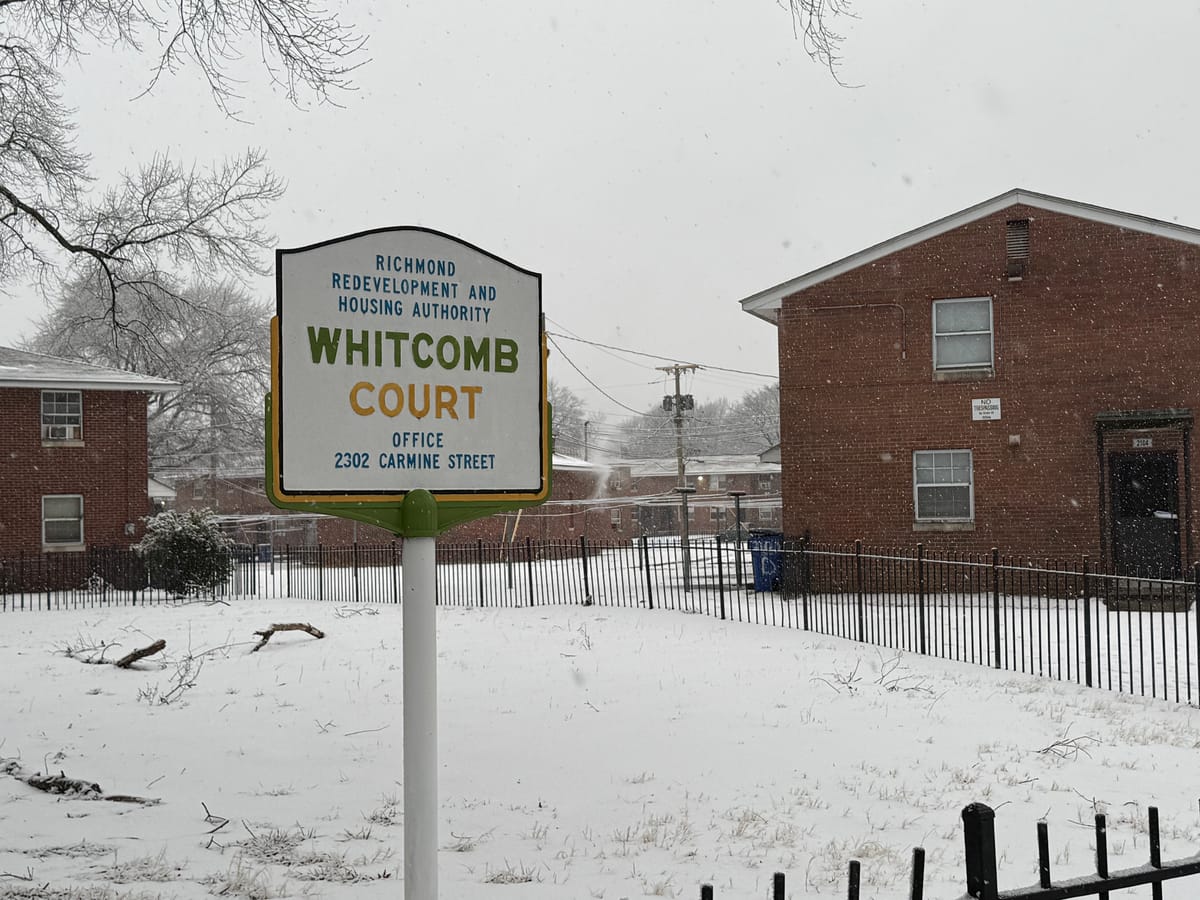
That’s the hope of a new pilot program recently launched by the city of Richmond and its public housing authority that will look at how energy efficiency upgrades throughout Whitcomb Court could both reduce energy costs and make residents’ lives a little more comfortable.
“We're hoping that this serves as the test case that will help us create a longer-term energy efficiency program for all of our public housing,” said Laura Thomas, director of Richmond’s Office of Sustainability.
The 447-unit Whitcomb Court was built in Richmond’s East End in 1958, meaning it’s now nearing 70 years old. The last evaluation of its condition found it was functionally obsolete, and the Richmond Redevelopment and Housing Authority plans to replace it as part of the broader redevelopment of all of the Big Six public housing communities.
Those efforts, though, are still years away, and in the meantime more than 1,000 people live in units that have to be heated, cooled and supplied with water.
“We still have to keep it up to date for the people that are still here,” said April Hurt, Whitcomb’s director of maintenance. “I used to be a resident, so I am aware of what some of the residents may want or some of their concerns.”
The pilot, which will cost just shy of $10,000 and is being funded by a grant from the Urban Sustainability Directors Network, will track and analyze electricity, gas and water usage at Whitcomb Court over the past 12 months as well as install basic efficiency upgrades like weatherstripping, LED lightbulbs and faucet aerators. It will also produce a list of possible energy efficiency strategies and provide information for RRHA residents about them.
“What we want to do is to get a baseline understanding of energy use in these 447 units,” said Thomas. “We don’t even know that the meters and the billing are accurate. … So we're really going to help RRHA understand where they're losing money and losing energy and baseline all of the information, because we simply don't understand what's happening there.”
Some of the inefficiencies are readily apparent.
“Many of [the units] don't have central heat or AC, and so they're relying on window units or other things for heat,” said Thomas. “Anecdotally, we've heard that folks use natural gas stoves for heat, which is, of course, a risk of fire safety, but also health safety.”
Hurt said it’s common to get work orders from residents asking for weatherstripping or guards that fit around the bottom of doors to prevent airflow. While RRHA generally upgrades lights to LEDs and adds weatherstripping when units turn over, she said, not all units have those fixes. She’s hoping that the pilot will be able to make basic upgrades more uniform throughout the court, even if more intensive upgrades are unlikely, given the limited scope of the pilot and the longer-term plans to redevelop Whitcomb.
“I’m still trying to push for excellency for the residents in the development,” she said.
The Whitcomb project is just one of several energy efforts Richmond is focusing on in the East End, where a recent study by the Community Climate Collaborative found the city’s highest energy burden rates — a measure of how much of a household’s income is spent on energy costs. Besides the planned creation of a solar farm on the former East Richmond Road landfill, the Office of Sustainability is exploring the possibility of a resilience hub in the area.
For the census tract that contains Whitcomb, researchers calculated a 9% burden, the highest of all.
Thomas said the pilot could begin to help alleviate that.
“We're hopeful that we can look back in a few years and see that 9% has gone down to 8% or 7% or 6%,” she said.
Contact Reporter Sarah Vogelsong at svogelsong@richmonder.org