March 18 Newsletter: Planned Parenthood location won't go forward
Weather: The warm-up begins, with a high of 57.
On this date in 1963, the Richmond School Board eliminates a “feeder” system that ensured continued segregation in public schools after being ordered to by a federal court.

Today's newsletter sponsored by Virginia Commonwealth University: As a top 50 public research institution, Virginia Commonwealth University has an unparalleled drive to discover, innovate and create. VCU impacts the human experience and tackles the problems of tomorrow. It's a university unlike any you’ve ever seen.

Planned Parenthood clinic not moving forward in Northside after city’s $10 property deal
In 2024, the city of Richmond agreed to sell a nearly $1.3 million property for $10.
The prospective buyer was the Virginia League for Planned Parenthood, which wanted to turn a school building in Richmond’s Northside into a health clinic that would expand access to abortion and other services.
The essentially free building wasn’t enough to make the project work, though. Last week, Planned Parenthood confirmed its plan for the Northside facility has been shelved, largely for financial reasons. Read more here.

Four city councilors float tax deferral plan to help offset rising home assessments
The proposal would allow certain homeowners to defer payment on real estate taxes that were more than 105% of what they paid in the prior year.
Deferred amounts could be paid back at any time but would have to be paid when the property was sold or transferred.
- City Council has also shown interest in the possibility of a long-term owner occupancy program, or LOOP.
However, a General Assembly study warned one unintended consequence of holding rates low for current homeowners is that fiscal burdens get shifted to young homebuyers, who are already stretched in this market. Read more here.

In FOIA officer case, city’s lawyer fires back at judge for questioning his ‘candor’
A lawyer representing the city of Richmond in a high-profile lawsuit about government transparency is arguing a local judge unfairly smeared him by publicly questioning how honest he’s been with the court.
The lawyer seemed to acknowledge he and the city were taking an extraordinary step by floating the possibility that the judge should step back from the case. Recusal, the filing said, is only being raised “reluctantly and with full respect for the Court.”
The opposing attorneys are also showing few signs of backing down from the legal hostilities, casting doubt on travel expenses the city filed recently. Read more here.
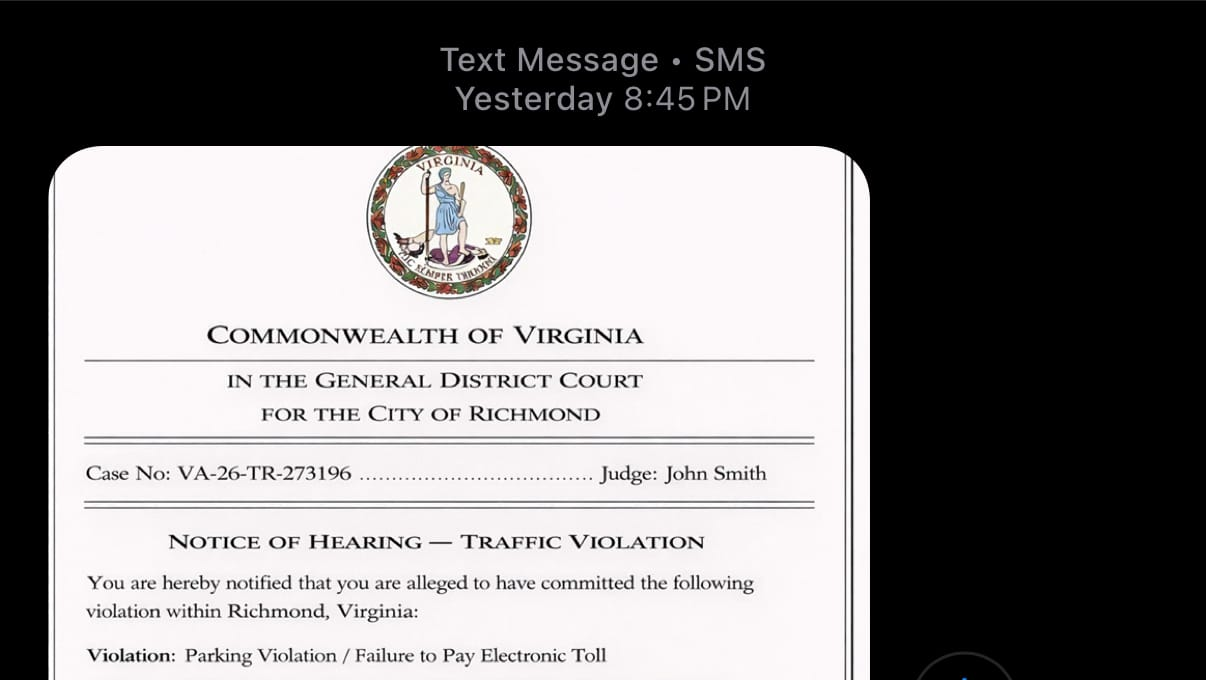
Scam text asks for 'electronic toll' payment, creates confusion at courthouse
Richmond Police and the Commonwealth's Attorney are advising Virginians about an online scam which tells the victim they have not paid an electronic toll fee.
The text appeared to be causing at least some confusion on Tuesday morning at the John Marshall Courthouse, as bailiffs were announcing to those waiting to enter that the text was not real and anyone trying to come inside to deal with it did not need to do so.
The scheme appears to be taking advantage of Richmond's recent transition to electronic tolling. Pay-by-plate tolls will be mailed to the house the car is registered to, and will not be sent by text. Read more here.
Today's sponsor:

Uncommon impact: VCU pairs efficiency with affordability
The Joint Legislative Audit and Review Commission’s report ranks VCU No. 1 for efficiency, a key part of the university's strategy to keep tuition growth as low as possible.
At VCU, the data shows that the university has prioritized and remains committed to keeping costs as low as possible — despite national higher education trends. For students from households earning less than $110,000, there was zero growth on average from 2019 to 2024.
Overall, the net price of a VCU education grew by only 8%, despite 22.5% inflation over that same period. Read more.
In other news
- Richmond DPU to clean up debris under T. Tyler Potterfield Bridge as part of sewage leak agreement (CBS 6)
- Richmond police issue 200+ tickets in illegal parking crackdown (Axios)
- Competing Chesterfield hospital proposals from VCU, HCA, Bon Secours each get state approval (BizSense)
The editor's desk
This is Sunshine Week nationally, which calls attention to the importance of open-records laws that allow insight into government spending and decisions. In Virginia, FOIA laws allowed us to gain insight into how much the city was spending on outside lawyers in the Connie Clay case, information that otherwise could have been hidden inside the larger budget.
Michael Phillips, founding editor
mphillips@richmonder.org
Sent this by a friend? Sign up for our free thrice-weekly newsletter here.
Want to support The Richmonder? Become a donor for as little as $9.99 a month and keep quality local journalism in the community.