In Brookland Park, is a mural a pro-Palestinian message or a revival of old racist symbols?
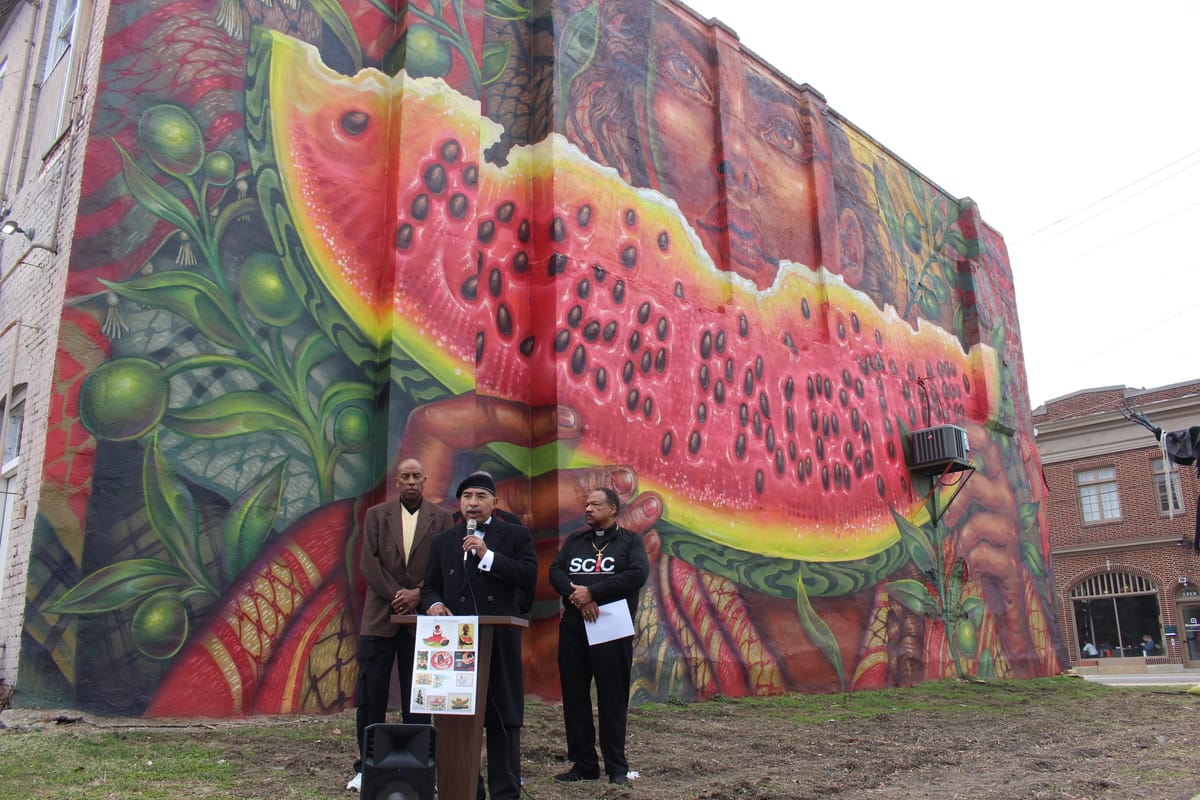
A pro-Palestinian mural in Brookland Park that depicts a dark-skinned woman eating a watermelon has sparked debate over whether the image revives racist caricatures of the past or offers a message of solidarity for Palestinians facing what some see as a genocide.
The massive mural was completed this December on the wall of Nevermore, a self-described “Gothic boutique and micro-gallery” that sits at the busy corner of Brookland Park Boulevard and North Avenue in Richmond’s Northside.
Created by Los Angeles artist Lauren YS, the mural shows a Palestinian woman looking straight ahead and eating a slice of watermelon whose seeds spell out “Free Palestine.” Olives twine around each side of the melon, while a keffiyeh peeks out from the upper-left corner.
The watermelon has long been a potent symbol of Palestine, used during times when Israel banned the Palestinian flag, and Lauren YS, who is Chinese American, told The Richmonder in an email that the mural “was clearly intended to confront the conflict in Palestine.” A press release they issued at the time of the work’s creation explicitly ties its symbols to “Palestinian heritage, nationality, longevity and steadfastness” and calls the painting “an emblem of perseverance, solidarity, and defiance against the occupation and the horrific slaughter of over 71,600 people.”
“I as an activist would never intentionally put my time, money and energy into creating something racist or harmful to any community, rather the opposite,” they told The Richmonder.
But for some members of Richmond’s Black community, the resulting image is all too close to the racist caricatures of Black people eating watermelon that proliferated throughout the Jim Crow era.
“Graphic illustrations such as this have been used to denigrate African American people, to make us feel like we’re less than, to make us feel smaller, to make us feel unintellectual, lazy, shiftless,” said William F. “Bill” McGee, president of the Richmond chapter of the Southern Christian Leadership Conference.
On Friday, McGee joined with Richmond NAACP President J.J. Minor, former Richmond Crusade for Voters President Jonathan D. Davis and civil rights activist Gary Flowers for a press conference calling on Nevermore owner Teresa Sharpe to make changes to the image, including perhaps replacing the watermelon with a Palestinian flag. They also said they intend to approach Richmond’s Public Arts Commission about establishing guidelines “governing permission of public art on private or public buildings.”
“We come fully aware of the Palestinian movement and its symbolism,” said Flowers. But, he added, “in downtown Northside, a historically Black neighborhood, … the sight of the watermelon that is painted behind me is offensive.”
Another message painted on the building reading “F*** ICE” also drew dismay from the four, who expressed concern about its proximity to Richmond Community High School several blocks to the east.
“Now, I have my own personal feelings about ICE as well, and I agree with that,” said Davis, referring to U.S. Immigration and Customs Enforcement. “But I don’t agree with it being painted on the side of a building that’s facing the street where kids can walk up and down the street and see it.”
Sharpe, however, has said the changes that the groups have asked for aren’t as straightforward as they seem.
Artists frequently balk at being asked to make retroactive changes to works they see as a cohesive whole — a view several expressed Friday during an impassioned debate between residents that followed the press conference. Furthermore, Lauren YS lives in California, Sharpe pointed out, and even getting the equipment required to work on a piece of such a large scale can take time.
It took four months to coordinate the actual painting of the mural, she said. And while she intends it to be temporary, with other activism-focused works rotating on the space, Sharpe said there was no definitive timeline for its replacement, particularly because of the expense of such murals. While Lauren YS did the Palestine work for free, typically such works cost tens of thousands of dollars.
“I think every viewer views this mural very differently,” Sharpe said. “We’ve definitely had a lot of people outpour their support of this message.”
Several of those people were present Friday.
“I’m Black, and I don’t find it insensitive,” said Duron Chavis, a Black community activist who founded an urban farming organization that works throughout the region.
Muralist Silly Genius, who is also Black, contended that the mural “speaks to the Palestinian plight, which is connected to the Black plight in America. She’s speaking to a global issue; it just happens to be here. … It’s a global issue.”
“But locally offensive,” Flowers insisted.
“Not to everyone,” said Silly Genius. “There’s a subversion of a trope here. You’ve got to give the artist room to subvert the trope.”
Writer Danita Rountree Green, who co-founded local nonprofit Coming Together Virginia, said “that what we are facing here is also a generational issue.”
“When I look at that, I do see something offensive. You may not as a younger person,” she said to Silly Genius and Chavis. Aesthetically, she said the mural is “in itself lovely, but I think that it causes a horrendous harm in this particular community.”
Sharpe told The Richmonder that she “would love to continue a dialogue” about the issue.
“We want to always keep in mind the voice of the community,” she said.
Contact Reporter Sarah Vogelsong at svogelsong@richmonder.org. Editor Michael Phillips contributed to this story.