Former city councilman’s group buys 14 billboards opposing Richmond’s code refresh
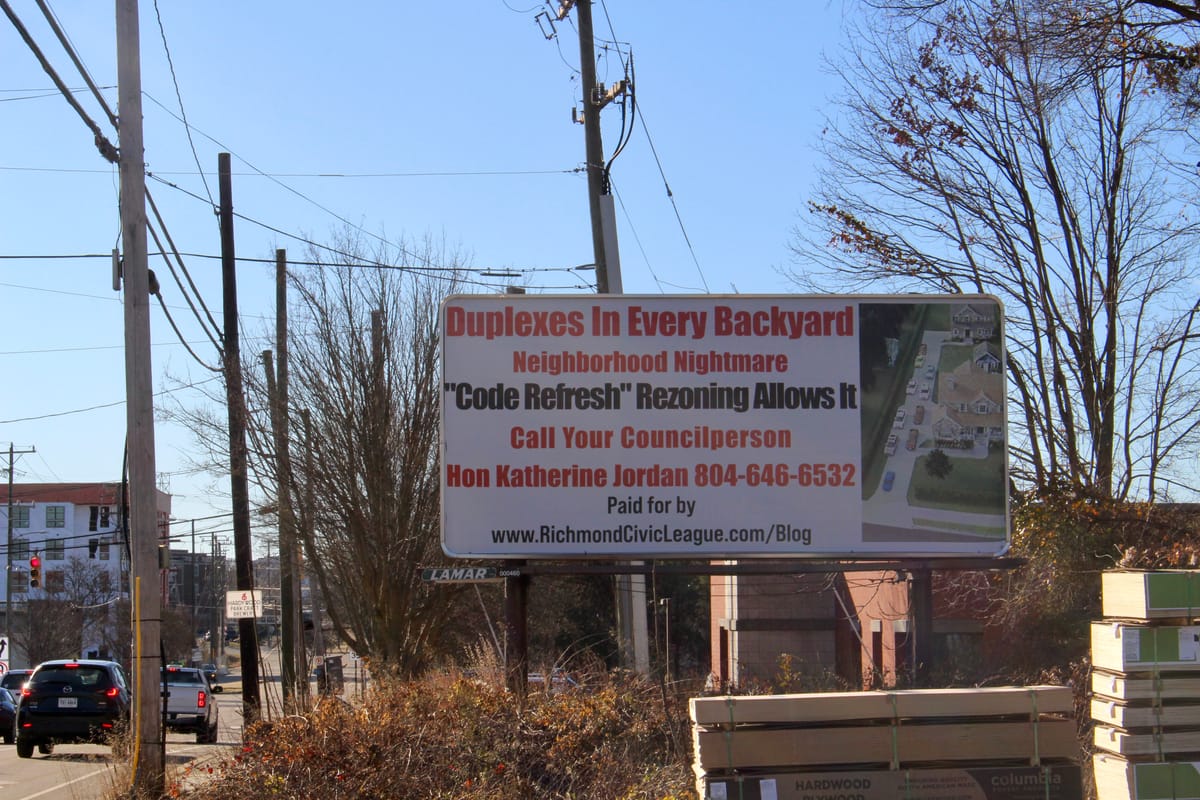
A group headed by a former Richmond city councilman has bought 14 billboards opposing the city’s overhaul of its 1970s-era zoning ordinance.
In an email to city councilors and members of the media Sunday, Marty Jewell, chair of the Richmond Civic League, said the advocacy group’s “expansive membership is opposed to code refresh as written even though we are open to incremental rezoning changes, and we embrace ‘true affordable housing.’”
The group’s three billboards take aim at a code refresh provision that would let residential property owners construct a second unit on their lot under certain circumstances, changes to how the city would allow single room occupancy housing and the potential impacts of a larger population on sewage overflows into the James River — an issue city officials have said is driven by rainfall rather than density.
“Rooming Houses Coming To Your Neighborhood: ‘Code Refresh’ Rezoning Allows It. Call Your Councilperson” reads one of the three signs. “Duplexes In Every Backyard: Neighborhood Nightmare. ‘Code Refresh’ Rezoning Allows It,” says another.
Jewell told The Richmonder that the billboards are being funded by individual contributions made by members of the Richmond Civic League, a group initially formed in 2019 to oppose the Navy Hill development.
“We have not decided on when the billboards may come down,” he wrote in an email. “We are however committed to opposing code refresh until it is defeated and replaced with a zoning plan generated by our citizens and one which fits who we are.”
Asked about the billboard campaign, city spokesperson Michael Hinkle said that “the city welcomes all voices to the code refresh conversation, understanding that the final version of this zoning code should balance the fundamental need to house our growing population with the wishes of residents who already call Richmond home.”
“This is why the city is iterating on the zoning code and why we are engaging in good faith efforts throughout our communities: to reach a zoning code that is fair, equitable, and in line with what our city needs today and in the future,” he continued.
Richmond — like other localities across Virginia including Charlottesville, Roanoke, Arlington, Alexandria and Fairfax County — has sought to overhaul its zoning code both to update decades-old land use rules and to encourage the production of new, more dense housing in response to soaring home prices and population increases.
After several decades of population declines, the city has seen significant in-migration over the past 15 years. U.S. Census data estimated Richmond was home to almost 234,000 people in 2024, up from nearly 227,000 in 2020 and 204,000 in 2010.
Rewriting the zoning ordinance was one of six “Big Moves” identified in the city’s 2020 master plan under former Mayor Levar Stoney. The project has also been embraced by Mayor Danny Avula, who most recently included it as a key part of a housing affordability plan released Tuesday.
“The housing affordability and supply crisis will continue into the future as Richmond’s population continues to grow,” Avula said. “Code refresh represents years of work and community input. I could not be more excited to prepare Richmond for the future by streamlining the construction of new homes through thoughtful increases in density that respect existing neighborhoods.”
The first draft of the overhaul, which was released in May, sparked backlash from many neighborhood associations and homeowners who said it allowed too much density and would encourage developers to tear down existing structures.
In response to those criticisms, the city made major changes in a second draft released in November. Most notably, the administration replaced a provision allowing duplexes by right with a provision that only allows the addition of a second unit if the current building is preserved and limits where on the lot it can be added.
Housing advocates, including all of the city’s most active nonprofit affordable builders, decried the shift. With the cost to build an affordable single family home running between $300,000 and $350,000 in Richmond today, they said, allowing smaller lots and denser development in the form of duplexes and triplexes are some of the only ways outside of subsidies that affordable developers can drive costs down.
Jewell said he believed the change in the duplex proposal was a good one. Nevertheless, he contended that the code refresh “as planned will predominantly provide market rate or full price housing” and characterized the project as a developer-driven “forced rezoning of 77,000 parcels in our city that we didn’t want and didn’t ask for.”
Instead, he’s asking for the entire plan to be scrapped and for the City Council to create a new commission made up of nine citizens to update the zoning.
City pushes back against rooming house claims
Besides the duplexes, the billboard campaign taps into broader public concerns about the impact greater density could have on infrastructure by claiming that the code refresh will lead to more overflows from Richmond’s combined sewer system into the James River.
In a discussion with the city’s Public Utilities and Services Commission earlier this year, Richmond Department of Public Utilities Director Scott Morris said that a greater volume of customers wouldn’t have much of an impact on overflows, which are driven by rainfall rather than more people contributing excrement to the system. Nevertheless, residents have repeatedly expressed worries about the issue at zoning and planning meetings.
The rooming house billboard, Jewell said, concerns the way in which the code refresh treats single room occupancy. Jewell said the refresh drafts would allow “unlimited rooming houses with unlimited numbers of unrelated persons, all over the city.”
“Just ask residents of Grace Street in the 60s, 70s and 80s, as their rooming houses created a nightmare situation with noise, drugs, and crime,” he wrote. “There were literally padlocks securing the door for each individual room and bathrooms were shared. It is absolutely incomprehensible that any thoughtful person could think this is a good proposal for Richmond.”
But Planning Department staff say that single room occupancy is not permitted by right in all districts in the latest draft, which categorizes them as “group living.”
Any use of a building for group living in a residential area would require a conditional use permit obtained through a process involving City Council approval, with one exception: the RM-C district, the densest of the proposed residential multifamily districts.
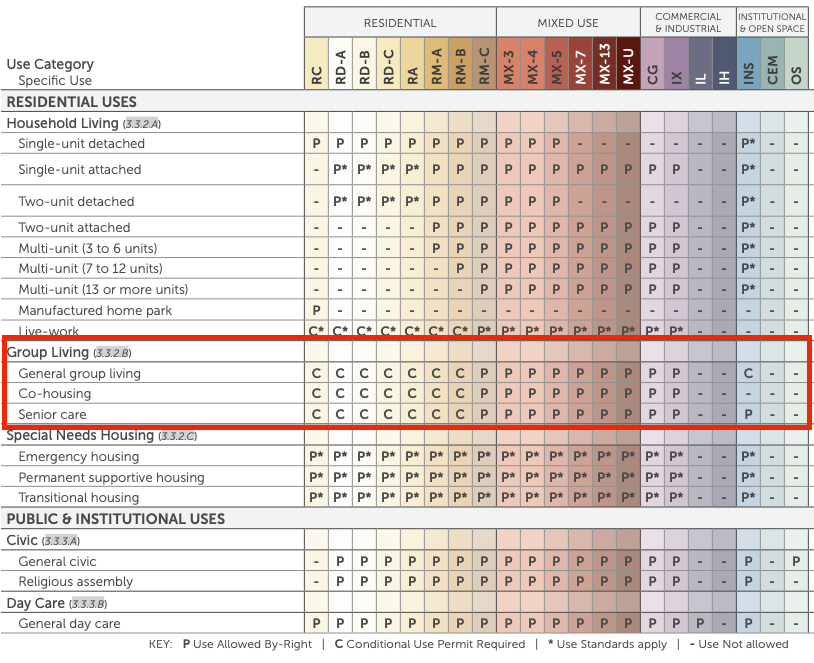
Group living would also require a conditional use permit in institutional districts — those intended for “larger-scale public, civic and institutional uses” like schools, churches and government buildings. Those uses would, however, be allowed by right in the mixed-use, commercial and industrial mixed-use districts.
Current city code does not use the term “group living” but instead regulates single room occupancy through provisions on lodginghouses, transitional housing and permanent supportive housing. While those uses are largely prohibited in single family districts, they are allowed in various others with a conditional use permit, particularly after the City Council loosened some restrictions in 2020 in an attempt to reduce homelessness.
Contact Reporter Sarah Vogelsong at svogelsong@richmonder.org