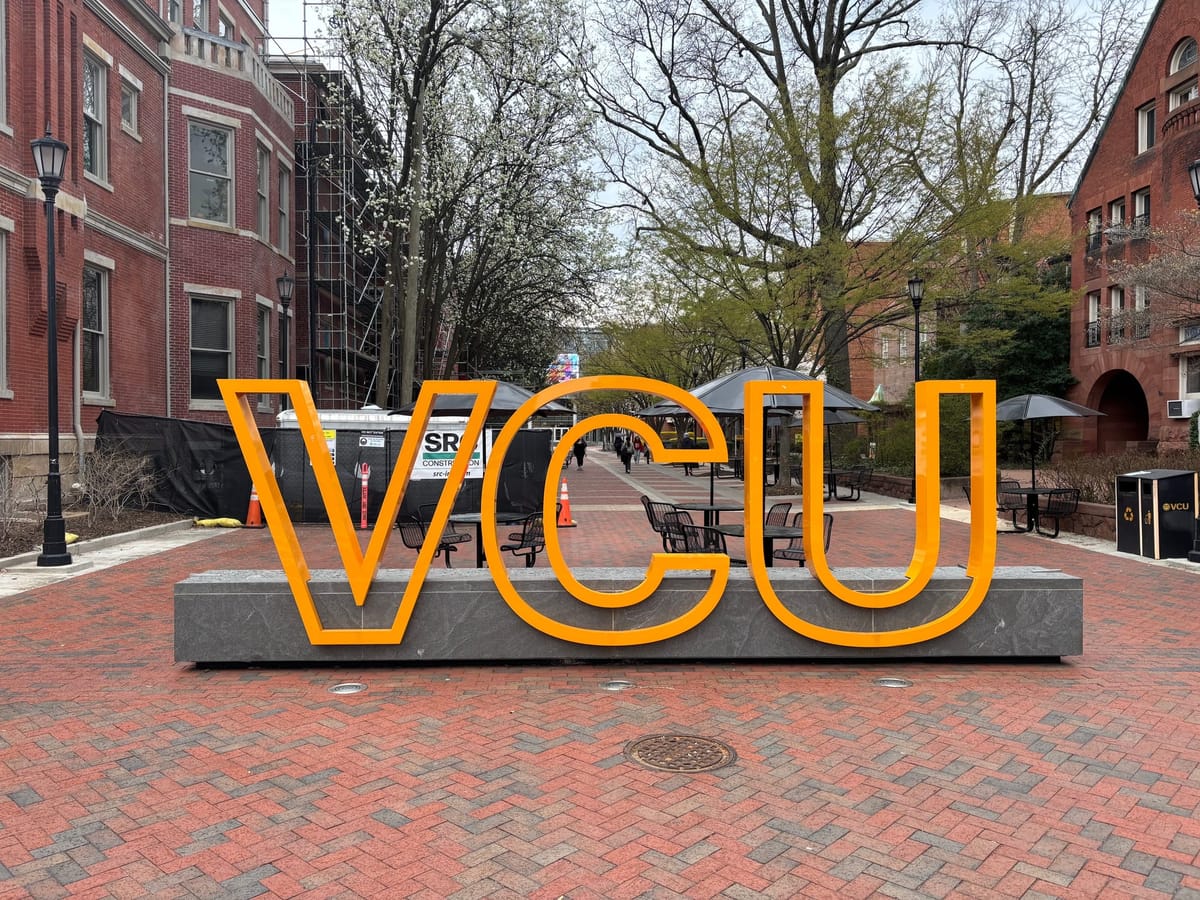
Entering Year 17, VCU’s president wants to see the school gain in prestige while remaining broadly accessible
Sometimes, it’s good to be an outsider.
Richmonders with long memories know the tensions between MCV and VCU when the two were united. But for school president Michael Rao, it’s just a reality he inherited.
“This came up a lot when I was new,” he said. “And then I just kind of ignored it, you know. I just said, ‘Legally, we are what we are. We’re together.’”
At first glance, the two have always seemed to be an unlikely pairing.
VCU’s undergraduate enrollment continues to expand, and remains accessible to most high school students in Virginia. Meanwhile, VCU Health is taking on bigger and more elaborate challenges, growing to become one of the nation’s best-funded research hospitals. (As a whole, VCU now conducts more than $500 million of research a year.)
Rao sees his role as encouraging an even deeper yoking of those two missions.
“What they’ve evolved to, with some encouragement, is incredible team science and creativity,” he said, noting that VCU’s arts students can help make complex medical solutions accessible.
VCU has radically transformed itself over the past few decades, creating a new Richmond along the way. But one thing that has remained steady is the school’s top leadership.
Eugene Trani took the reins in 1990, and handed them to Rao in 2009. Rao’s contract runs through 2030, a stretch of 40 years where the school will have just two presidents.
Rao sat down with The Richmonder to reflect on VCU’s standing, both in the city and in the academic world, and his vision for the school over the next five years.
He believes VCU can remain true to its core value of accessibility while continuing to gain prestige for its research work. Asked what success will look like in 2030, he doesn’t hesitate to offer his vision.
“Five years from now, VCU will continue to be even more comparable to the nation’s very best research universities, all while still continuing to accommodate and find the potential in students from various perspectives, who come from the widest range of socioeconomic backgrounds — the very bottom end and the very top end,” he said.

Politically aware, but not political
The seas are stormy in higher education at the moment, but while controversy has found other state schools, VCU has largely steered clear of major disruption.
Rao sees a kindred spirit in Richmond Mayor Danny Avula, who he views as also trying to stay above a partisan fray.
“I think he, like I, understands the value of being politically aware, but not getting political,” Rao said. “I think it’s more important than ever. A lot of times political stuff is driven by people’s egos, and I try not to have a lot of that.”
As Gov. Glenn Youngkin’s administration departs, and Abigail Spanberger’s begins, Rao touted his success working with both parties.
“One of the advantages of being in Richmond is I have not found one governor — and I’ve worked with five or six — I’ve not found one legislature, no matter what the party leadership was, that didn’t want to understand more about our mission and the challenges and the complexities that we deal with in terms of having a large number of in-state students who have high need,” he said.
He then ties the conversation back to the earlier point about VCU and MCV.
“We have two boards, both are just awesome, incredible. They get it,” he said. “We spend most of our board meetings talking about the mission and who we serve.
“We don’t talk about old names, new names, things like that.”
Growth inside a growing city
Avula and Rao will need to lean on that relationship as VCU’s growth continues to change the trajectory of the city.
As a state school, VCU does not pay traditional property taxes on its real-estate holdings.
In the lead-up to a downtown development deal in 2021, VCU Health had agreed to pay $2.5 million annually through 2045 as a PILOT, or payment in lieu of taxes. The deal fell apart, and the state ordered VCU Health to stop making the PILOT payments.
Avula’s administration signaled in May that it was not interested in pursuing litigation to collect the money, with a spokesperson telling VPM that it was better for the city to “stay at the table” with VCU.
The decision was another signal of the clout VCU carries within the city.
Rao said he has told people since arriving that the success of the university will bleed into the town.
“There’s not a university that has had the trajectory that we’ve had that hasn’t ended up really creating a lot of rapidly rising economic activity around it,” he said.
“That rapidly rising economic activity, it means that more people will be drawn from other places who even have nothing to do with the university. It’ll mean companies come here; it’ll mean the companies that are here will expand and hire more people, and they’ll need places to live.
“So I said (a decade ago): Get ready. This is coming, right? You’re in a really cool place, and we’re going to make this cool for our students. But also, one of the things I’m always endeavoring to do is how do we, how does VCU, contribute to making Richmond more fun?”
One of Rao’s early initiatives was to build more on-campus housing, citing statistics that students who live on-campus are more likely to graduate. These days, he spends just as much time thinking about off-campus housing.
Of his early conversations, Rao remembers saying “you may think there’s enough housing in Richmond now, but that’s not always gonna be the case if we play this right.”
Measures of success
Rao was at his most animated when discussing long-term goals.
He noted that VCU has doubled its research funding over the past seven years, to $560 million, with the goal of doubling again to reach $1 billion.
The school received a $104 million donation in 2022 to enhance its liver center, and continues to compete for top grants.
In the medical world, primary care is the first step for patients, building up to quaternary care, a fourth stage that often involves national or even global referrals. Rao wants to see VCU in that group.
“We’ll see success when we are seeing the largest number of patients who truly need a tertiary and quaternary hospital,” he said. “We are a primary safety net, and that’s OK, but the reality is the real need for VCU is going to be to use as many of those beds as possible for people who are in really, really, really tough shape, whether it’s chronic or congenital, and they can’t live without going to a research university hospital.”
That success at VCU Health would initially appear to be at odds with the undergraduate program, which continues to cast a wide net for students. But Rao views them as connected.
“Our faculty members who are in the sciences see the value of other disciplines and their input to what they’re doing,” he said. “Some of that’s incentivized by grants. Because the grants now say, we don’t want just the scientific answer, we want to know how you’re going to be disposed to take care of patients.”
One example he offers: “How do we reduce stigma around mental health issues? It’s going to take people from many different disciplines. So I’m going to keep incentivizing through the seed funding that we do. I’m going to keep incentivizing people to come together from unlikely disciplines, including the arts.”
And while he said he believes the school’s faculty, at both campuses, is on board with the vision, he added that he’s not afraid to provide a little nudge every now and then.
He referenced Lyndon B. Johnson’s famous quote as he pushed the Civil Rights Act through: “What the hell’s the presidency for?”
“There are, you know, occasional historical things that come up,” Rao said. “But again, if you just keep your ego out of it and rationalize, ‘Why are we all here?’ We’re really here because we're providing and fostering a mission that lifts people’s lives.
“I can give people from Virginia who might come from the poorest circumstances, socioeconomically, give them a chance to be a part of this.”
As higher education, and the city, change around him, Rao has the green light to continue that work for the next five years.
“This mission is really complex,” he said. “It needs all of my attention. It needs me to use the voice of the presidency to get everybody on board. It needs the voice of the presidency to have the kind of research that’s going to result in a Ph.D. thesis or a dissertation that’s going to be transformative somewhere in the world.”
Contact Michael Phillips at mphillips@richmonder.org. This article has been updated to note that VCU Health was responsible for the downtown development deal.
VCU is a sponsor of The Richmonder, but like all subjects we write about, was not allowed to influence or review this story. For more information, see our policies.