Dukes, delegates and duels: How a charcoal ‘warming machine’ witnessed centuries of Virginia history
Summers in Virginia have always been the stuff of sweltering, steamy legend. Writing to his brother in England, one 18th century observer said simply that the heat was “beyond your conception,” while John Smith himself observed that Virginia summers were “[as] hot as in Spain,” an apparently impressive qualifier.
Yet Smith also noted winters here were “[as] cold as in France or England,” and indeed Virginia can record impressive low temperatures during the winter months. Since the mid-18th century the state’s lawmakers have tended to convene in the winter months, and thus in the years before central air they required some way to heat their legislative chambers, if only to keep pneumonia at arm’s length.
One means of doing so starting in the 1770s was with a towering cast-iron stove, one that would witness centuries of momentous history in our state legislature, including what may be the only instance of a duel-like shootout in a state capitol in U.S. history.
The stove, which numerous historical accounts describe grandly as a “warming machine,” was originally commissioned by Norborne Berkeley, 4th Baron Botetourt, one of Virginia’s last colonial governors, for use in the colonial capitol in Williamsburg.
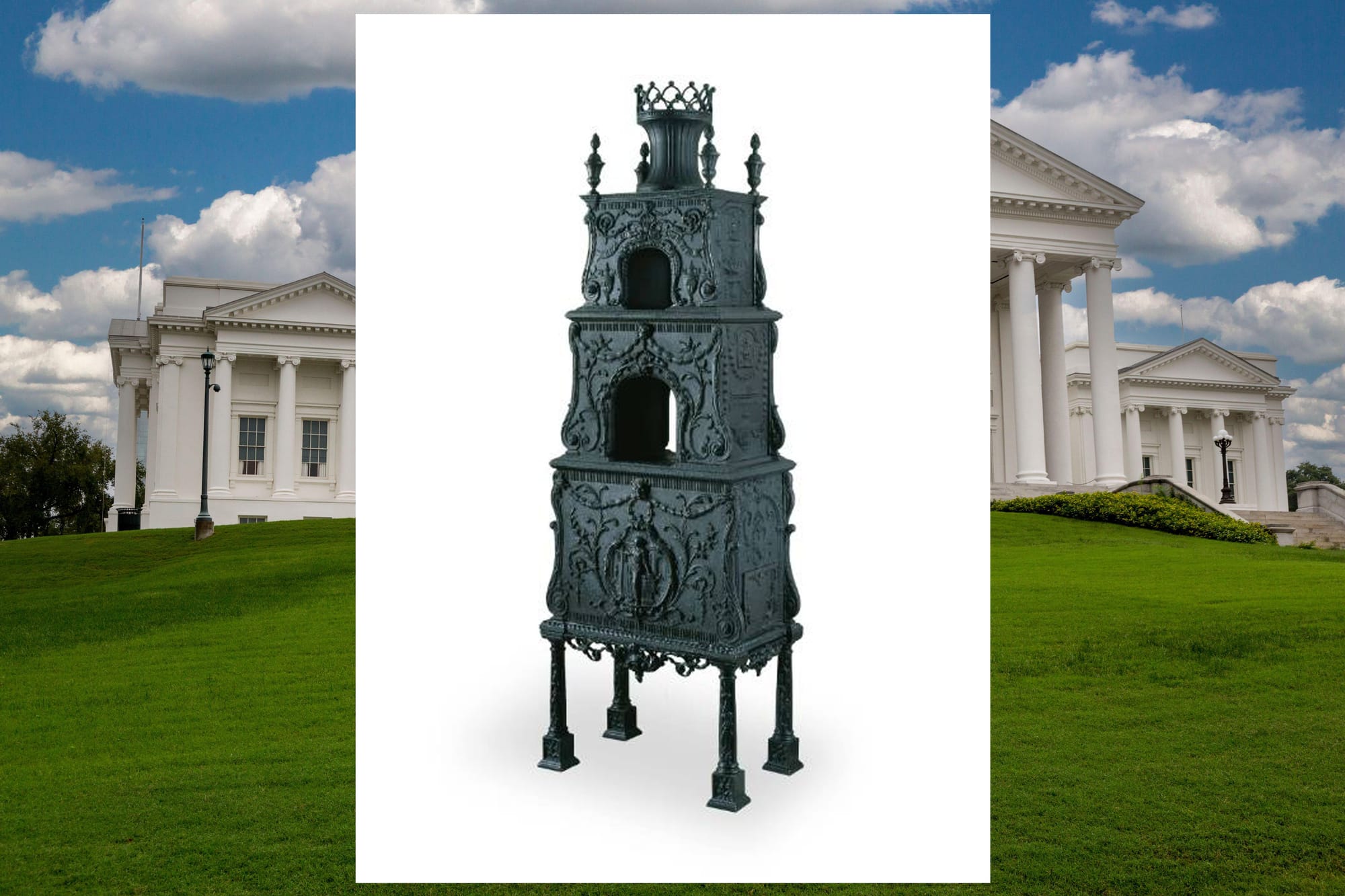
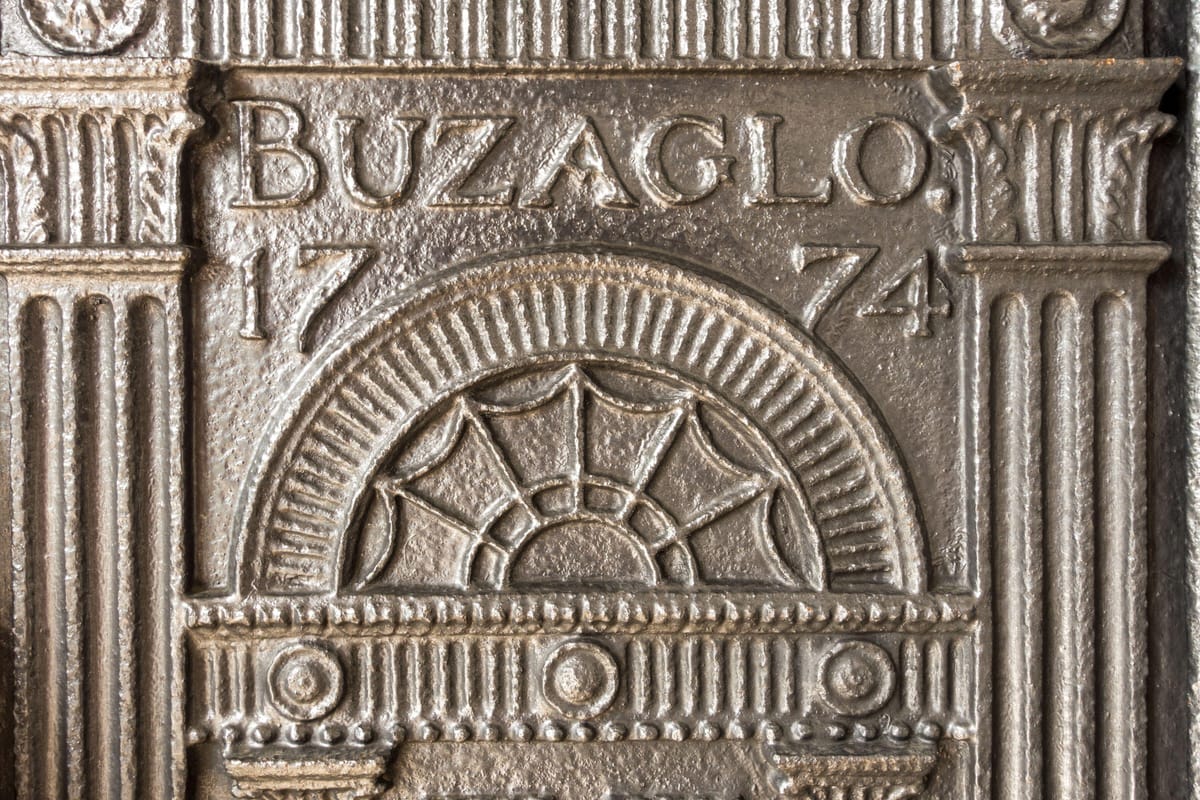
Botetourt had ordered the stove from Abraham Buzaglo, a Moroccan-born British inventor. Though Botetourt died before its delivery, his executor, the Duke of Beaufort, saw that the stove was delivered to the colony.
Buzaglo himself developed a well-deserved reputation for building gigantic stoves, probably motivated in no small part by his feelings on the hideously cold winters of London, in which, as one observer delicately put it, “a man roasted one part of his anatomy in front of a coal fire while his posterior was freezing.”
Upon shipping Boutetourt’s stove to Virginia, Buzaglo wrote rapturously that the triple-decker structure—shipped over to the U.S. in multiple boxes—was “a masterpiece not to be equalled in all Europe” and one that “does honour to Great Britain.”
Of course, the colonial lawmakers just a few years later did honour to Great Britain in their own way by joining a revolution against it.
In 1780 the state capitol was officially moved to Richmond; the colossal stove was brought with it, so fearsomely large and heavy that it needed to be floated up the James River on a barge.
For many years the stove helped warm the Virginia State Capitol Building during the frigid winter months. Mark Greenough, an historian at the Capitol who leads tours of the centuries-old building, said the stove was used for many years in the Old Hall of the House of Delegates before being moved to the Rotunda, near the famed Houdon statue of George Washington.
Contemporary instructions for using the stove directed users to “put on cinders enough as high as the blowing-hole” and “shut the great door, and keep the little one open.” Stokers were warned to “never make too strong a fire; for if you do, it will smell like a box-iron.”
During its years in the Rotunda, Virginia Gov. William "Extra Billy" Smith reportedly “liked to warm his coattails at the stove on a regular basis,” Greenough says. Legislators used to gather around it to smoke cigars, so much so that it allegedly began to delay assembly business; the stove was subsequently moved as a result. Lawmakers would also reportedly use it to roast raw peanuts.
And Greenough recounts the stove’s “minor supporting role” in a “larger-than-life farcical incident” in the Capitol Rotunda just after the Civil War. In January of 1866 Henry Rives Pollard, the editor of the Richmond Examiner, was locked in a war of words with Daily Richmond Enquirer editors Nathaniel Tyler and William Coleman. (In an era when newspapers are seemingly on the brink of extinction, it can be easy to forget that at one time a small U.S. city could support multiple broadsheets, the respective editors of which often hated each other like poison.)
Having apparently reached the boiling point, Pollard on Jan. 5 “decided to find and cane Tyler and reasoned that Tyler and perhaps Coleman would be at the Capitol covering the Virginia General Assembly session.”
Greenough said contemporary reports indicate Pollard “lurked” behind Buzaglo’s towering stove while waiting for his two targets to emerge from the House Chamber.
“When Tyler, Coleman and two delegates emerged, Pollard and Coleman ended up exchanging shots fired from their pistols,” Greenough said.
Thankfully, “the only casualty was part of the marble tassel” on the cane of Houdon’s Washington statue, which Pollard had hidden behind for cover. A 1997 retrospective by the Virginian-Pilot said all three men “were dragged into the House of Delegates chamber by the sergeant-at-arms,” though in the end Pollard was only issued a small fine and a reprimand.
The Richmond newspapers, meanwhile, “expressed far more concern over the damage to Washington's statue than the fact that the two hotheaded gunslingers might have been killed in the fracas.” Thankfully the tassel has been repaired in the intervening decades. The stove was evidently unharmed.
Some time after its star turn in the Great Newspaper Shootout of 1866, the Buzaglo stove was rendered obsolete by the Capitol’s new steam heating system. It was moved to the Capitol gallery on the third floor, where, Greenough says, it was displayed “as merely a cold relic of its former glory,” in an unremarkable alcove that has long since vanished.
The warming machine apparently sat silent for decades before finding its way to Colonial Williamsburg, where it sits on display today at the Dewitt Wallace Decorative Arts Museum. It remains there as a towering three-tiered testament to the days before modern heating and central air, when temperature control was a thing of imprecise difficulty.
Richly adorned in cast iron stylings, it features reliefs of lion’s heads, mascaron, and Lady Justice presiding over the Magna Carta—a work of unmistakable Englishness, delivered to an English colony that was on the verge of separating from England forever.
The stove’s remarkable lifespan, and its quiet place in the background of so much vital American history, is a potent reminder that history itself is never very far distant; it is ever-present, ever-relevant, something to be studied and treasured.
In an era where historical knowledge seems on the wane, where many of us seem to be living in what the English writer Theodore Dalrymple calls “the eternal present,” we could do worse than consider the Buzaglo stove, which has been with the state of Virginia since before Virginia was a state and which has seen the monumental transformation of both local and global orders.
Writing in his seminal 1856 work “Richmond in By-Gone Days,” Samuel Mordecai observed that the warming machine at the time had survived “three British monarchs, and been contemporaneous with three kingly monarchies, two republics, and two imperial governments in France,” no small feat for a charcoal heater.
Of course, Mordecai observed, the stove had also been witness to “only one constellation of republics in the United States,” though that “constellation” was even then on the verge of tearing itself apart and would only be put back together, and liberated, through tremendous bloodshed and sacrifice.
Yet, like the Buzaglo stove, the United States still endures—”I hope and trust,” Mordecai wrote, “one and indivisible, now and forever.”