Council asks Avula admin to consider lower property taxes, higher pay for contract janitors
Mayor Danny Avula still has several weeks to finish his next budget proposal, but the City Council voted Monday to ask him to allocate about $1.1 million to cover pay increases for contract janitors who work at city buildings.
For the budget the mayor will present in 2027, the Council wants Avula to explore what it would take to lower Richmond’s real estate tax rate by four cents, dropping it from $1.20 per $100 of assessed value to $1.16.
Both requests came in the form of non-binding resolutions, which means Avula can take them into consideration but isn’t required to do what the Council wants.
The pair of unanimous votes stood out as somewhat rare examples of the Council giving the mayor’s team policy instructions rather than the other way around.
The Avula administration had publicly resisted both proposals, citing concerns about unknown financial impacts.
Minimum wage
The Council and labor advocates have pushed for expanding Richmond’s $20 an hour minimum wage for city employees to contract staffers who technically don’t work for the government. In last year’s budget season, Avula’s administration asked for more time to study the issue.
When that study was complete, Avula’s team recommended no changes to the pay structure, warning the costs to the city could be too steep and other types of contract employees could expect similar treatment.
The study also explored raising pay for contracted security guards. Because the city recently changed that contract to require armed guards, the pay rate for security staffers has already risen to the $20 minimum.
Through Monday’s vote, the Council formally asked the administration to at least consider budgeting the money to raise pay for contract janitors alone.
Latrice Gregory, a member of the SEIU 32BJ labor union that has supported the push to raise pay for contract workers, told the Council that the city’s policies have too often “left essential workers like myself behind. Gregory previously worked as a cleaner in city buildings, she said, but recently left for a new job at Chesterfield County Public Schools.
“For the first time, I truly feel valued and I’m earning the wages and benefits that all Richmond contract workers deserve,” Gregory said.
Gregory said she was advocating for “the city’s unseen pillars” like her 72-year-old mother, who still works cleaning city buildings.
Councilor Stephanie Lynch (5th District), a lead patron of the resolution on worker pay, said the goal is to “to mirror the city’s own commitment to its workers.”
The Avula administration was noncommittal on how it plans to respond to the Council’s request.
“It is not fully clear just yet what the impacts would be of us pursuing this action,” said Chief Administrative Officer Odie Donald II, who told the Council he had no issue with the body making its desires known.
In a statement after the vote, Avula said he shares the values the Council expressed in its resolution.
“My team and I will continue to process through the fiscal and operational considerations presented by the resolution,” the mayor said.
Avula will present his fiscal year 2027 budget proposal on March 11.
Taxes
The Council is giving the mayor another year to think about the possibility of lowering property taxes after years of effective tax increases for residents who have seen their home values skyrocket.
State law encourages local governments to consider lowering tax rates to shield residents from burdensome tax hikes. Richmond has not done so, and has consistently chosen to collect the extra tax money as property values increase.
The Council has repeatedly voted down efforts to lower the tax rate, but Monday’s vote is a symbolic step in the other direction. The resolution initially asked Avula to prepare a lower-tax budget for this year, but an amended version pushed back the timeline to next year, when the city will be past a one-year freeze on property assessments that will constrain the city budget.
Lynch, who also sponsored the tax rate resolution, said the early request for a lower tax rate was a solution to the city’s misaligned budgeting and tax assessment cycles. The Council traditionally votes on a budget in the spring and sets the tax rate in the fall after new assessments go out, but those processes will line up after the one-year freeze.
The longstanding system, Lynch said, erodes the Council’s ability to to set a tax rate that “fully funds its budget while ensuring we are not inappropriately overtaxing our residents.”
Lynch said the resolution “is not about taking anything away from our operating budget,” but will instead help the Council ask “are we taking too much?”
“I hope this gives us greater transparency, insight and information to make the right choice when we’re asked to set the tax rate each year,” Lynch said.
Lynch’s proposal led to a public mayor-Council feud last year. After Donald told a Council committee the administration wouldn’t prepare a lower-tax budget even if the Council formally asked for it, Councilor Sarah Abubaker (4th District) faulted him for what she said was an overly dismissive answer that didn’t align with the administration’s professed commitment to open collaboration with the legislative body. Avula then fired back, drafting a memo that said Abubaker had overstepped and misunderstood Council’s authority by suggesting Donald has to follow non-binding directives.
Avula’s opposition seemed to soften after Lynch agreed to push back her resolution to fiscal year 2028 and it became clearer her resolution had the votes to pass.
In a statement Monday, Avula said he appreciate’s Lynch’s leadership on the issue and shares the Council’s interest in exploring ways to lower the tax burden on Richmonders.
“I will continue to carefully consider Council's input in the planning process,” Avula said.
Lynch said it was her understanding that the administration will not be preparing two distinct budgets for the Council’s consideration based on different tax rates. Instead, she explained Monday, the Council is expected to get a rundown next year of what spending reductions would be necessary to balance the budget at a $1.16 rate.
A four-cent reduction in the rate would save a typical Richmond homeowner about $150 on their yearly property taxes.
Officials honor Wilder’s 95th birthday
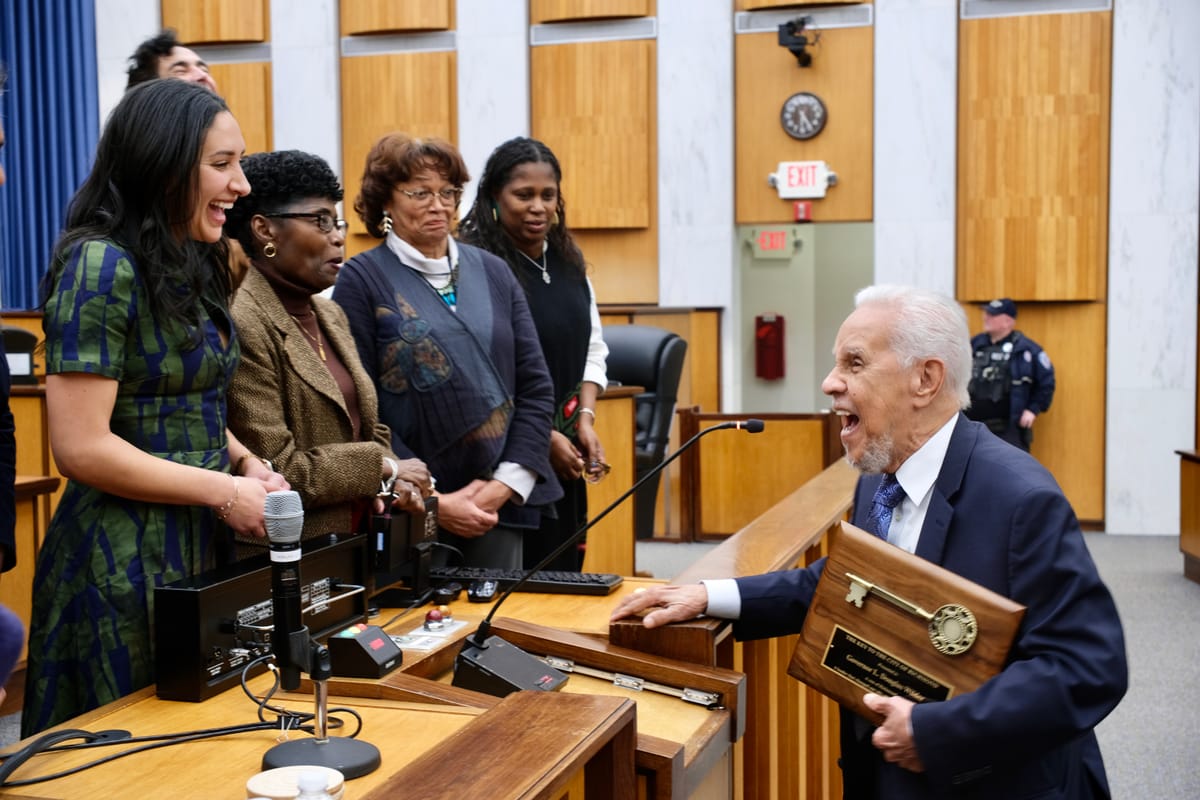
Before proceeding to its official business, the Council took time to honor the recent 95th birthday of former Gov. Doug Wilder, who in 1989 became the first African-American governor elected in any state.
Wilder was also the first Richmond mayor elected under the city’s current strong mayor form of government.
On Monday, the Council honored him with an official proclamation.
“We honor you not only for the history you made but for the future that you helped unlock,” Avula told Wilder as he presented the former governor with a key to the city.
In a speech, Wilder encouraged city officials to make education a top priority.
“Every time I make a speech relative to government… I tell them that the most important form of government is local government,” Wilder said. “That’s where the rubber really meets the road. That’s where the buck stops.”
Contact Reporter Graham Moomaw at gmoomaw@richmonder.org