Bill Martin was known as the Valentine's leader. He was also a quiet champion for Richmond's LGBTQ+ community.
As one of Richmond’s most prominent historians, Bill Martin was known for his advocacy on behalf of all of the city’s residents, including a focus on racial justice.
He also worked passionately, though quietly, on a cause that was personal for him. Martin, who was gay, was a champion and connector inside Richmond’s LGBTQ+ community.
“Bill was doing this work before anybody else,” said James Millner, Director of Virginia Pride.
Millner noted how Martin’s advocacy began as a Virginia Tech student in 1975, when he successfully sued for the right to form a gay student union.
“When you think about somebody doing that in 1975, six years after the Stonewall uprising, in what was then a very conservative Virginia and a very conservative part of Virginia, I think that really tells you all you need to know about Bill Martin,” Millner said.
Martin was tragically killed on Dec. 27, at age 71, after being struck by a driver while walking in a crosswalk just blocks from the Valentine.
The Valentine will host an open house on Saturday afternoon in his memory, and is also accepting online submissions from those who knew him.
Many in the community were surprised to learn of the depth of his ties to the LGBTQ+ community.
“Bill was not going to be the person that was leading a Pride parade, right? He wasn't going to be the person out there in front,” said Millner. “But he did things like organize gay history tours of Richmond through the Valentine. He ensured that artifacts related to LGBTQ history were well represented within that museum, including things like the pride flag that flew over the Federal Reserve building that caused so much controversy.”
That work wasn’t done with fanfare.
“That just wasn't who he was,” Millner said. “He did these things quietly, un-assumedly but with intention and with success.
“And that was something I thought was very unique about him because a lot of folks, when they are working towards progress, for people who are left on the sidelines, they want to make themselves the center of that – and that's just not what Bill did. Bill did it quietly, subtly, but very powerfully.”
Millner said he’d often run into Martin, who’d be dressed in his trademark suit or even a tuxedo, late on a Friday or Saturday night at Barcode, a popular gay bar in the city.
“And oftentimes Bill would be sitting at a table or at the end of the bar by himself, just having a drink,” said Millner. “And I was thinking: How many people that shared that space with him, how many queer people, knew who he was? And if they knew that the reason that they were able to be in that space is because of the work that he had done for the decades before.”
Curating Richmond’s story
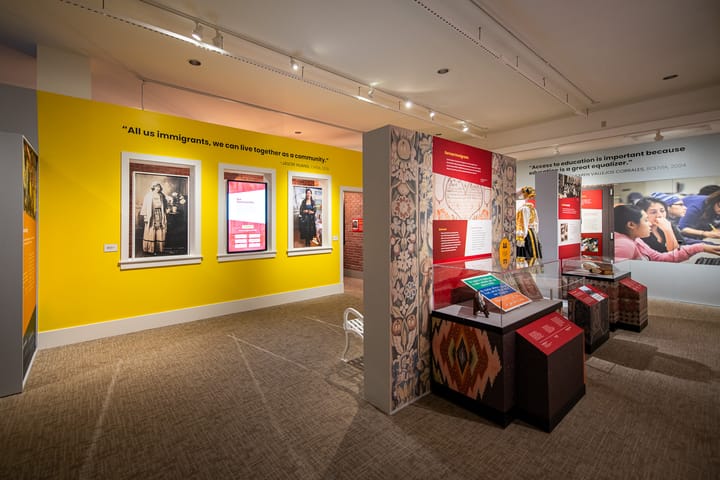
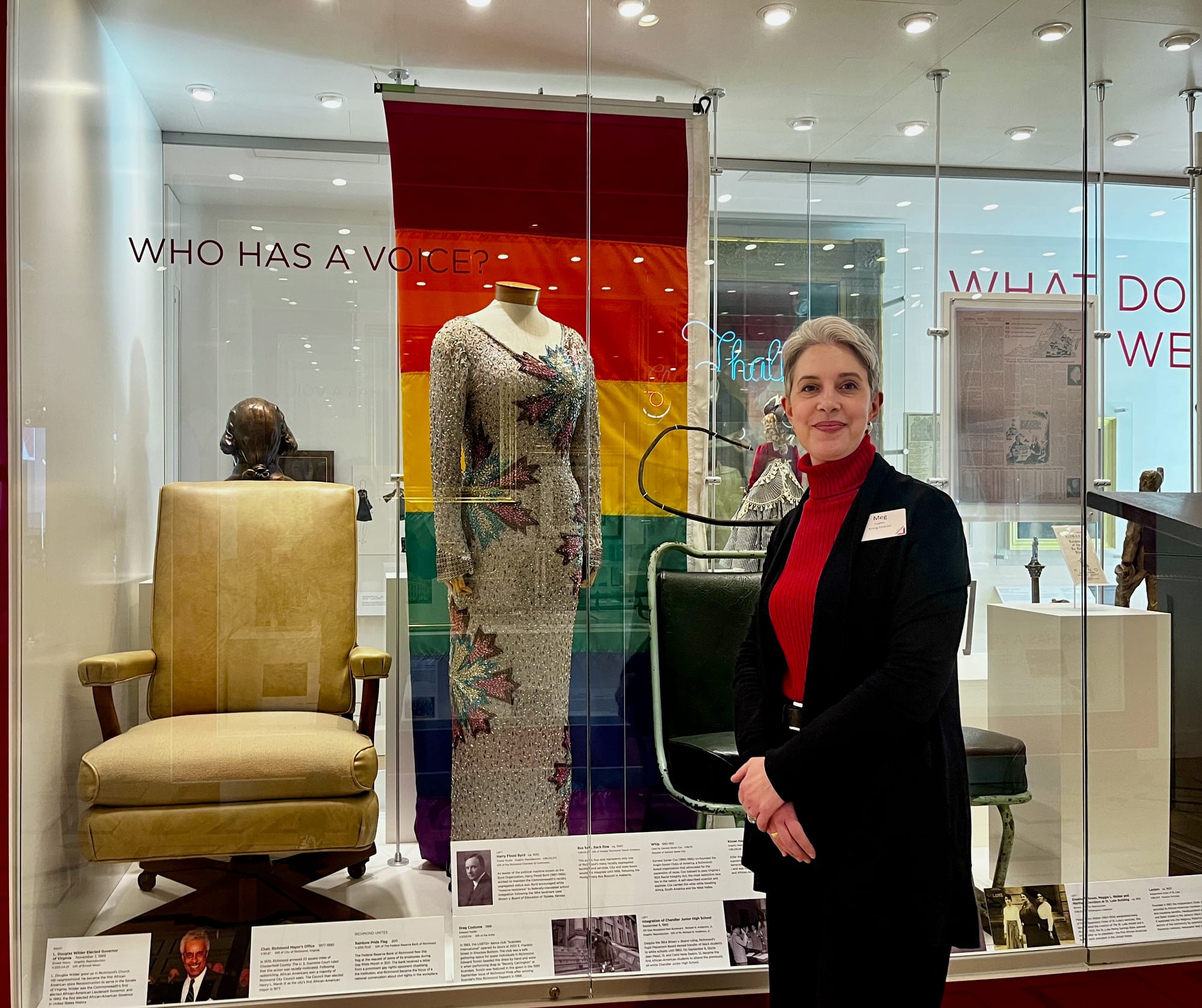
Meg Hughes is standing between two, almost floor-to-ceiling glass cases on the main floor of the Valentine. Inside the arm-length wide cases are pieces of Richmond history. It’s part of a long-term exhibit called “This is Richmond, Virginia.”
“It is thematic. And it's arranged around questions: ‘Where do we live?’ ‘How do we come up with our values?’” said Hughes, who has served as the acting director of the museum since Martin’s death.
She then points to a section titled ‘Who has a voice?’
“This is where we look at power dynamics and government and conflict, and who's included and who's excluded,” she said.
Strategically placed items include a peach-colored pantsuit worn by Betty Bauder, an executive at Thalhimer’s department store who, in the 1970s, was a trailblazer for wearing it because it went against the dress code for female employees at the time. Adjacent to that is a portrait of Eleanor Shepard, the city’s first female mayor.
But two of the objects inside the case speak a little louder right now.
“One of which, this pride flag, has been on view since this exhibition opened in 2014,” Hughes said. “This was a flag that was flown by an employee group at the Richmond Federal Reserve.”
The flag gained national attention after conservatives wrote to the government in protest.
The other object is a sparkly, hand-sewn dress that was a drag costume from the 1980s.
One of Martin’s main contributions to the LGBTQ+ community was to make sure their voices were included, said Millner.
“He told stories and ensured that the stories of queer people were intertwined with those of the other famous Richmonders and historical figures,” he said. “It was his powerful way of just ensuring that we had a seat at the table. That our community was represented as part of Richmond's story.”
An advocate for artists and entrepreneurs
The Valentine’s gay history tours were started by Beth Marshak, who wrote the book “Lesbian and Gay Richmond.” At the time the book came out in 2008, Marshak was a master tour guide at the Valentine.
“And I suggested that we could do a tour based on the book,” she said, but added that the person in charge of the tours wasn’t very comfortable with that idea. “So I contacted Bill directly. And he said he thought it was a good idea.”
Marshak said Martin wanted to get approval from the museum’s board because some members may disagree with the idea. It was approved, with the first one being a bus tour.
“I also developed some walking tours of Carytown that focused on LGBTQ, which the Valentine still does,” said Marshak. “Gradually, they incorporated some of [my] information that I had shared in my book and in my later research in some of the other tours as well. And that's one of the things that he encouraged, was that the tours would reflect the broader population of Richmond.”
Martin’s efforts to lift up members of the LGBTQ+ community often went beyond the Valentine’s walls.
In 2009, Kevin Clay was working at Nordstrom. But wanting to leave retail, he started GayRVA.com, the first online news outlet for the LGBTQ community in the state of Virginia.
“I started the website as a blog, as a kind of a hobby and then it turned into a more robust publication,” said Clay. “And as I was reaching out to community members, I remember meeting Bill at an event. He had expressed interest in the work that I was doing with GayRVA.”
Clay asked Martin to be on his advisory board.
“Bill was very helpful to me in the beginning and shared with me some of his early activism.” Clay said. “And I think that someone in such a position of influence in Richmond, being able to work and live as an out gay man was very important, especially looking back 10, 15, 20 years ago, it was a different time. So the fact that Bill was able to accomplish so much is really incredible and speaks a lot to his character.”
Graphic designer Lisa Cumbey, who designed and did the branding for the Carytown store Mongrel, said Martin not only supported her but her brother, Alan Cumbey, as well. Alan Cumbey, who died of AIDS in 1992, was an artist and a writer whose work often appeared in Style Weekly. He did the artwork for an exhibit titled “Smoke Signals” at the museum.
Lisa Cumbey said Martin had a way of connecting all sorts of communities.
“He was so graceful about how he did it. I don't know if it was because of his debonair way but he was able to get people to accept things and acknowledge that things were important in ways that I hadn't really seen done before,” said Cumbey. “And he did it for a lot of different communities, not just the LGBTQ community.”
Hughes said Martin worked hard to make sure different communities were included in both long-running and short-term exhibitions.
“So that it wasn't just one exhibition or one tour that was given five years ago and then you never hear anything about it again,” said Hughes. “[It’s] that the regular offerings of the institution include different communities, and that's where I think you move the needle on being more inclusive in your storytelling.”
Millner said Martin was seamless in how he navigated between all communities.
“It struck me how effortlessly Bill moved between different communities of different socioeconomic status, race, gender, sexual orientation, politics,” said Millner. “He sort of managed to transcend it all. Bill was never intimidated by a barrier. He looked at every barrier as an opportunity for change.”
To Millner, Bill Martin’s legacy, especially within the LGBTQ+ community, will be one of gratitude.
“I think there were people that said, ‘Queer people didn't have seats at tables of power,’ but I think Bill was at those seats,” said Millner. “And it wasn't overt, it wasn't loud, it was him sitting there and ensuring that our voice was in those rooms and in those conversations.
“Whether that was with the movers and shakers and the wealthy elite of Richmond, or whether that was working in grassroots communities around issues of race and gender and sexual orientation and gender identity, Bill's voice was there for us.”
This article has been updated to correct the spelling of Betty Bauder and Lisa Cumbey's name.