Avula, Council members at odds over best revenue stream for Affordable Housing Trust Fund
Despite agreement that Richmond needs to come up with a more predictable way of funneling money into the city’s Affordable Housing Trust Fund, Mayor Danny Avula and members of the City Council are at odds over what the fix should be.
Both parties are looking to the city’s skyrocketing real estate tax revenue for a solution. Over the past decade those returns have more than doubled, from roughly $231 million in fiscal year 2017 to over half a billion this year.
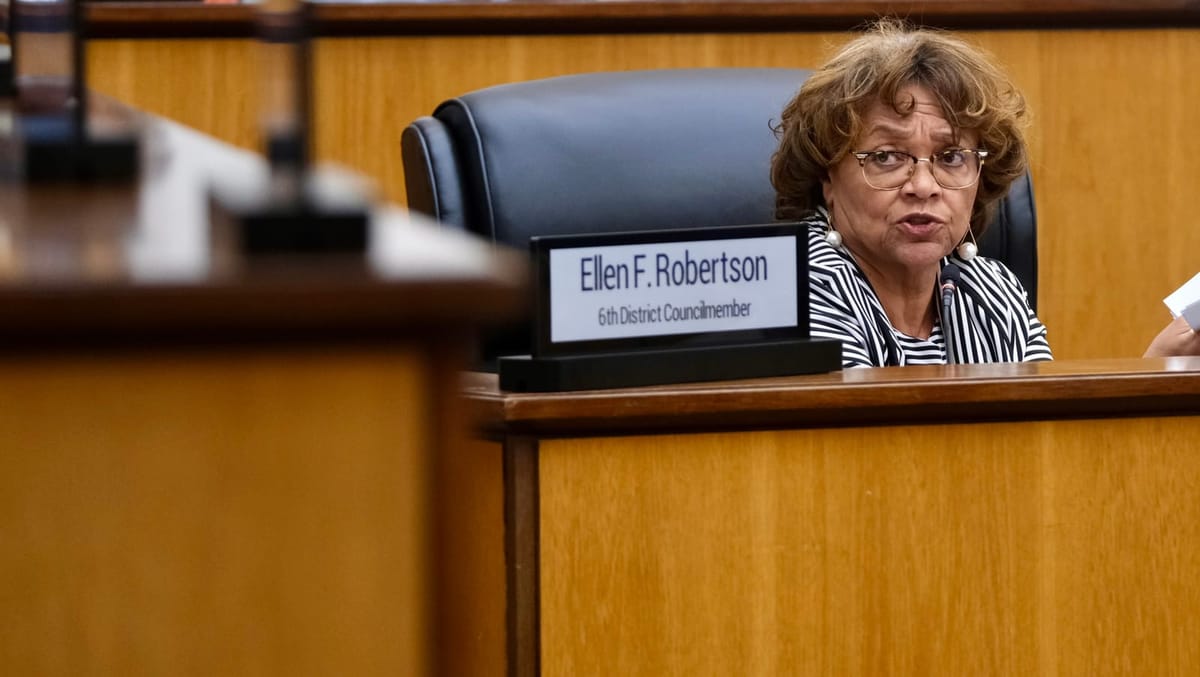
“I believe that we are a city that has enough money that we can afford a lot of things,” said Councilor Ellen Robertson (6th District) during a meeting at City Hall Monday. And, she argued later, “if we want people to live in this city — and we do — we’ve got to ante up the necessary funding to make it affordable.”
Robertson has put forward a plan that would commit 2.5% of annual real estate tax revenues to the trust fund. That approach would have netted the trust fund just under $11 million in fiscal year 2024, the last year for which actual real estate revenues are available, and an estimated $12.6 million this year.
Avula is proposing a different strategy. His plan would devote either 15% of annual increases in real estate tax revenues — an amount that would have been about $6.4 million in 2024 and an estimated $6.3 million this year — or a minimum of $10 million to the trust fund.
There are also several caveats: The mayor doesn’t have to appropriate more than $12 million, and he can decrease or even eliminate the transfers if they would cause reserves to dip below a required level, if they threaten the city’s ability to meet financial obligations or if the trust fund balance is more than 75% of what the city transferred to the fund the prior year.
In a presentation Monday, Avula pitched his plan as a fiscally responsible compromise that offers needed flexibility to a government attempting to meet numerous, ever-shifting needs.
“We’re still absolutely committed to doing at least $10 million in the Affordable Housing Trust Fund,” he said. “It’s the where it comes [from] that we need flexibility with.”
First established in 2008, the Affordable Housing Trust Fund provides grants and loans to developers and groups involved in building and preserving affordable rental and ownership units. Similar trust funds have been set up around the state and country, including in neighboring Henrico County, where a $60 million fund was created in 2024 using revenues from data center taxes.
Richmond’s fund has operated on a more modest basis. Up through 2023, impact reports for the fund indicate it received only about $10 million in total revenues from the city — with some years seeing no dollars — and it did not issue awards until 2015.
Recent years, however, have seen increases. In 2023, the City Council approved the sale of $50 million in bonds over the next five years for the production and preservation of affordable housing. The proceeds of that approach, known as the Equitable Affordable Housing Program, flow into the trust fund and will continue through fiscal year 2028. Awards subsequently rose, amounting to about $7 million in 2024 and over $9 million in 2025.
Favor appears tipped toward Robertson proposal
While a Council committee chose to move both plans forward for the full body to consider later this month, favor so far appears to be tipped toward Robertson’s proposal.
Either plan will need five votes to pass, and both Council President Cynthia Newbille (7th District) and Councilor Kenya Gibson (3rd District) have signed on as co-patrons to Robertson’s ordinance. Councilor Sarah Abubaker (4th District) has said she’s willing to do so too if it’s amended to include more rigorous reporting and a requirement that the Council consider whether the spending should be reauthorized in five years.
Richmonders Involved to Support Our Communities (RISC), a group of religious congregations that have taken up affordable housing as a signature issue, has also thrown its support behind Robertson’s plan. Besides questioning how Avula’s proposal would provide funding in the coming year, when a temporary tax rate freeze goes into effect, members cast the Council ordinance as a stronger, more predictable commitment.
“One ordinance creates certainty. The other makes funding for affordable housing optional,” said Marvin Gilliam, pastor of Mt. Carmel Baptist Church and a co-president of RISC.
Avula emphasized Monday that his proposal guarantees $10 million annually, arguing that “the obligation in the ordinance that we’ve written is not discretionary.”
“There’s only two exceptions to that,” he continued, pointing to the financial shortfall conditions outlined in the plan.
Gibson pushed back on that stance later in the evening, asking how the administration could reconcile those conditions with its view that the spending isn’t discretionary.
“When the language says, ‘In the determination of the mayor,’ is that not the same as providing the mayor discretion?” she asked Lawson Wijesooriya, Avula’s chief of staff.
“Yeah, I think that’s fair,” Wijesooriya replied.
The latitude the administration has to direct or withhold spending to and from the Affordable Housing Trust Fund has been a sore point for RISC dating back to former Mayor Levar Stoney’s second term, and the distrust members of the group have toward the city over that funding was evident Monday.
In 2021, the City Council passed an ordinance creating two revenue streams for the fund. Under that law, revenues from expiring real estate tax exemptions and up to $1 million from the sale of tax delinquent properties were directed into the trust fund’s coffers. But while the city since then has put significant dollars toward affordable housing — through bond sales, performance grants and low-income home repair programs — it has never followed through on the 2021 ordinance.
“We’ve had a law on the books that requires it for five years now. And how many of those five years has it actually been funded according to the law? The answer is zero,” said Alex Creager, pastor of Bon Air Presbyterian Church and a RISC member.
Officials have said the 2021 ordinance, and particularly the provision related to the exemptions, is complicated to administer, and both Avula’s and Robertson’s proposals offer a replacement.
Not all of the responses to the competing plans were in favor of the Council-led option. Justin Ferguson, a broker and Richmond resident, said Avula’s ordinance “does check a lot of boxes.” Two other speakers, Greta Harris of the Better Housing Coalition and Tom Fitzpatrick of Housing Opportunities Made Equal, urged the two sides to go back to the negotiating table to craft a plan both could back.
“We’re in a time where division weakens our power and being together strengthens it,” said Harris.
Council Vice President Katherine Jordan (2nd District) echoed that desire, saying she hoped to see an ordinance “that gives us both commitment and flexibility.”
Robertson, though, made it clear that she was not willing to accept Avula’s plan, calling the revenue that would be produced by the 15% slice of tax growth “an insult to the demand for what we are talking about.”
“It was with great difficulty that I came to a place where I felt that what was being proposed by the administration … failed to agree to some of the things that I thought we had agreed to,” she said. “And I’ve made that very clear to them.”
Both she and the mayor’s office have said talks are continuing.
“No one is walking away from this,” said Robertson. “And we are all open to any creative strategy to get us successfully where we need to be.”
Contact Reporter Sarah Vogelsong at svogelsong@richmonder.org. Greta Harris serves on The Richmonder's Board of Directors, but as per our policies, she was not allowed to influence or review this story.