At charged meeting, Trammell calls for citizen commission to rethink code refresh
City Councilor Reva Trammell is proposing that a new commission of residents be put together to advise the City Council on Richmond’s overhaul of its 1970s-era zoning code, a process known as code refresh.
At a meeting called Thursday by the Richmond Civic League, a loose coalition of residents led by former Councilor Marty Jewell that has become one of the loudest critics of Richmond’s code refresh, Trammell announced she would be putting forward an ordinance this spring to create the new body.
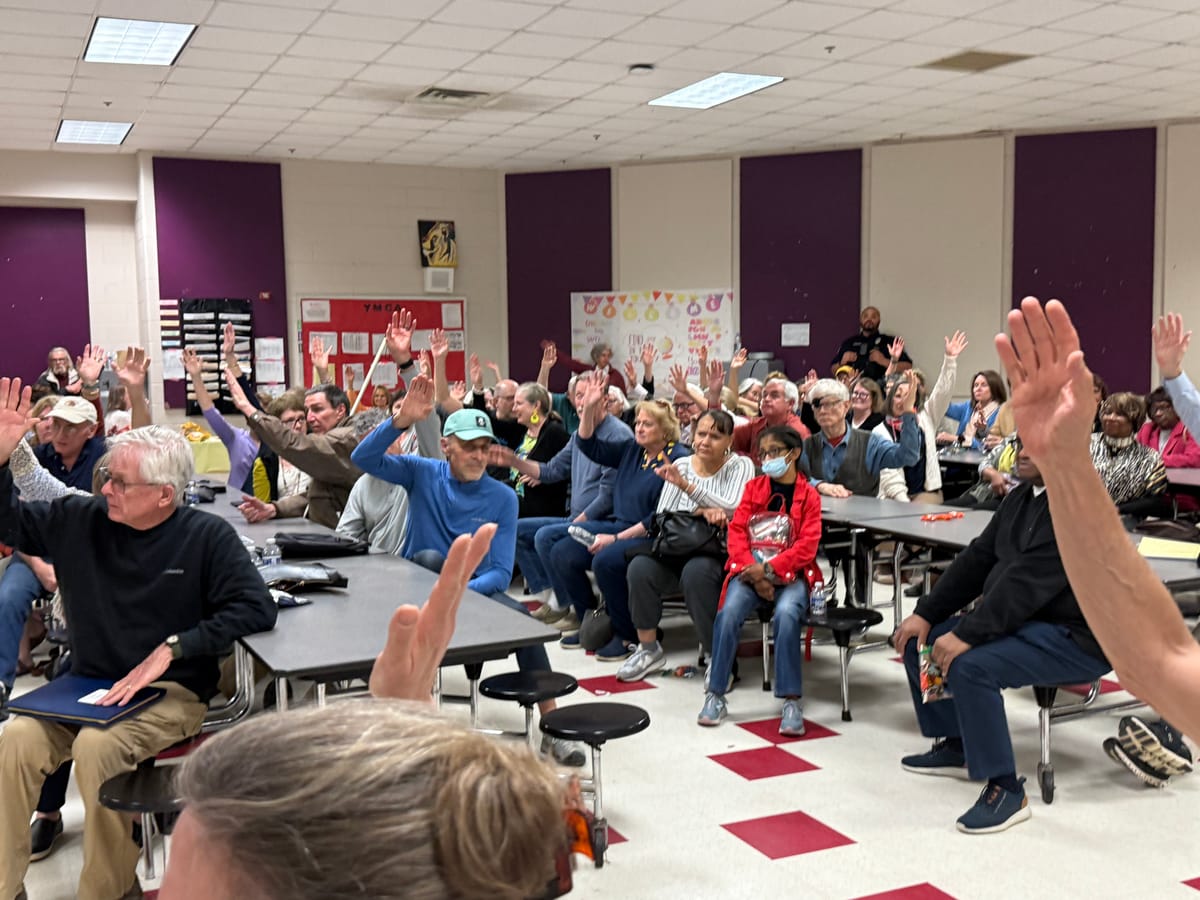
“We’ve got to fight this tooth and nail,” she told the crowd of more than 150 people who gathered at Holton Elementary.
Trammell, who represents the 8th District, will need the support of four other councilors in order to create the commission. She said Thursday that she had secured four co-patrons but declined to provide their names.
Several city councilors in attendance said they were still considering the idea.
“I think at this point there needs to be very clear specificity in what the goals of the commission are, but I definitely am in support of having community input,” said Councilor Kenya Gibson (3rd District).
Exactly how the commission would work is still being hammered out, but Trammell said it would be composed of 18 citizen members and would begin work within 30 days after appointments. Each of the nine city councilors would be allowed to pick two members, who would not be required to live in their district. No developers or people in the building industry would be permitted.
The commission, which would have to conclude its analysis within 180 days of its formation and provide a report to the City Council 30 days after that, would “research, review and question everything about code refresh from a neighborhood or citizen’s perspective and then make a final report to us on City Council,” said Trammell.
In a statement to The Richmonder on Thursday night, Mayor Danny Avula defended the current approach, saying that “stopping or delaying this process won’t create more homes for more people — it will do the opposite.”
As of Nov. 19, the Avula administration said it had held 94 community outreach events to get feedback from thousands of Richmonders on the code refresh. It has also held Spanish-language meetings, and mailed flyers to homes.
The zoning overhaul, which has been underway for over a year, is currently under development by Richmond’s Planning Department. A second draft was released this November, followed by a public comment period lasting more than three months. Avula has said that the city intends to produce a third draft but hopes to have a final proposal before the City Council sometime this summer. Any plan will first go before the Planning Commission, which will vote to recommend that the Council either approve or reject the plan.
The idea for an advisory group is not new. Richmond’s Zoning Advisory Council, a subcommittee of the Planning Commission, meets every month to provide feedback to the city and its consultants for the rewrite, Code Studio. The council has no decision-making power, but its members help guide the evolution of the city’s plans.
The ZAC, however, has been controversial. Many neighborhood groups have accused it of being stacked with developers, leading the Avula administration to expand its membership this fall.
On Thursday evening, numerous speakers lambasted the ZAC as being in the pocket of developers. Although at least two members were present at the meeting, none raised their hand in response to a question from one speaker asking that they identify themselves.
“Code refresh started out and was designed by 18 people. Fourteen of them are builders and developers,” Jewell told the crowd. (Exactly who is considered a “developer” is not consistent among opponents of code refresh, according to conversations with The Richmonder.) “It’s all designed to enrich developers and builders.”
The rally
Thursday night’s Richmond Civic League event promised residents the opportunity to speak out against the city’s code refresh. A 9-minute video that kicked off the meeting laid out the Civic League’s case against the rezoning initiative, warning that it would accelerate gentrification and raise property taxes, among other concerns.
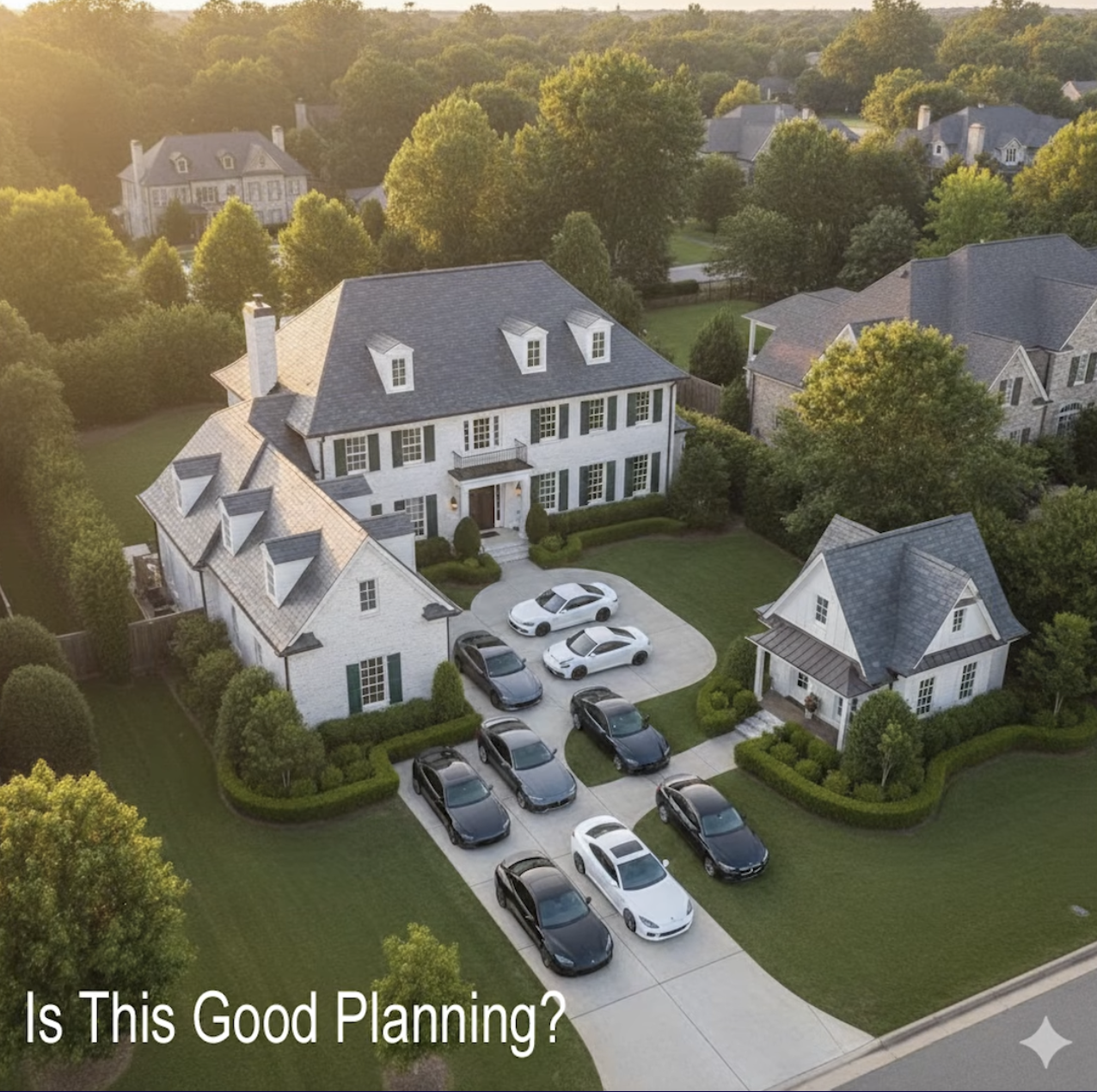
It included an AI-generated image showing three houses stacked on a lot, with nine cars jockeying for space in the driveway. The image is a reference to proposed density rules that would allow residents to build a second unit on their property in certain areas if they preserve the original structure, as well as an accessory dwelling unit.
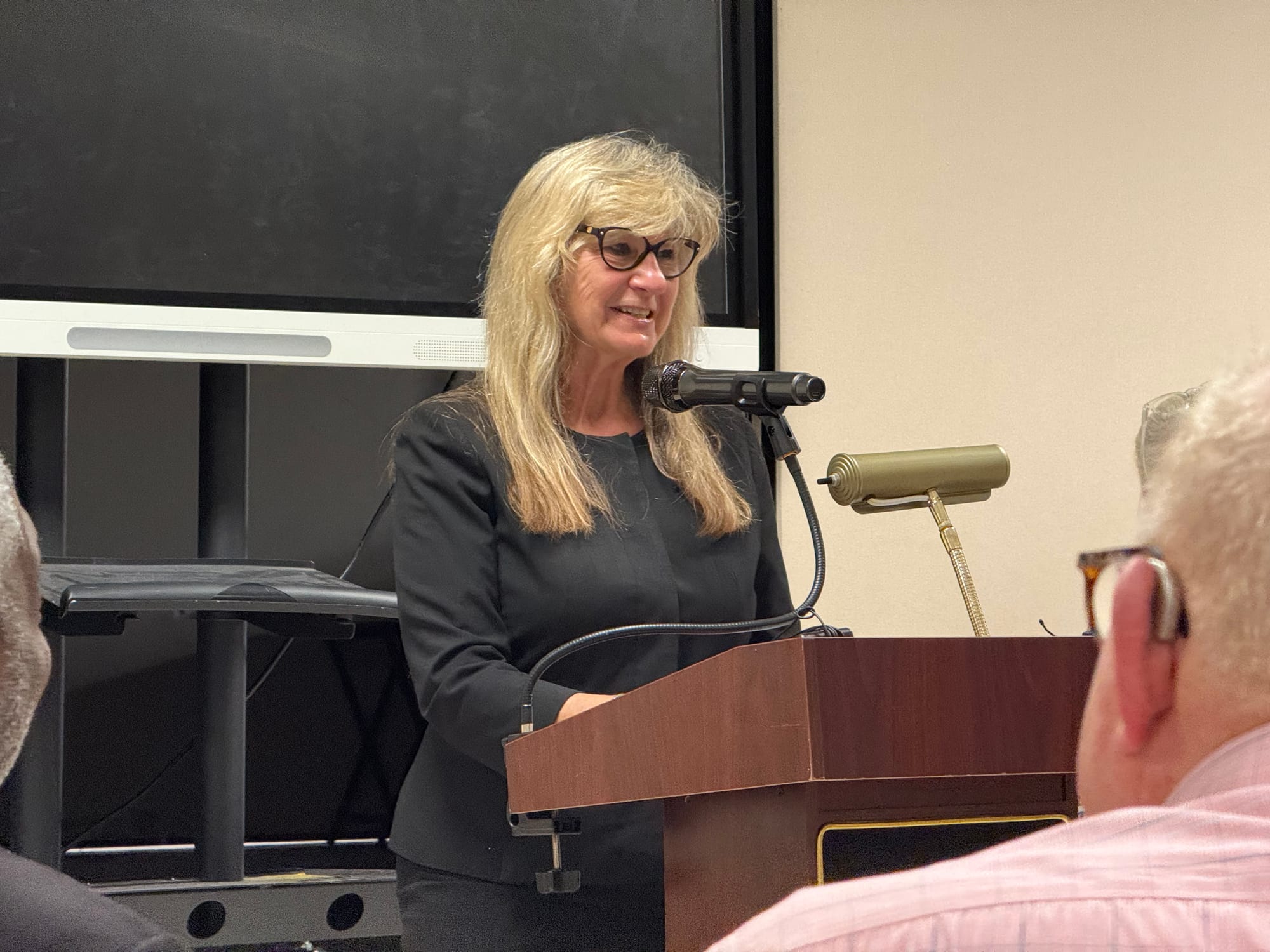
Jewell set the tone early in the evening, telling attendees that “this is the most blatant conflict of interest I’ve ever seen.”
“Somebody’s asses need to go to jail,” he said.
From there a parade of speakers unleashed a barrage of complaints against the effort, which will rewrite the rules for where and how development can happen in the city in a comprehensive way for the first time since the 1970s.
Some of those statements expressed anger about decisions the City Council has already made, including its 2023 votes to get rid of parking minimums citywide and allow accessory dwelling units on nearly all residential lots by right.
But they were unified in their desire to have a more direct role in shaping the code refresh before it reaches the City Council later this year.
“What we need to make sure is that our voices are heard — we the people. It's just plain and it's just simple,” said Michelle Mosby, a former city councilor.
The crowd, which skewed older and appeared to be mostly homeowners, railed against allowing developers to build up lots and increase density in their neighborhoods during a public comment period.
“I’m personally insulted by somebody looking me in the eye and telling me there’s a housing problem, when I look as far as the eye can see and there’s housing,” said 7th District resident Ashly Hutchens. “There are a bunch of giant ugly rectangles that are going up everywhere.”
In his statement to The Richmonder, Avula supported the idea, as he did throughout his mayoral campaign, that bringing more people into Richmond will allow young people to buy houses and continue to grow the city’s tax base.
“At the end of the day, if we want to be a city where teachers, nurses, service workers, and young families just starting out can live, we have to make room with more homes for more people,” he wrote.
‘It’s time to speak up’
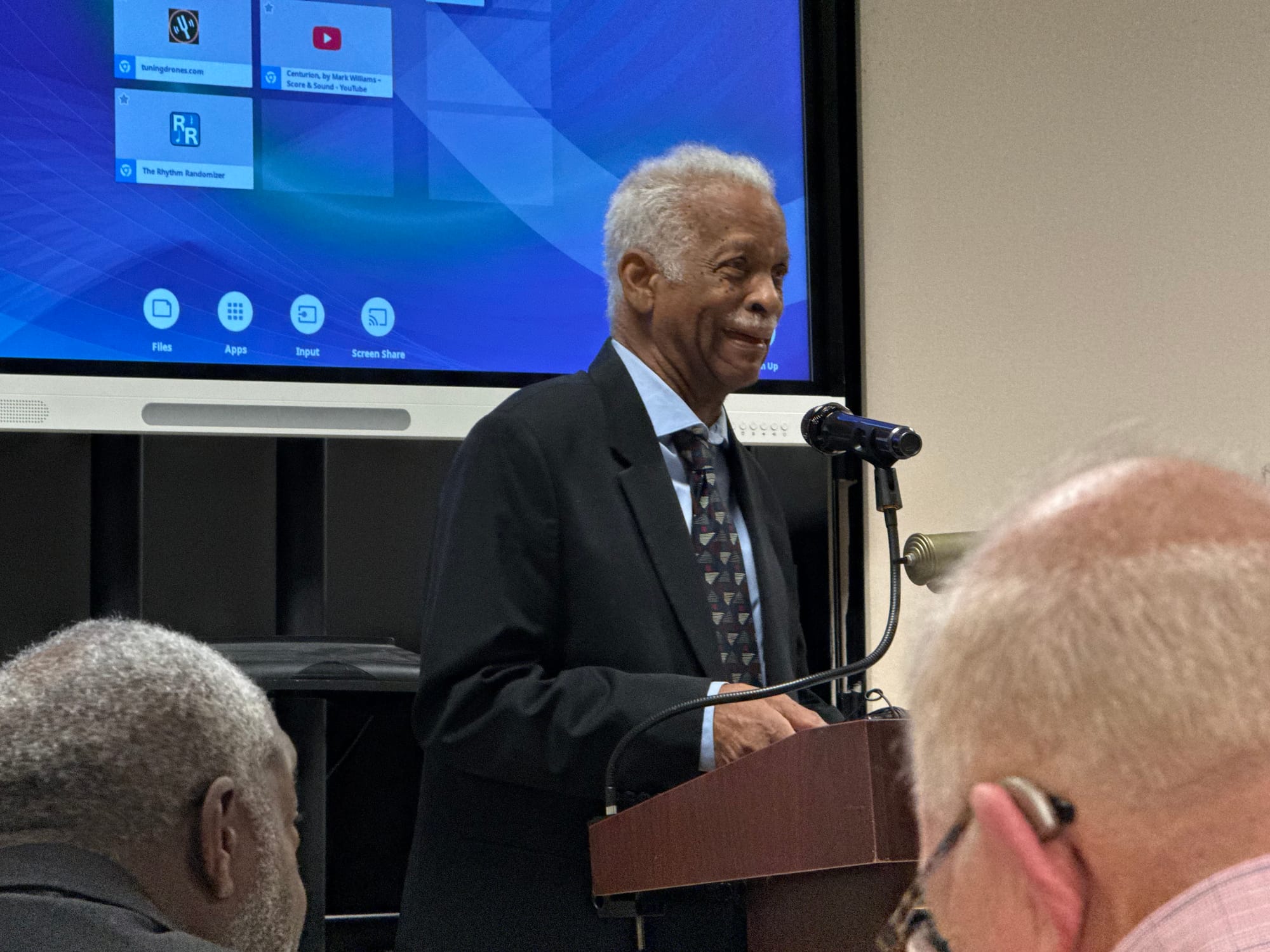
Also at Thursday’s meeting was 4th District resident Ernie Brown, the former board chair of the Bank of Richmond who Jewell said is helping fund the Richmond Civic League’s activities.
“We’re making political mischief,” Jewell said.
He continued: “You’ve got folks from Northern Virginia moving into the city because prices are ridiculous up there. It ain’t affordable there anymore. And they are swamping Richmond, displacing our folks.
“Historically, there were five Black districts and four white districts. Today it’s flipped, and it’s going to continue to flip. Now, our racial issues aren’t what they used to be. Much better, much improved. But it still ain’t level and it still ain’t equal in terms of what we get out of this city.”
 Richmonder Staff
Brown said he’s been involved with city politics for a long time, but said watching the code refresh play out made it feel like “it’s time to speak up.”
He said he understands the city has conducted a number of meetings but believes attendance has been low and word hasn’t spread about the effort.
“When you’re talking about rezoning 77,000 parcels, and you’re going to do it, in effect, by force, everyone deserves to know,” he said, adding that he would wait and see what the third draft of the map looked like before planning next steps.
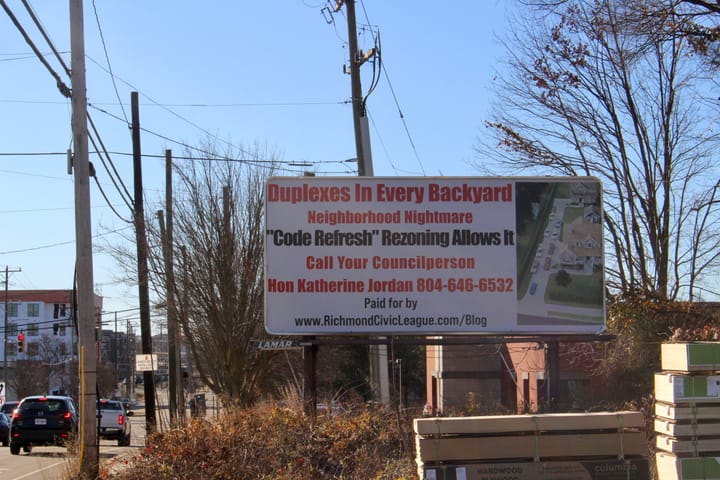
The Richmond Civic League has already purchased 14 billboards around the city to spread its message.
 Sarah Vogelsong
Tension and growth
Jewell’s observation that people are flocking to Richmond is an accurate one.
Since 2008, the city has gained about 32,000 residents and continues to be a hot destination for young professionals.
That has produced tension with current homeowners, who indicated on Thursday night that they believe the influx of newcomers is threatening the character of their neighborhoods.
Former West End Councilor Bruce Tyler was one of the speakers.
“You look at the districts that we have, there are two districts that are predominantly single family, the 1st and the 4th Districts. And the 1st and the 4th Districts pay a disproportionate amount of taxes in comparison to the other districts,” he said, adding that downtown businesses also pay a large share.
“We're going to tinker with that. And I’m tremendously concerned about that, because two things could happen,” he continued. “One, housing costs are going to go down, which means the tax base is going to evaporate. Or two, just the opposite. The tax base will increase, but where will the affordable housing be?”
Much of the anger Thursday night was directed at the developers who speakers said would profit from the code refresh.
“This is an opportunity for a group of people to make a whole lot of money and not talk to you about it,” said local pastor Garry Callis Sr. “You could be in your house chilling one night, and the next morning you wake up, and what in the world is going on? You walk outside, there’s a five-story building next to your house. And you wonder, what in the world just happened?”
Most residential zoning in the code refresh calls for three-story maximums, although homes adjacent to significant transportation corridors could see greater heights.
The public comment period for the second draft of the refresh ended March 1. A third draft is expected later this spring.
Contact Reporter Sarah Vogelsong at svogelsong@richmonder.org and Editor Michael Phillips at mphillips@richmonder.org.